Surprised by C.S. Lewis (with a broadsword)
A bit of passion for your subject is no bad thing in a teacher, and I’ve been known to be pretty adamant about the quality of the literature I’m teaching, particularly if it’s Horace or Virgil. But C.S. Lewis took advocacy of the poetry he was teaching to another level again, on the evidence I’m about to present.
Assiduous readers of this blog know that C.S. and I have history: a dubious story about him and the inspiration for The Lion, the Witch, and the Wardrobe is repeated under my window ad nauseam by tour guides. But a happier connection is Lewis’ enthusiasm for one of my favourite poems, Matthew Arnold’s Sohrab and Rustum, the story (from the Persian poet Ferdowsi, but reinvented by Arnold as a mini Homeric epic) of the single combat between the warriors Rustum and Sohrab: eventually Rustum slays Sohrab, unaware that Sohrab is his son. I knew that Lewis was fond of the poem because in his autobiography Surprised by Joy he described falling under the spell of Arnold’s evocative scene-setting as a twelve-year-old boy: “what enchanted me was the artist in Pekin with his ivory forehead and pale hands, the cypress in the queen’s garden, the backward glance at Rustum’s youth, the pedlars from Khabul, the hushed Chorasmian waste” (p. 53).
The anecdote that follows is new to me, though. It’s from Humphrey Carpenter’s The Inklings (p. 214), and I owe it to the immensely well-read John Stoker. (I owe the reference to Surprised by Joy to the equally well-read Gail Trimble, I should add.) Carpenter is describing Lewis’ confrontational style of teaching, which divided opinion among his undergraduates (“A few lapped it up, but some very nearly ran away”):
‘If you think that way about Keats you needn’t come here again!’ Lewis once roared down the stairs to a departing pupil. And on another occasion when an Australian student professed that he could never read Arnold’s Sohrab and Rustum, and refused to admit its good qualities even after Lewis had chanted a hundred lines of it at him, Lewis declared, ‘The sword must settle it!’ and reached for a broadsword and a rapier which (according to J.A.W. Bennett, who was there) were inexplicably in the corner of the room. They fenced – Lewis of course choosing the broadsword – and, said Bennett, ‘Lewis actually drew blood – a slight nick.’
Those were the days. I’ve a shrewd idea what the HR Manager would say today if I tried to settle a disagreement about the power of Horatian word placement with a duel. I do actually inflict Sohrab and Rustum on my own students quite regularly, on the pretext that it’s a nice encapsulation of Greco-Roman epic style, but I try to resist the impulse to reenact the story with authentic weaponry when I do so.
Anyhow, here’s a chunk of Sohrab and Rustum that Lewis loved and I love, Rustum wistfully recalling his youthful affair with Sohrab’s mother, and Arnold capturing nostalgia perfectly. If anyone doesn’t love it, of course, I’m afraid I’ll have to see you outside:
as, at dawn,
The shepherd from his mountain-lodge descries
A far, bright city, smitten by the sun,
Through many rolling clouds—so Rustum saw
His youth; saw Sohrab’s mother, in her bloom;
And that old king, her father, who loved well
His wandering guest, and gave him his fair child
With joy; and all the pleasant life they led,
They three, in that long-distant summer-time—
The castle, and the dewy woods, and hunt
And hound, and morn on those delightful hills
In Ader-baijan.
A passage to India

This is as good as a guest post, since absolutely all the research for it has been done by my brother. It’s a short one, too, to make a change, and none too cheery. But it offers just a glimpse of Scots in the British Empire, and that seems timely given recent interest in the relationship of the one to the other.
Henry Maxwell was born in 1826 in Edinburgh. His father, also named Henry, probably died in 1831, at the age of 24; his mother Catherine lived until 1880, dying in a poorhouse in Dundee. In 1846, also in Dundee, the younger Henry married Isabella Ferguson/McIntosh (she was an illegitimate child, a fact that was even recorded on her death certificate; her mother Sarah Ferguson was perhaps 16 years old when she bore her, but may have been closer to 13). Henry and Isabella had a lot of children, two at least of whom died young, and Henry found employment in an industry that dominated Dundee at the time: jute.
Dundee was an established centre for whaling, and it had been discovered that whale oil allowed raw jute, a vegetable fibre imported from India, to be machine-spun into hessian on an industrial scale. For a while, driven by entrepreneurs known as Jute Barons, the industry boomed, and Dundee, “Jutopolis,” along with it. Henry Maxwell rose to be an overseer in a jute mill, and may have achieved the promotion by virtue of being literate: it is most unlikely he ever attended school, but his mother was the daughter of a printer, and thus almost certainly literate herself.
Around 1870, Henry moved to India, to Barnagore (Baranagar) in Bengal, on the Hooghly river just north of Calcutta (Kolkata). His relocation was part of a canny attempt by the Jute Barons to get ahead of the competition by establishing jute factories at source. In due course the jute industry in India would eclipse Dundee’s, but there is apparently machinery still in use in Indian jute mills bearing the legend “Made in Dundee.”
For Henry Maxwell, the poor boy from Edinburgh who was now in all likelihood managing part or all of a jute mill in Bengal, this must have marked a significant upturn in his fortunes. His wife and family, back home in Dundee, had moved to a more salubrious part of the city, a further indication of greater prosperity. But their luck didn’t hold. On August 17th 1872 we find Henry dictating his will in Barnagore, and two days later he’s dead. In Bengal in 1872 it’s a reasonable guess that the cause of death was cholera, but there were plenty of other possibilities. Henry left everything to his wife Isabella, including the sizeable sum of £655 he had saved in India. But back in Scotland Isabella herself was terribly ill: she died of TB in December of the same year.
If the Maxwell family had had a chance of achieving respectability, it was abruptly snuffed out. Henry Maxwell had taken out a life assurance policy and owned stocks and shares, quite the model of the middle-class man. But that all changed after his death. We’ve already heard how Henry’s mother died in a Dundee poorhouse in 1880. There were two poorhouses in Dundee, and Isabella’s mother died in the other one in 1887.
A desperate story, to be sure. But in this story of grinding poverty and (frustrated) social aspirations, the role of India is as a land of opportunity. Whatever impact the jute industry had on native Bengalis, for this Scottish family it almost provided the passport to economic security and social advancement. During the referendum debate the notion was widely bandied about that Scotland had somehow been the passive victim of British, or maybe English, imperialism. In reality Scots exploited the opportunities presented by the empire energetically, and were disproportionately represented among that empire’s functionaries. Henry Maxwell and his Jute Baron employers are a case in point.
As you may have guessed by now, my interest in these people is more than academic: Henry Maxwell was my great-great-grandfather.
Update, 18.04.2015. Henry Maxwell’s great-great-great-grandaughter, my niece, Mhairi Campbell, has located Henry’s grave in the Scottish Cemetery, Kolkata. No inscription survives:

A thistle and a rose

I’m doing what I spend a big chunk of the summer doing: staring at the west wall of St Mary’s, Oxford’s University Church.
That’s the view I get as I sit at the computer, waiting for inspiration to hit me: in the photo above, which predates the age of computers just a little, I’m in the curtained window jutting out above the street. Between me and the church is an alleyway, St Mary’s Passage, running from High St into Radcliffe Square, the heart of Oxford University: you can see one side of the circular Radcliffe Camera, a library, that dominates the square, and the Old Bodleian Library behind it.
Needless to say, I’m ridiculously lucky in where I go to work every morning. But I have been known to grumble about the tourists. Twice or three times a day, and in the summer months closer to fifteen times a day, a tour guide will halt his group under my window and explain how C.S. Lewis was inspired to write The Lion, the Witch, and the Wardrobe by what he saw in the alleyway beneath me: a Victorian lamppost, a couple of fauns carved at the top of the main door to the building, and an image of the Green Man on the same door which bears a passing resemblance to a lion with a mane. Hence, the theory goes, Aslan, Mr Tumnus and the mysterious lamppost Lucy sees when she first stumbles into Narnia.
How true that story is, I really don’t know. To be honest, after listening to several thousand retellings of it by now I’m beyond caring. But that isn’t to say I’m not fascinated by my surroundings as I sit in that window. The building, known as St Mary’s Entry, is old, dating back to around 1600, but we know very little about its history: for a long time up until the 1880’s it was a pub, the City Arms, and it only came into full use by the college in 1919. That’s more or less all we know.
But there are some clues, and the best of them happen to be in my office. According to An Inventory of the Historical Monuments in the City of Oxford (1939), it contains a number of features that seem to date to the early seventeenth century.
There is an elaborate Jacobean overmantel:

Two fauns that echo the two around the door downstairs, but are much older: the ones outside seem to be Victorian. Here’s one of the fauns inside:

Most intriguingly of all, there is a design around the door of the room featuring roses in the spandrels at the top:

and at the bottom (the authors of An Inventory missed this), thistles:

I suppose all the recent discussion of Scottish independence has made me pay more attention to the roses and thistles, and I had assumed some connection with the Acts of Union in 1706/7, but when I thought about it (with the Jacobean carvings inside the room in mind, especially), the more obvious link was to James I of England and VI of Scotland, a century before the Act of Union, whose coins carried images rather similar to those around my door. James had wanted a full union of Scotland with England, but the issue was as controversial then as now, and they remained sovereign states under one monarch until the reign of James’ great-granddaughter, Anne.
Well, it’s a good excuse to speculate. And whatever I come up with can’t be any less likely than the spiel of the tourist guides.
Once James was in the frame, and a date for the woodwork (independently reached) of the early seventeenth century, what caught my attention was an event I hadn’t previously been aware of, a visit by the king, accompanied by Queen Anne and his eldest son Henry (and the five-year-old Charles, future Charles I), to Oxford at the end of August 1605, two years after his accession to the English throne.
There was nothing low-key about this visit: all Oxford was galvanized to put on the best possible show of itself. We have three extended accounts of it, Rex Platonicus (Oxford, 1607) by the University Orator Isaac Wake, in Latin, which is too busy hymning the king’s praises to provide much in the way of useful detail, but evidently did Wake’s career no harm: he went on to be knighted, an ambassador in Venice and elsewhere, and M.P. for the University of Oxford. What he has to say about James’ arrival will give you a flavour of the whole work: certe ingresso iam Jacobo sensit Civitas quiddam se amplius capere quam quod murorum suorum angustiis comprehendi posset, “For sure, now James had made his entry, the City felt that it held something greater than the narrow compass of its walls could contain.” Flattery will get you everywhere.
Anthony Nixon’s Oxfords Tryumph (London, 1605), is as relentlessly panegyrical as Wake, but a little more concerned with the nitty-gitty of the visit, even though Nixon is seriously confused about Oxford geography. But the real gem of a source for the visit is a document surviving in a manuscript in Cambridge University Library, an anonymous account by a “spy” from Cambridge, The preparacion at Oxford in August 1605 against the comminge thither of King James, with the Queen and young Prince; together with the things then and there done and the maner thereof. This Cambridge witness may, according to John R. Elliott Jr. in The History of the University of Oxford Vol. IV (p.648, n.32), have been one Henry Mowtlowe; but apparently Cambridge sent as many as forty spies “to view in secret and note the whole event” staged by their arch-rivals. For whatever reason, The preparacion at Oxford… provides the kind of realistic detail Wake and Nixon meticulously avoided: the King falling asleep in a long theatrical performance, and waking up to say, testily, “I marvell what they think me to be!”; or the hundred or so “scholars” sent to prison the day before the king’s arrival for some kind of “uncivill” behaviour (apparently involving inappropriate headwear) in St Mary’s church.
The King arrived at Oxford on Tuesday August 27th 1605, riding south from his ramshackle palace at Woodstock. The officials of the University and City of Oxford rode out to welcome him on the Woodstock Road in what was then countryside a mile north of Oxford, and is now the northern suburbs where I live. In a “fair meadow” near Aristotle’s Well (which now lies under a house on the corner of Kingston Rd and Aristotle Lane, but I think what is these days the intersection between Woodstock Rd and Polstead Rd is meant, very near the childhood home of Lawrence of Arabia) there was a bit of timeless town v. gown needle as the city authorities, led by the Mayor, attempted to upstage the University, and were put firmly in their places. It’s great to see that certain things (town v. gown; Oxford v. Cambridge) haven’t changed much in 400 years, and I’ve been enjoying imagining all the houses away as I walk the dog, picturing the Chancellor, Vice-chancellor, “the Doctors, Proctors and certaine Senior Masters … upon their foote-cloath [caparisoned] Horses, verie richlye furnished to meete the King” (Nixon), the speeches to the King from University (in Latin) and City (in English), and the presentation of gifts (the City’s considerably more valuable than the University’s), before James and his entourage continued their progress towards the city.
Just outside the North Gate, James stopped to be entertained by the first of a series of dramatic performances during his four-day stay in Oxford. James was very keen on academic debate, less so (as we’ve already seen) on the theatre. What’s interesting about this short performance is that it bears some kind of relation to Shakespeare’s Macbeth. In front of St John’s College, which stood outside the city walls, three “sibyls” recalled the prophecy given to Banquo that his descendants, the Stuarts, would rule Scotland, and added their own prediction of James’ glorious future. The connection has been made with the three witches’ prediction to Banquo at Macbeth 1.3 (“Thou shalt get kings, though thou be none”), and some have even speculated that William Shakespeare might have been in the audience outside St John’s. From there James made his way across the city to Christ Church, where he and the Queen were accommodated: as they rode from north to south of Oxford, according to Nixon, the left side of the street, between Christ Church and St Giles’ church, was lined with academics in precise order of seniority from Doctors of Divinity at the gate of Christ Church to plain old undergraduates up at St Giles’.
Here’s John Speed’s map of Oxford, as it happens dating to around 1605, though much indebted to earlier maps: south is at the top, so James was approaching Oxford from the bottom right. From St Giles’ to Christ Church is about 1,000 metres.

In total, James spent four days in Oxford, from Tuesday August 27th to Friday the 30th. On the last day, after visiting the Bodleian Library, he stopped in at my college, Brasenose, but I don’t think my roses and thistles can have anything to do with that since in 1605 St Mary’s Entry, while owned by Brasenose, was not an integral part of the College proper, and was let out to tenants. A slightly earlier map of this part of Oxford here, by Ralph Agas, illustrates this, “Brasen nose Coll” stopping well short of “Saint Maries”.

But there’s another possibility. James’ and the Queen’s accommodation was at Christ Church, Prince Henry’s at Magdalen College; in the course of his time in Oxford James visited New College, All Souls’ and Magdalen as well as Brasenose, St John’s and the Bodleian Library. But by far the majority of the king’s time was spent in the University Church, St Mary’s, just across the alleyway from here.
On Wednesday and Thurday, August 28 and 29, James attended “disputations” in St Mary’s, Latin speeches delivered in favour or against propositions by academics in five subjects, Theology, Law, Physic (Medicine), Natural Philosophy (roughly, Physics) and Moral Philosophy. The form of the exercise, formal and rhetorically sophisticated speeches in Latin, had its roots in the medieval university, and reflected the importance that continued to be attached to the fluent and persuasive presentation of academic knowledge, but the topics addressed were entirely contemporary. Since we’re in 1605, that still leaves them, for us, interestingly poised between the familiar and the archaic. During the Physic disputation, for example, the question was addressed, An creber suffitus Nicotianae exoticae sit sanis salutaris, “Whether the often taking of Tobacco be wholesome for such as are sound and in health”; whilst when the discipline was Natural Philosophy a topic of debate was, An opera artis possit aurum conflari, “Whether Golde may be made by Arte.”
James was tremendously keen on these exercises, regularly making his own contributions to the learned disputes, and allowing the sessions to continue in St Mary’s without complaint for as long as five hours: hardly surprising that he fell asleep in the play that followed. But King James clearly left the Oxford men convinced that in the new king they had someone who shared their own intellectual appetites.
Now, my room with its peculiar decorations is in the shadow of St Mary’s church. If the roses and thistles have anything to do with James’ visit (which is undoubtedly a very big “if”, but I’m stumped for another explanation), it may just be that they are part of the general beautification of the city that was undertaken in preparation for the royal visit. However, the Cambridge witness talks, as one would expect, of a polishing up of the externals: “Against the King’s coming to Oxford, it was provided, that all rayles, posts, barrs of windows, casements, and pumpes, should be newly paynted, and all armes were newly tricked. The like was done also in all the streets of the City, and at the severell Gates thereof, with dials and such like; the streets were very finely paved and well swept.”
The decorations in my room are quite invisible from the street, and I can’t help wondering whether this building beside St Mary’s church was prepared for the use of the royal entourage during those two days of “disputation”, for rest, refreshment, or, who knows, a lavatory break. I can’t explain the rose/thistle motif except as some kind of reference to James, while the quality of the carved fauns and the fireplace decoration seem to me to bespeak a room that expected some important visitors.
What I’m letting myself wonder, of course, is whether James VI of Scotland and I of England took his ease, one day 409 years ago, in what is now my teaching room.
But perhaps I should settle for Mr Tumnus.
Dunno much about γεωγραφία…
 Behold! A map of the city and harbour of Cartagena, in southern Spain, for your delectation. And it may make things easier later on if you note carefully the position of the island of Escombrera or Escombreras, right at the bottom.
To the Romans Cartagena was known as Carthago Nova, New Carthage, and it was celebrated as one of the very finest natural harbours they knew. It’s easy enough to see why: in the sixteenth century the Genoese admiral Andrea Doria was in the habit of saying that the three most secure anchorages in the Mediterranean were “Cartagena and June and July.” Under the settled conditions of the Roman Empire Carthago Nova was best known for its production of the highest quality garum, fermented fish sauce, an evil-smelling staple of Roman cuisine. That island Escombrera was in antiquity Scombraria, named after the scombri or mackerel from which this garum was manufactured.
But Carthago Nova had had an intense and troubled history, the consequence of that splendid harbour. In 228/7BC a Carthaginian general called Hasdrubal (there were quite a few answering that description) established it as a base for Carthaginian operations in Spain: he named it simply “Carthage”, since Qarthadasht in Punic means “New City”; the Romans called it “New Carthage” to distinguish it from the Carthaginian mother city in North Africa.
New Carthage was the key to Spain, and in 209BC, during the Second Punic War between Rome and Carthage, the 25-year old P. Cornelius Scipio (later and better known as Scipio Africanus the Elder) captured it with a lightning manoeuvre. Henceforth the advantage in Spain, and in the war as a whole, shifted decisively towards the Romans. In 202BC Scipio would crush Hannibal at the battle of Zama: the capture of Carthago Nova was felt to have been a critical step towards that ultimate Roman victory.
My own interest in New Carthage came from thinking about Virgil, not the most obvious route in. But I and Ronnie Shi (remember that name, Classicists, for she will go far) have been writing an article about the harbour in North Africa where Aeneas and his companions find refuge in Aeneid Book 1, after the storm brought about by scheming Juno has blown them off course. Here’s the Latin, and a translation, of Virgil’s description of the place (Aen. 1.159-69):
est in secessu longo locus: insula portum
efficit obiectu laterum, quibus omnis ab alto
frangitur inque sinus scindit sese unda reductos.
Hinc atque hinc uastae rupes geminique minantur
in caelum scopuli, quorum sub uertice late
aequora tuta silent; tum siluis scaena coruscis
desuper horrentique atrum nemus imminet umbra.
fronte sub adversa scopulis pendentibus antrum,
intus aquae dulces uiuoque sedilia saxo,
nympharum domus: hic fessas non uincula nauis
ulla tenent, unco non alligat ancora morsu.There is a place in a deep inlet: an island forms a harbour by the barrier of its flanks; all the waves coming from the open sea are broken by it and divide as they flow into the distant recesses of the bay. From this side and that huge cliffs loom skywards, twin headlands, and beneath their peaks the broad waters are safe and still. Above rises a backdrop of shimmering woods, a dark forest with quivering shadows. Under the cliff-face straight ahead there was a cave of hanging rock, and within it fresh water and seats in the living rock, the home of nymphs: here no chains moor the weary ships nor anchor fasten them with its hooked grip.
Ronnie and I were intrigued by a detail in Servius’ late-antique commentary on the Aeneid, where he records that some readers wanted to see Carthago Nova, in Spain, behind this description of a harbour near the original Carthage, in Africa. This struck us as quite an exciting idea: a hint of New Carthage at this point of the poem would introduce lots of interesting associations with Scipio and the Second Punic War, the life-and-death struggle between Carthage and Rome that is very much in the air as the ancestral founders of the two cities, Dido and Aeneas, meet and fall in love.
I won’t inflict the details of our argument on you. That pleasure can be reserved until we persuade a journal to accept it, crossed fingers. But I will share just one of the details that persuaded us Servius might have a point–that ancient readers could have picked up a hint of Carthago Nova in Virgil’s African harbour.
At the heart of our argument are resemblances between Virgil’s poetic harbour and descriptions of Carthago Nova in the historians Polybius and Livy. Their accounts are very similar, Livy imitating Polybius, so I’ll just quote Polybius (10.10.1-3). But one clear point of similarity between Polybius’ Carthago Nova and Virgil’s Carthage should be the island that sits in the mouth of the harbour and protects it from the effects of the open sea:
(New Carthage) lies halfway down the coast of Spain in an inlet facing the southwest wind. The inlet is about twenty stades in depth and about ten in breadth at its entrance. The whole inlet serves as a harbour for the following reason. At its mouth lies an island which leaves only a narrow channel on either side into the inlet, and as this stands in the way of the waves from the sea, the whole inlet is calm, except when south-westerlies blow on both channels and raise billows.
It seems clear to us that ancient readers of Virgil would have been reminded of the Spanish port when reading about the African one, although there’s a question where readers of the Aeneid would have got their idea of the layout of Carthago Nova. In Virgil’s great predecessor Q. Ennius, we think, rather than Polybius or Livy, but that’s another story. However, there’s a fascinating wrinkle here that takes us back to the map at the top of this post. At the beginning I called your attention to the island of Escombrera/Scombraria. That’s the island Polybius describes as sitting in the mouth of the harbour at Carthago Nova, and of course it’s that island-in-the-mouth that’s a key point of contact between Virgil and the historical descriptions of Carthago Nova.
But look at the map and it’s as clear as your nose that Escombrera doesn’t sit in the mouth of Carthago Nova harbour, or anywhere near it: in fact it lies a good three miles away.
Now, this isn’t a problem for our argument, because all we need to establish is that Virgil’s harbour looked like (what Virgil’s readers thought) Carthago Nova looked like, and Virgil’s readers would have got their idea of the place not from maps, which in our sense the Romans didn’t really have, but from descriptions in authors like Ennius. But I still think it’s fascinating that Polybius and Livy could have got it so wrong, that the ancient historical record of a location as important as Carthago Nova was so spectacularly inaccurate.
Now the obvious thing this tells us is that the Romans had an extremely limited grasp of geography. It’s clear from elsewhere in Livy’s history, for instance, that readers weren’t interested, and historians made little attempt to interest them, in geographical precision. This isn’t just another example of the practical Romans’ notorious suspicion of the intellect: yes, the Greeks were more into the theory of geography (a Greek word, after all), but both Greeks and Romans lacked some of the basic technical resources that allow the kind of accurate mapmaking we’re familiar with.
Perhaps it’s safer to say, though, that the geographical knowledge on show here is more sketchy than straightforwardly bad. We do, in fact, have an ancient account which places Escombrera in its true position: the Greek writer Strabo, in the course of a survey of the Spanish seaboard, mentions Carthago Nova, “by far the most powerful of all the cities in this country,” and “the Island of Heracles, which they call Scombraria, from the mackerel caught there, from which the best fish-sauce is prepared. It is 24 stadia distant from New Carthage.” A stadion was equivalent to about an eighth of a Roman mile, so that’s about right. In general the ancients knew as much as they needed to know about their physical surroundings: there might even be pockets of quite impressive accuracy, but the pieces were never joined up.
Proving that the Romans were rubbish at geography is quite satisfying, I have to admit. But what I find most interesting, exciting even, about all this is something a bit different. I mentioned earlier the question of which text it was in which Virgil’s readers found what they knew about Carthago Nova. We suspect Ennius’ great national epic the Annales, which will certainly have given space to Scipio’s glorious capture of the city. Reaching that conclusion involves some pretty dry research comparing possible earlier accounts to decide who influenced whom: there’s an appropriately forbidding German word for the exercise, Quellenforschung, sources-research. But in this case, it seems to me, Quellenforschung achieves something remarkable, capturing an individual human experience at a remove of well over two thousand years.
What on earth am I talking about?
Well, it seems clear how the error in the historical record about the position of Escombrera crept in. Because, as a recent Spanish book all about the island explains, “[Viewed] from the innermost part of the bay of Cartagena, the island of Escombreras seems to close off the mouth of the harbour almost completely.” In other words, seen from a vantage point at the southern edge of the city, the island does look like it sits squarely in the mouth of the harbour, and it follows that that is where the original source behind Polybius, Livy, and indirectly Virgil (who for various reasons is most likely someone even earlier than Q. Ennius), must have been standing when they noted down their entirely false eyewitness impression.
 So we can tell that someone, sometime sat on the dock of the Carthago Nova bay and shared an optical illusion with posterity. But who was it?
It may at a stretch have been Polybius himself, who certainly visited Carthago Nova in the second century BC. But there’s reason to believe that Polybius was mainly dependent for his account of the city on earlier sources. On whom precisely is a matter of speculation, but there seem to be four contenders: Scipio Africanus himself, who wrote a letter about his campaigns in Spain and at Carthago Nova to king Philip V of Macedon (Polybius 10.9.3); C. Laelius, a close friend of Scipio and an important informant of Polybius (Polybius 10.3.2); or most likely of all, one of two historians of whose work very little survives, but whom we know Polybius used extensively in his own history, Q. Fabius Pictor and Silenus.
Q. Fabius Pictor is an important figure in Roman literature, the very first Roman historian, although his history of Rome was, originally at least, written in Greek, the language of such intellectual pursuits as history writing and geography. Fabius would be a strong candidate for our eyewitness if his history extended down as far as 209BC, the date of the capture of Carthago Nova, and that is far from certain. (To be honest, very little is certain about Q. Fabius Pictor.) Fabius was exceptionally well-connected on the Roman political scene, a member of one of the most prestigious families in a very prestige-obsessed city, and second cousin of one of Hannibal’s most effective opponents, Q. Fabius Maximus Verrucosus, known for his tactics as Cunctator, “the Delayer”. Fabius Pictor had a political career himself, it seems, before turning to writing history with the advantage of his extensive insider knowledge; the section of his history devoted to the Punic Wars adopted a predictably pro-Roman stance.
But my candidate for the man staring out to sea is the Greek historian Silenus. Probably a native of the city of Caleacte in Sicily, Silenus was part of Hannibal’s retinue during his famous fifteen-year campaign in Italy, which started with Hannibal’s departure from Carthago Nova in 218BC, “recording the actions of Hannibal with great diligence,” according to Cicero (Div. 1.49) as he inflicted such catastrophic defeats on the Romans as Trasimene and Cannae. Among other things, the fragments of Fabius and Silenus suggest interesting ways in which the Romans and Carthaginians competed for hearts and minds, both for example keen to associate their side of the war with the hero-god Heracles/Hercules/Melqart, a figure worshipped across the Mediterranean and especially popular among the non-Roman peoples of the Italian peninsula, whose sympathies were of crucial importance in the conflict.
So was it Silenus standing there gazing out at Escombrera in the spring of 218BC? It is the very purest speculation, but one thing that makes me want to believe it is that Strabo (3.5.7) refers to Silenus as “something of an idiotes” on geographical matters, and while the Greek word idiotes doesn’t quite mean “idiot”, it comes pretty close to “hopeless amateur”.
That would be a fair assessment of the original source of the information about the location of Escombrera.

Grave 12, Row D, Plot 1
A couple of blogs ago I wrote about Bob Brandt, a predecessor of mine at Brasenose College who was killed at Ypres in 1915. Back then his story set me pondering questions of anonymity and memorials. From the record of Brandt that his family, led by his mother Florence, had left in The Times, especially, I formed the impression of an unusually passionate determination to preserve his memory, one driven (I speculated) by the peculiar circumstances of his death and burial. A friend, Ralph Furse, wrote in the introduction to a collection of Brandt’s letters in 1920, “The surge of heavy fighting swept back and forward over the spot where he fell, and an unknown grave adds to the grief of some who loved him best,” although (as we shall see) there is reason to believe his place of burial was, in fact, known, at least at the end of the war.
Since I first wrote about Bob Brandt, thanks entirely to Oliver Moody, who picked up the blog for a Times article, I’ve been able to make contact with living members of his family. A couple of days ago I visited Dr. Anne Evans, Bob Brandt’s great-niece, who as luck would have it has researched Brandt and many other members of her family, discovering lots of fascinating things which regrettably aren’t relevant here. (A taster, though: colonial Boston was largely constructed from timber supplied by the Brandt family business.) From Anne I learned that my hunch about the impact of Brandt’s death on his family had been in the right ballpark, but that there was a larger story to tell. That story is still very much one of anonymity and memorials, however.
Dr. Evans showed me a lot of archive material relating to her great-uncle, and a thread running through it was the intense devotion of Bob Brandt’s mother to his memory, an echo of which I’d picked up in her scrupulous commemoration of his death in The Times every July. A particular collection of material relating to Bob, including a grainy photo of him breaking a public schools record for throwing a cricket ball, an achievement I’d read about in his Brasenose obituary, was remembered as forming a kind of shrine on the wall of her bedroom; other material may even have been buried with her. Florence Brandt’s bible also survives, interleaved with memories of her loved ones, often clippings from The Times. Again Bob has a special prominence. This is all impossibly poignant to read today, but Anne will I think forgive me for sharing her grandfather Edmund’s (Bob’s brother’s) experience of his mother’s state of mind, an awareness of being eclipsed by his better-looking, more brilliant, dead younger brother. As I said in my previous blog, what I find most compelling about working with the dry records of The Times or the census are these glimpses one gets of flesh-and-blood family dynamics.
Something I also touched on in that earlier blog was the loss expressed by Bob’s friends, and two items in Anne’s archive stood out for me as good illustrations of that. One is a long, typed appreciation of Brandt written by Cyril Bailey, his undergraduate tutor at Balliol College, and for me the editor of a seminal commentary on Lucretius, De Rerum Natura. It’s actually very honest about Brandt’s strengths and weaknesses as an academic, and helped to clarify in my mind why Brandt didn’t stick with his academic position at Brasenose. Bailey also describes, very movingly, the growing friendship between tutor and undergraduate, and a familiar picture emerges of a man who made friends very easily with a wide range of different people–because his own interests were so uncircumscribed. His career at Oxford and afterwards really speaks of a man open-minded and quite undecided what to do with his life. He was very young, and yet, as I say, someone who was the focus of intense affection:
Yet few people I have known h[a]ve made a more lasting impression: when I meet Balliol men now and we speak of loss[e]s it is almost always Bob who is mentioned first, and many tell of the[i]r deep affection for him. One a little while ago, who did not even know him extraordinarily well, said “I think of him almost every day: I have lost seven of my own people in the war and seem hardly to feel it, but Bob–“. And certainly I can well understand this feeling for I know it well…
He had a talent for friendship, as they say, though, as Anne and I discussed, it was noticeably a talent for exclusively male friendship. The following images confirm that talent in a different way, and I think I’ll be forgiven for not even attempting to introduce them, beyond saying that it is a list, in his own handwriting, of people to whom his personal effects should be offered in the event of his death. The names are worth a google; Brandt moved in some rarified social circles.


Brandt did die, of course, and the name at the top of his list wrote the introduction to his collected letters. Either Fox or Sonnenschein (Stallybrass) of Brasenose wrote his obituary in the College magazine, and Bailey of Balliol wrote an appreciation. From his year of social work in London after leaving Brasenose College come the references to “The Mission” and “Dockhead Boys’ Club” in Bermondsey, well explained in this blog on John Stansfeld, who founded the Mission in Bermondsey: I wonder if anything of Brandt’s did end up on the wall there. For his family, however, my conversation with Anne confirmed how very heavily the matter of Bob Brandt’s burial and commemoration had weighed with them. In fact the issue turned out to be even more complex than I’d appreciated, enough to ensure that it has persisted, as yet without any resolution, ever since.
A sketch of the situation is as follows. At the end of the war, or very shortly afterwards, Bob Brandt’s brother Edmund was taken by an officer of the Rifle Brigade, Brandt’s regiment, to see where he was buried at Talana Farm, a cemetery behind the British lines at Ypres that had been in use by French and then British troops from April 1915 to March 1918. The officer in question had known Brandt. Photographs taken by Edmund, such as the one below, seem to focus on a particular burial, Grave 12, Row D, Plot 1, here marked with a dark wooden cross next to a white cross. The much more recent image below it shows the same scene once the original wooden grave markers had been replaced by the official stone memorials of the Imperial War Graves Commission.


It’s easy enough to see that Grave 12, in the middle, is by now marked as anonymous (“A Soldier of the Great War, Known Unto God”), and flanked on both sides by named tombstones. The family believe, and Dr Evans has convinced me, that by the time the cemetery came to be restored by the Imperial War Graves Commission, any identifying text on the wooden cross shown to Bob’s brother had been lost, hence both the anonymous tombstone and Bob Brandt’s inclusion on the list of missing at the Menin Gate at Ypres. But Dr Evans is marshalling evidence for an approach to what is now the Commonwealth War Graves Commission to secure some recognition at Talana Farm that Bob Brandt is indeed buried there. It is far from the first attempt to do so, but it’s certainly going to be the most carefully researched. The family’s plan is that on July 6, 2015, the centenary of Bob Brandt’s death, they will congregate at the cemetery to inaugurate an inscription, even if all it says is that Bob Brandt’s body is strongly believed to lie in this cemetery.
Bob Brandt has become far too real a character for me in the last few weeks for me not to wish Anne and her family all good luck in that campaign.
An Afghan Evening at Astley’s

Gosh, time flies. Three years ago I was deep in writing The Buddhas of Bamiyan. I’d reached my favourite part of it, the nineteenth century, when a motley bunch of spies, prisoners, missionaries and dreamers brought the giant Afghan buddhas to the attention of the European public for the first time.
It’s a close call, but for me the most charismatic and interesting of all these visitors to Afghanistan was Lady Sale, a tough, opinionated military wife taken to Bamiyan along with her widowed daughter and baby granddaughter as a prisoner of the Afghans in 1842: I’ve blogged here and here about Florentia Sale, her granddaughter, and the enormous celebrity she enjoyed as a result of her captivity. For a period in 1842-4 Lady Sale was the second-most-famous woman in the British Empire, and when her diary of her time in Afghanistan was published in 1843, A Journal of the Disasters in Affghanistan, 1841-2 was a bestseller.

Lady Sale encapsulated a lot about the Western encounter with Afghanistan in the nineteenth century. But back in 2011 there was a detail about her I’d seen but ignored, because I didn’t appreciate its significance. In Punch (1845, p.236) a humorous review of the annual exhibition of paintings at the Royal Academy mentioned “No. 33”, “A Portrait of Lady Sale, with whom we had become familiar at ASTLEY’S.” The portrait in question is presumably this one in the Somerset Military Museum in Taunton: it forms a pair with another, by the same artist, of her husband Maj.-Gen. Sir Robert Henry Sale. Astley’s, I knew, was a circus in London, but that was really all I knew.
It was at this moment that I found myself being dragged, not entirely willingly, to a circus performance in a muddy field one Friday evening. It was Gifford’s, and the best night’s entertainment I’d ever had, a “traditional” circus taking its lead from early circuses like Astley’s. Inspired, I did enough reading to establish that, if somebody’s portrait was being exhibited at the Royal Academy Summer Exhibition and that person was also being featured in an Astley’s production, well, they really were a phenomenon. Lady Sale was the toast of the toffs in their salons at one end of Victorian society, and a 24-carat British heroine in the eyes of the very different demographic of the Astley’s audience: Marius Kwint, a scholar of the early circus, describes the “plebeian elite” of “artisans, governesses and small tradespeople” whose domain was Astley’s Amphitheatre (Past & Present 2, p.109).
So Astley’s circus got a sentence in my book. This year, though, my involvement with the circus reached a whole new level. Well, not really, but I did find myself in a rather giggly, star-struck state at Gifford’s HQ discussing circus-friendly classical myths, and how flexible Greco-Roman myth could be (answer: as flexible as you like). Last week the Morgan family went to see the finished product, Gifford’s funny, thrilling and also very beautiful show The Thunders, and I took away a programme containing something like my name for the scrapbook. To cut a long story short, there’s nothing like having a role in a circus production, albeit a vanishingly small one, to reawaken interest in the subject. As I watched the 2014 Gifford’s Circus, my mind turned back to Lady Sale. I needed to find out what Astley’s had made of the heroine of the hour in 1843.

Our most detailed information about this show is in Punch again (Punch felt a strong affinity for circus, and it’s not too hard to see why). I’ll get to that account soon, but some background first. Lady Sale had been taken prisoner by the Afghan leader Akbar Khan in the course of a massacre of British forces retreating from Kabul, during the First Afghan War in early 1842. She and her fellow prisoners, including a daughter widowed in the retreat, and a baby girl born to her daughter in captivity, were finally rescued near Bamiyan in September 1842, but by that time “the Cabul Prisoners” had become a cause célèbre that has been compared to the US Embassy hostages in Tehran in 1979-81, their situation tracked minutely by newspapers, and sometimes illustrated by letters smuggled out from the captives themselves. In the plight of the prisoners the British public seemed to invest its profound anxiety about the Afghan campaign, culminating as it had done in one of the greatest catastrophes British forces ever suffered. When the captives were rescued, in turn, it was felt as a surrogate victory, and the family, Maj.-Gen. and Lady Sale, their daughter Alexandrina Sturt and granddaughter Julia, toured Britain amid great excitement in 1844.
Meanwhile Astley’s Amphitheatre, the venue of this production, was having its own problems. In 1841 it burned to the ground, the third time this had happened since Philip Astley, the father of modern circus (with an unfortunate penchant for wooden construction), first established it beside Westminster Bridge in 1769. (For an interesting history of the building, see here.) On Easter Monday, April 17, 1843, Astley’s reopened under new management, and with a brand-new show. A report in The Times (April 18, 1843) describes the plush new venue, including drop curtains representing “the procession of the competitors and the glorious Olympians as they progress to the Greek city”, and the show that had been chosen to inaugurate it, “a new piece entitled The Affghanistan War.” The incidents depicted in the production, although “enlivened … by a few drolleries and a little love”, would be all-too-familiar to readers of The Times, but “afforded an excellent means of displaying those equestrian performances for which Astley’s has been so long distinguished, and … received the warmest plaudits of an admiring multitude.” The leading character in the show was obviously Lady Sale, who, according to The Era (April 23, 1843), “stormed through the night with irresistible fortitude at the head of her little band of more timid fellow-captives.” Blackwood’s Lady’s Magazine (1843, p. 62) was very impressed, and indicates that the show was both spectacular and a big hit:
The grand military and spectacle of the Affghan war, which has been visited by thousands, continues to draw nightly crowds. It is got up in unparalleled grandeur, and the many scenes throughout the spectacle convey an excellent and true idea of the sufferings of the Caubul army, and the retreat to Jellalabad… [T]here can be little doubt that the heads of families will avail themselves of this great treat, for where do we expect to find amusement for juveniles if it is not at the Amphitheatre?
The equestrian scenes in the circle are novel, and the dresses and decorations are magnificent, exciting praise and admiration.
What The Times and Blackwood’s are describing here, the precise plot aside, is a pretty typical production at Astley’s: horsemanship predominates, as it had since the days of Astley himself, but trick-riding was interspersed with fairground acts like acrobatics, clowning, and tumbling, the classic circus recipe. Over time Astley’s had come to specialise in “swashbuckling melodramas on horseback, or ‘hippodramas’” (Kwint p.95), productions that knitted the various individual acts into a narrative, typically of recent events, and since Astley had been a military man, and his circus always retained a slight military flavour, recent military events fitted the bill nicely. Astley’s staged The Death of Tippoo Sahib; or, the Storming of Seringapatam in 1799, the year Seringapatam was captured, for example. One of the images here is of the staging of a battle during the Crimean War about a decade after The Affghanistan War, again more or less contemporaneously with the real events.
Punch‘s description of the Affghanistan War production appears in Punch’s Pocket Book for 1844 (pp. 128, 131), a diary for 1844 combined with humorous pieces on events of the previous year:
(128) THE CAPTIVES AT CABOOL
[We are enabled to extract the following highly interesting details from WIDDICOMBE’s Journal of the Astley’s Affghanistan Campaign; and offer no apology in bringing them before the notice of the reader.]
THE DISASTERS OF THE KHYBER
THEIR situation was exceedingly distressing. No sooner had they traversed the pass, than the dying English were obliged to throw a white tunic over their uniforms and climb up the ladders to the platforms at the back of the set pieces, whence, as Affghan chiefs, they fired blank cartridges upon their fellows: and when the curtain fell on this dismal tableau, the smoke was most overpowering. The paper snow fell without intermission during the whole of the scene, and the cavalry were sadly harassed by the unceasing volleys of oaths from the prostrate supernumeraries who had laid down upon the sawdust to die.
AKBAR KHAN
The behaviour of Akbar Khan, whilst in the green room, surrounded by our officers, was mild and courteous; but the instant he appeared on the stage of his exploits, he became savage and ferocious, offering a fearful example of Affghan treachery.
SUPPLIES
Amongst the auxiliaries provisions generally ran short and a penny was frequently given in exchange for a meat-pie brought by a camp-follower, who proved to be the emissary of a Feringhee confectioner, and was allowed the entry of the stage door and Khoord Cabool fort, between the acts, upon parole. Higher-priced luxuries were beyond the reach of the supers, who never got beyond the pies, for few could command the necessary sixpence to arrive (131) at Jelly-le-bad–from its indifferent composition very properly named.
CAPTURE OF GHUZNEE
The taking of Ghuznee was not that severe struggle that has been imagined. It was chiefly owing to the tact of General Broadfoot, who, whilst the Affghans were defending only the front ramparts of the first set piece, directed our troops to a ladder placed behind the side-scene at the left second entrance, by scaling which they gained the platform leading through the Canvas Tower direct to the Capital. At the conclusion of the contest, it was pleasing to see the English sharing their accommodations in their dressing-rooms with the Affghans, and drinking together.
RETURN OF THE CAPTIVES
The meeting between Lady Sale and her husband, for the first time after her imprisonment, took place in the prompter’s box, through the exertions of the call-boy. The interview is described as remarkably affective; but as there is a two-and-sixpenny fine for loitering in the first entrance, it was not seen by many. The heroic manner in which she fought the double sword combat with six Affghans, whom she put to flight, drew down the loudest praise; and her beautiful sentiment, that “the heart of the Briton, even amid the snows of India’s icy clime, still beats warmly for his native home upon the sea-bound isle,” threw an enthusiasm into the auxiliaries never before equalled.
This is Punch and satirical, so obviously a very distorted picture of the production. The basic joke is to present the difficulties of staging this ambitious theatrical production as if it were the Afghan War itself: the audience are turned into “auxiliaries”, and the whole account imitates the form of reports, based on letters or diaries of captives, Lady Sale especially, that had appeared in newspapers during and after the First Afghan War, often headlined “The Cabul Prisoners” or “The Cabul Captivity”. The role of Lady Sale, author of the definitive eyewitness account of events, is given to John Esdaile Widdicombe, the ringmaster at Astley’s and a well-known London figure in the first half of the nineteenth century. Dickens recalls Widdicombe in the eleventh of the Scenes in Sketches by Boz, “Astley’s”:
Everybody knows the man, and everybody remembers his polished boots, his graceful demeanour, stiff, as some misjudging persons have in their jealousy considered it, and the splendid head of black hair, parted high on the forehead, to impart to the countenance an appearance of deep thought and poetic melancholy. His soft and pleasing voice, too, is in perfect unison with his noble bearing, as he humours the clown by indulging in a little badinage…

The episodes of the First Afghan War spoofed here are the retreat from Kabul towards Jelalabad through the Khurd Kabul pass in January 1842 (confused, as it often was, with the more famous Khyber Pass); the capture of Ghazni by the British “Army of Retribution” led by General Nott in August 1842 (W.D. Broadfoot was the name of the “Acting and Stage Manager” at Astley’s); and the rescue of the prisoners and reunion of Lady Sale with Maj.-Gen. Sir Robert Sale in September. The references to the prompter’s box and the call-boy seem to suggest that the performers playing Lady Sale and her husband missed their cues, and the description of the transformation of (the actor playing) Akbar Khan from friendly to savage plays off descriptions of the real Akbar Khan’s perceived hypocrisy, at times charming and hospitable, at others bloodthirsty. Lady Sale described an encounter in her Journal: “Mohammed Akbar Khan passed us; bowed, and smiled– ‘he can smile, and smile, and be a villain.'” The London and Paris Ladies’ Magazine of Fashion (1843, p. 48) offers an intriguingly conflicted take on the representation of Akbar Khan, very much the villain in the dominant British narrative of the war and the massacre:
Akhbar [sic] Khan is the very beau ideal of a savage hero, and we could not but feel an agreeable self-congratulation that there is no attempt to represent him in a mean and degraded point of view. We very much doubt, small step as this may seem in liberality, if it would be the case on any other than an English stage.
Two things strike me as particularly interesting about this circus production and Punch‘s reaction to it. The first is what we learn about how the events of the First Afghan War were realised in a circus performance. One of the things I discovered in that meeting at Gifford’s was that, no matter how elaborate the plot of a production, circus is circus, and the individual acts always have priority over the wider narrative. At Astley’s the Afghan War, as The Times report tells us, provided lots of scope for the specialist skills of the circus performers: trick-riding, in particular, but we also get hints of acrobatics and maybe highwire acts. Lady Sale and her husband furnished a handy love motive. It’s harder to see where clowning might come in, but The Era talks of “two or three comic characters … introduced with good effect,” and they may have included that perennial butt of humour, the Welshman (see below). A review in the London and Paris Ladies’ Magazine gives an impression of the elaborate scenery: “The Hall of Audience is a very splendid and gorgeous piece of grouping [the impressive tableau, or posed scene, was a stock-in-trade of Astley’s]… The Khyber pass with its rocks heaped on rocks, its snowy summits, and horrid rugged masses and its narrow defile brought forcibly before us the grandeur and romance of the place.” But the most vivid insight into how recent events became circus entertainment is Lady Sale herself, played (according to Theatrical Times 1848, p. 480) by Mrs H. Campbell: given her “double sword combat with six Affghans, whom she put to flight”, it’s clear that her role was acted by a performer specialising in spectacular sword play. I would love to have seen that.
The second thing that intrigues me is how rapidly, on this evidence, the British public processed and came to terms with a catastrophe on the scale of the massacre of 1842, often considered the greatest reverse ever suffered by British arms. Barely a year after the ghastly scenes in the Khurd Kabul pass they were the subject of a popular circus, complete with “drolleries”, making excellent amusement for juveniles. A year on again and Punch is getting a food pun out of the name Jelalabad, the destination of the ill-fated retreat, to which only one man from the whole army, Dr Brydon, succeeded in making it. The appalling privations suffered by the soldiers and camp followers during the retreat, struggling through snow and under withering fire from the heights above them, are turned into a circus audience’s quest for affordable refreshments in the interval. In this version of events, of course, the First Afghan campaign was not ultimately a disaster, because the British are vindicated: the full title of the show was apparently The Affghanistan War! or, the Revolt of Cabul! and British Triumphs in India. “Of course, the British arms are not suffered to be degraded in this national piece,” the London and Paris Ladies’ Magazine explains. “Everything is done to maintain the honour of the nation, alike by a Welshman who fights with his toastingfork, and by Lady Sale, who cannot be affrighted into ignominious terror.”
Certainly, if by 1843 Britain was well on the way to converting humiliating defeat in Afghanistan into moral victory, what comes across clearly from the production at Astley’s (and Punch‘s satirical take on it) is the crucial role that Lady Sale played in that psychological process.

I’ve read some extremely interesting material on early circus in the last few days. I recommend anything by Marius Kwint, for example this, and for the images especially, M. Rendell, Astley’s Circus. Nell Gifford writes movingly about her life in the circus here, the director Cal McCrystal is interviewed about the current show here, and if you are anywhere near the Cotswolds, do please go and watch Gifford’s Circus, this year or someday. Tracy Chevalier’s novel Burning Bright recreates Astley’s circus at the end of the eighteenth century. There are still quite a few copies of The Buddhas of Bamiyan available, too, and they’re going increasingly cheap…
POSTSCRIPT
A nice surprise in my email inbox yesterday (July 29th). I had found a reference to an original playbill, or programme, of The Afghanistan War in the Harvard Theatre Collection at the Houghton Library, the special collections library of Harvard University, and I wrote to them, speculatively, to ask if they would send me a scan. An outrageous request, to be honest, but they did, bless them. It’s so well preserved, and the printed text still so vibrantly colourful, that suddenly the whole event seemed to me rather modern and familiar, rather than late-Georgian and strange.

The playbill gives the cast, a sketch of the plot, and some hints as to how the events of the Afghan War were realized by circus acts. My suspicion that a Welshman provided laughs is confirmed by “Taffy a Tap”, played by Mr Robert Power, and it looks like the same applied with an Irish character Mahoney McHard, and three Afghan women Leola, Kela and Balascha. I’m intrigued by the “Captain Vincent” played by the producer/director of the show, W.M. Broadfoot, since one of Lady Sale’s fellow-captives, also the author of a bestselling journal of his captivity, was an officer called Vincent Eyre, an amateur artist who captured the portrait of Lady Sale above and this image of Bamiyan:

Naturally Widdicombe, the ringmaster, was cast as Lord Ellenborough, the Governor General of India.
The circus had three acts, and the playbill advertises, in BIG, COLOURFUL LETTERING, a string of visually impressive set-pieces, including “Interior of the Royal Citadel of Shah Soojah, the DEAN KHANEH, or SPLENDID HALL OF AUDIENCE”, “The CITY OF CABUL!!!“, “The SNOW STORM!” The uprising against the British occupiers was shown in Act 1, the retreat through the passes in Act 2, and Act 3 presented the reconquest of Afghanistan by the British in 1842, culminating in “Lady Sale the Heroine of Cabul with Fame guarding the Sovereign of Great Britain and Watching over her protectors forming a Last Tableaux of ENGLAND’S GLORY!” Needless to say, a very positive spin on a notoriously disastrous campaign, with the character and story of Lady Sale very crucial to that spin.
Astley’s introduces itself on the playbill as “This Established Temple of Equitation”, and there was obviously great scope in all this for performances with horses. The Afghanistan War was also followed on the programme by other acts. But the playbill offers more information as to how circus performers other than trick riders and clowns found a place in a historical hippodrama. A festival in the city of Kabul in Act 1, apparently staged by Kabulis to distract the British from the uprising, featured the “first appearance of the Belechee Tribe, in their Wonderful Jeux Gymnastiques and Incredible Feats, Messrs. Nunn, Honey, Walker, and Felix,” “Kyberee Tribe in their Extraordinary Wonders–Messrs. Twist, Steward, Baker and Boswell,” and (my favourites) “The Dancers of Bameean in their Bell Dance–Principal Dancers, Mdlle. Cromini and Mr. Lake.”
A Mods Don at Ypres

I am a “Mods don”, or at least that’s one, rather old-fashioned way of describing me. What it means is that I’m a tutor at an Oxford college, Brasenose, who’s particularly concerned with preparing the Classics students for their first examinations, Honour Moderations (or Mods), in their second year.
That may all sound like the very definition of an ivory tower, and if so, on this occasion, good. Because this is the story of how deep into the charmed cloisters of academia the Great War penetrated, a story very relevant to the Mods don at Brasenose a hundred years later, but entirely unknown to me until ten days ago.
Mods dons at Brasenose, it’s heartening to learn, tend to have a good innings. My predecessor started here in 1957, his predecessor in 1922. Before him a man named Herbert Fox (remember that name) had held the job since 1889, having himself succeeded to Charles Heberden, who started in 1872. If I can only make it to 2022 I’m having a party, and you’re all invited, since it’ll then be a century since my predecessor-but-one took up his Fellowship, and 150 years since the arrival of my predecessor-but-three.
That much I knew, but it turns out I have another predecessor I was entirely unaware of. I owe this information to David Walsh, author (with Anthony Seldon) of Public Schools and the Great War, who has very generously written an article for the college magazine (which I edit) on the impact of the First World War on Brasenose College. An important theme, in the book and the article, is the disproportionate losses suffered by the privileged elite that attended public schools and Oxbridge in the early twentieth century, precisely because they were a privileged elite, and hence fed the junior officer ranks that found themselves most exposed to danger, and suffered predictably appalling casualties. The fatality rate for all British combatants was one in ten, Walsh and Seldon remind us, for products of public schools one in five.
Druce Robert (“Bob”) Brandt was one such product of a privileged education: Harrow (there’s an image of him at school here) and Balliol College, Oxford. He was a very talented Classicist and, something that seemed to count as much in Oxford in those days, a fine cricketer, too. After an operation for appendicitis almost killed him as he was about to sit Finals at Oxford in 1910, he took an aegrotat (a degree awarded when illness has prevented a candidate sitting the exams: Brandt features in a spoof of a Class List in Punch) and that was enough to secure a fellowship in Classics offered him by Brasenose. It’s slightly harder to get a fellowship here nowadays, but the whole game of academia was very different then. Brandt’s obituary in the college magazine acknowledges that “he would, perhaps, have never made a great contribution to written learning,” but argues that this isn’t the best way to evaluate an Oxford scholar, whose legacy lay, not in massive Germanic works of research, but in his influence on the students he taught: “That is the tradition of Oxford–her way with her biggest men: their work lives for posterity in their disciples: vitai lampada tradunt [‘They hand on the torch of life’, from Lucretius, cf. Sir Henry Newbolt].”

Why Brasenose felt it needed another Classicist in 1910 is quite hard to say. My guess is that it had something to do with the health of Herbert Fox, Fellow in Classics at Brasenose from 1889 to 1921. Fox was another cricketing Classicist, in fact his Wikipedia article gives half a sentence to his thirty years at Brasenose, and almost all the rest to cricket. But he seems to have suffered recurrent ill-health, and spent extended periods recuperating away from Oxford. Eventually in 1921 he took early retirement. I suspect Bob Brandt was brought in to support Fox, with a view, in the longer term, to taking over the role of Mods don fully.
If that was indeed the plan, it wasn’t to be. Brandt found the life of an Oxford academic too tame. “Under all,” he wrote to the Principal of Brasenose, “there lies the conviction that my proper place is not in the educational but in the industrial or political world–the feeling that I must be up and doing, not sitting and talking.” This was in his resignation letter, and in 1913 he left Oxford (though he remained a Fellow of Brasenose until the end of his life) and, according to his obituary, “plunged into social work in Bermondsey.” In other words, Brandt became involved in the Settlement Movement, an effort by university-based social reformers to break down the cultural barriers and massive economic discrepancies between social classes. Middle-class colonies like Toynbee Hall were established as centres for social work in the slums of Tower Hamlets and Bermondsey and elsewhere, desperately deprived areas in the late nineteenth and early twentieth centuries. Then again, I’ve just been sitting in a meeting discussing how to reconnect Oxford and the inner city, so plus ça change. Maybe Teach First is the reincarnation of the Settlement Movement.
Brandt was privileged but idealistic, then. It’s hard not to warm to this young man impatient to make a positive difference. He had also been in the Officers’ Training Corps at Oxford, which we should also consider a sign of idealism in its time, and in 1913 he joined the Special Reserve, something like the Territorial Army. When war broke out in August 1914, Special Reservists were mobilised immediately; Brandt was posted to the training depot at Sheerness, his deployment to France apparently delayed by a foot injury. For a while he was engaged in training up “Kitchener’s New Army”, men who had responded to the call for volunteers at the start of hostilities. Then, in May 1915, Brandt crossed to France with the 1st Battalion of the Rifle Brigade. (The details of his service I owe to Christopher Stray and the Balliol College Register; and there is a moving letter to his young godson as he prepared to set out for France here.) Near Ypres on July 6th 1915, at 27 years old, and leading a company all of whose officers “had been knocked out the day before,” Lieutenant Brandt was killed.

The Great War memorial in Brasenose Chapel: 1914 and 1915 (photo: Andrew Sillett)
His commanding officer wrote to his parents:
“Your son fell, wounded in two places, about 6.30 a.m. … during the successful assault on a line of German trenches. The attack had been gallantly led by your son with his company on this section of the front assaulted, and he had reached the German parapet and was engaged in cheering on his men to renewed efforts when he fell, and, it seems, died almost immediately.”
This particular assault may have achieved its aims, but the Ypres Salient was a focus of conflict from the beginning to the end of the war (Alan Palmer’s The Salient is a very readable history), and they were still fighting over Pilckem and Boesinghe, the location of Brandt’s death, in 1918. Officially, by July 1915, the Second Battle of Ypres was over, but “local actions took place from time to time without any appreciable result,” although still at immense cost in casualties, and this was one such essentially pointless action.
The official history of the Rifle Brigade makes depressing reading here. The attack was originally planned as part of a larger action, but was undertaken on July 6th even though the wider plan had been shelved. (A letter to this effect was sent by the Divisional Commander General Wilson to his superiors, but “there seems to have been no reply.”) The impression is strong of a date in the diary that a bureaucratic command structure was determined to honour, no matter the human consequences. “Within five minutes of zero all the officers were out of action,” including “Lieutenant Brandt of ‘B’ Company” “shot through the heart on the German parapet.” The action gained “some seventy-five yards of ground on a frontage of three hundred yards.” The fact that Brandt’s name is inscribed on the Menin Gate at Ypres indicates that he has no known grave.
Obituaries in general, and I suppose especially obituaries written in war time, accentuate the positive. Bob Brandt’s obituary in the college magazine stands out nonetheless. He seems to embody for the writer (Herbert Fox, I presume, although it isn’t attributed) an ideal of Edwardian Oxford, and the epitome of the disaster visited upon Oxford by the Great War:
“All the gifts of the gods were his. It is given to but few to combine intellectual brilliance with sanity of judgement; both were his in pre-eminent degree. It is given to fewer still, whilst maintaining an exacting standard of self-criticism, to enjoy life to the full. No one tried himself by higher ideals than Brandt, yet the grace and charm which sprang from the joyousness of his inner life made him the most delightful of companions and the most lovable of friends… He always looked straight into the heart of a question, and it was a real help to others to know what he saw. But in spite of this very unusual maturity of judgement, he retained to the end the most wonderful, the most seductive, boyishness. It never left him… When with the insight of a master of language he hit upon the exact rendering for some difficult phrase, or detected some spark of hidden fire in an unpromising scholarship candidate, the same thrill of boyish expectancy ran through him as when, with the enthusiasm of a novice, he went in search of an Irish trout, or for the first time opened a Basque grammar, or started in the freshness of the early morning to raid the Oxfordshire fritillaries.”
“He loved life, but he gave it,” the obituary concludes. “For many of us the simple old Greek line has gained a new meaning and a new beauty: Ὃν οἱ θεοὶ φιλοῦσιν ἀποθνήσκει νέος [‘Whom the gods love dies young’].”
Bob Brandt was missed. In 1926, W. T. S. Stallybrass, the future Principal of Brasenose, had an obituary to write for the college magazine of Herbert Fox, his colleague in Classics. Stallybrass reminisces about his early years as a Law Fellow (he joined Brasenose in 1911) in company with his closest friends Fox and Brandt: “Those were halcyon days, for Bob Brandt was still with us,” and he quotes from a letter Fox had sent him when his poor health forced him to retire: “The jolliest time I had at B.N.C. was when you and Bob and I were together.” Fox had taken the death of his colleague especially hard, even amid the tide of Brasenose casualties that faced him in the newspaper every morning: “I have just heard about Bob. It is the worst of all,” and later: “Bob’s death becomes more awful every day.” To men like Fox, it seemed the war would leave nothing left of Oxford. Harold Macmillan, wounded at the Somme, never completed his Oxford degree after the war: “I could not face going back to Oxford. Whenever I went there, it seemed to be “a city of ghosts.””
Others outside Oxford mourned Brandt, of course. I’ve spent a bit of time in the census and the Times Archive trying to fill out a picture of him, but he really died too young to leave much of a record. What I did find in The Times was a notice which appeared for many years in the In Memoriam section on the anniversary of his death, July 6. The details vary slightly from year to year, sometimes giving more detail of Brandt’s rank or affiliation (“LIEUT. DRUCE ROBERT BRANDT, The Rifle Brigade, 6th Batt. (attached 1st Batt.)”) or specifying the location of his death (“Pilckem, near Ypres”). A few early notices identify him as “our son” or “our dear son”. There’s a pattern if you look hard enough: notices for a few years immediately after his death in 1915, then a pause until 1925, but then until 1947 a notice every single year, on the 5th or the 7th if July 6th was a Sunday. After that, it becomes more unpredictable again.
I went to death records to shed some light, and reminded myself how evocative of real lives, and intensely moving, the dry facts of deaths and census records can be. It transpired that Brandt’s father died early in 1925, and his mother, Florence, in 1949: it was clearly a mother’s devotion that had ensured his name appeared in the newspaper every year without fail from 1925 to 1947, after which time, I fear, Florence (who died in February ’49) was too frail to make the arrangements. Thereafter the notices appear more fitfully, but it’s clear that Brandt’s surviving siblings, Edmund (d. 1965) and Florence Winifred (d. 1971) continued to honour their mother’s determination to commemorate Bob’s death, albeit less punctiliously with the passing of time.
Bob Brandt, as we’ve seen, was one of “The Missing”, men whose bodies were never found, or never identified, a fact which tempers rather the solicitous words of his commanding officer to his parents. The huge number of missing in this war was a trauma which exercised the post-war world greatly, and called forth some remarkable responses from creative minds: tombs of the Unknown Warrior, like the one in Westminster Abbey; Kipling’s exquisite formulation for their tombstones, “A soldier of the Great War, known unto God” (Kipling’s own son was among the missing); Lutyens’ Cenotaph in Whitehall, and his architectural masterpiece at Thiepval, the Memorial to the Missing of the Somme composed of interlocking arches in such a way as to create the wall space for 73,357 names. One grieving father mentioned by Seldon and Walsh bought some land on the Somme battlefield where his son, Lt. Val Braithwaite, had died, and erected a cross inscribed, “God buried him and no man knoweth his sepulchre.” The urge to commemorate is all the stronger when the dead have no known grave. It feels intrusive even to speculate, but that Florence Brandt’s son had no known place of burial makes her act of commemoration in print all the more explicable, and all the more poignant. (16.06.2014: in Ralph Furse’s introduction to D. R. Brandt: Some of his Letters, published in 1920, I have subsequently found the following: “The surge of heavy fighting swept back and forward over the spot where he fell, and an unknown grave adds to the grief of some who loved him best.”)

1961 saw Benjamin Britten’s War Requiem, with its settings of Wilfred Owen’s poetry; Joan Littlewood’s Oh! What a Lovely War was first staged in 1963, while in 1964 the BBC broadcast its Great War TV series. The First World War was returning to the public consciousness in the early Sixties. The very last notice I could find in The Times, coincidentally or not, appeared on July 6, 1965, the fiftieth anniversary of Bob Brandt’s death.
Big Cat Hunting at Seringapatam
They do say that teachers learn as much from their students as vice versa. Well, this began with an image posted on Twitter by Aymenn Jawad.

I’d never come across the Seringapatam Medal before, but when I read more about it, it reminded me of Greek and Roman coins: small discs of metal which, partly because they are so small and the messages they carry so concentrated, can convey a huge amount about the historical context that produced them.
Aymenn’s photo was of what is technically known as the “obverse” of the medal. After some tough negotiations, He was kind enough to post the other side (the “reverse”):

The medal commemorated the storming of the island city of Seringapatam (more correctly known as Srirangapatna) by the forces of the British East India Company and their allies in 1799. Seringapatam was the capital of Tipu Sultan, ruler of Mysore, and its capture ended the reign, and the life, of an Indian ruler who had been a thorn in the side of the British for some time.

There’s a very full description of the medal in Nidhin Olikara’s interesting blog The Seringapatam Times. It was produced at the famous Soho Mint in Birmingham, and two names are especially important, Conrad Heinrich Küchler, the engraver, and Sir Charles Wilkins, a famous academic and orientalist who seems to have been the brains behind the design. Olikara explains how a vast number of these medals were issued, all the troops involved in the capture (for the first time) receiving one, with a gradation of metals (gold, silver-gilt, silver, bronze and tin) from highest to lowest rank. Aymenn’s example is bronze, and would originally have been awarded to an Indian officer or Indian or British non-commissioned officer, or someone considered to have comparable status. See W. A. Steward, War Medals and their History (1915), 11-14 for the details of the issue, but here’s a slightly less glamorous specimen, tin and by now much corroded, such as would have been given to the lower ranks:

What caught my interest most about this medal was the writing on it, which I think is extremely clever, but also very revealing about Tipu, and about the difficulties the British faced in India at the close of the eighteenth century. I’ll try in what follows to explain what I mean, but let’s start off with the design.
On the obverse (the first image) there’s a lion overcoming a tiger, the lion’s tail wrapped around a penant with a Union Jack and some text in Arabic, اسد الله الغالب, asadullah al-ghalib, “The triumphant lion of God.” In the exergue of this side of the medal there is a Latin date, IV MAY. MDCCXCIX, 4th May 1799, the day of the capture of Seringapatam.
On the reverse (second image) there’s a depiction of the actual assault. The sun high in the sky indicates the time of the attack, 1 pm. Soldiers storm the city, some carrying flags, others scaling-ladders. The city’s landmarks, a Hindu temple, its central mosque and monumental flagstaff, are visible amid billowing smoke. The capture of this heavily fortified city was predictably bloody for the attackers, and we have an account of its aftermath by Col. Arthur Wellesley, the future Duke of Wellington:
Nothing… can have exceeded what was done on the night of the 4th. Scarcely a house in the town was left unplundered, and I understand that in camp jewels of the greatest value, bars of gold, etc. etc., have been offered for sale in the bazaars of the army by our soldiers, sepoys, and followers. I came in to take the command on the morning of the 5th, and by the greatest exertion, by hanging, flogging etc. etc., in the course of that day, I restored order among the troops, and I hope I have gained the confidence of the people. They are returning to their houses and beginning again to follow their occupations, but the property of everyone is gone.
In the exergue of this side, again, there’s writing, but this time it isn’t Arabic or Latin but the lingua franca of princely India at this time, Persian. It is the longest text on the medal: srirangapatan ra khoda dad 28 ziqa’dah 1213 hijri (سری رنگپتن را خدا داد ۲۸ ذیقعده ۱۲۱۳ هجری), “God gave Seringapatam the 28th of Ziqa’dah [the eleventh Islamic month] 1213 by the hijri calendar.” 28th Ziqa’dah or Dhu’l-qa’dah in 1213 hijri converts tidily into Saturday 4th May, 1799. The organization of this Persian text gives strong emphasis to the words khoda dad (خدا داد) at the bottom: “God gave…”
The overt message of this medal is clear enough. Tipu Sultan was very keen on tigers: tigers decorated his furniture and his firearms, like this cannon at Powis Castle; tiger stripes featured in the decor of his palaces, and his troops wore tiger-stripe uniforms (on the right of this painting); he even had tiger watermarks in his books (my thanks to Ursula Sims-Williams for that beautiful image). Here Bonhams publicise some gorgeous Tipu items at an auction, tigers prominently to the fore.
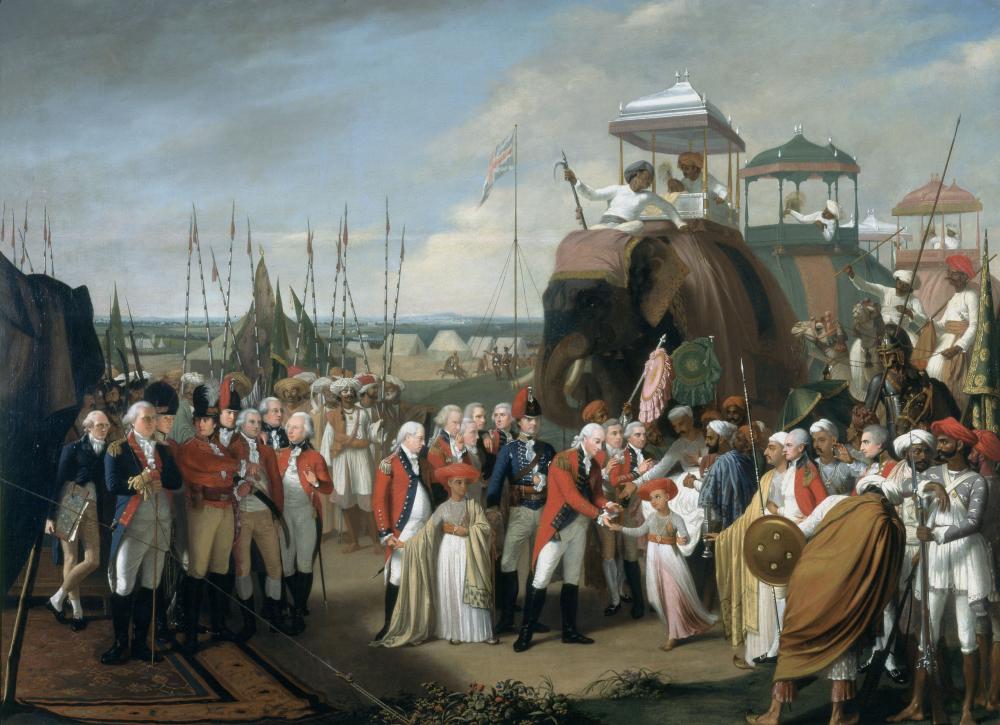
Most notoriously, “Tipu’s Tiger” is a near-life-size mechanical model of a tiger mauling a prostrate Briton, which contains a concealed pipe-organ simulating the tiger’s growling and its victim’s cries as he moves his arm up to and away from his mouth. A contemporary note explains the symbolism, makes a proposal, and gives us some further information which will be useful later on. Tipu, it says,
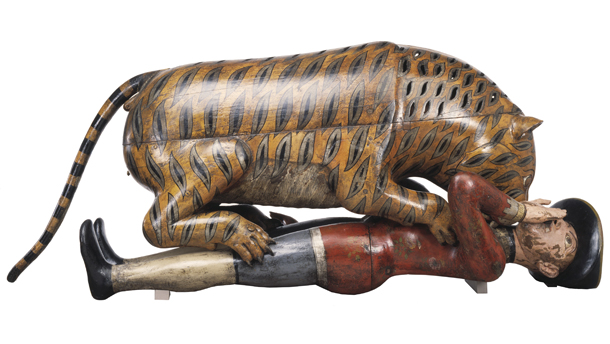
frequently amused himself with a sight of this emblematical triumph of the Khodadad over the English Circar [or Sircar: government/authority]… It is imagined that this characteristic memoreal… of Tippoo Sultaun may be thought deserving of a place in the Tower of London. Tippoo called his dominions the Sircar e Khodadad or god-given Sircar.
Tipu’s Tiger is now in the Victoria and Albert Museum, and there’s lots of interesting information about it on the V&A website. But what’s obvious enough is that the tiger was Tipu’s special emblem. As the “Tiger of Mysore”, Tipu could present himself both as a courageous and powerful Muslim sultan (the tiger being an age-old symbol of Persian royalty), and as a figure that also appealed to his many Hindu subjects through the tiger’s associations with the god Shiva.
On the medal, of course, the tables are turned, and a British lion overcomes Tipu’s tiger. The penant above the two big cats drives the point home. Alongside the Union Jack, the message: the lion of God is triumphant.
But there’s a bit more going on here. In Tipu’s symbolic language, lions and tigers were pretty interchangeable. In other words, Tipu was equally happy to call himself a lion, and the implications were essentially the same. In actual fact, the Arabic expression used on the British medal had been a motto favoured by Tipu. If you look at these images from Bonhams of a gun made for Tipu, you’ll see at the far left of the written decoration on the barrel the face of a tiger, but that face is actually composed of the very same Arabic words, asadullah al-ghalib, “The triumphant lion of Allah,” in mirror image. Here’s a close-up of this exquisite calligraphic tiger:

Asadullah al-ghalib was a name of Imam ‘Ali, the cousin and son-in-law of the Prophet who is especially celebrated by Shi’a Muslims: Tipu trod a fine line between Shi’a and Sunni Islam, as well as keeping his Hindu subjects on-side. On the medal, though, when the British claim to be the “triumphant lion of Allah”, they’re using Tipu’s own words against him.
And I think we can see something very similar happening on the other side of the medal. The important words here are srirangapatan ra khoda dad, “God gave Seringapatam”. Khoda dad means “God gave…”, but khodadad can also be an adjective, “God-given”. And as we learned from that contemporary account of Tipu’s mechanical tiger, Khodadad, “The God-given”, was the name that Tipu used for his Kingdom of Mysore: Tipu was its divinely ordained ruler. From the British Library, and the ever-generous Ursula Sims-Williams, comes an image of the front cover of a gorgeously bound copy of the Quran taken from Tipu’s library at Seringapatam. The script at the centre-top reads Sirkar-i Khodadadi, “the God-given government”:
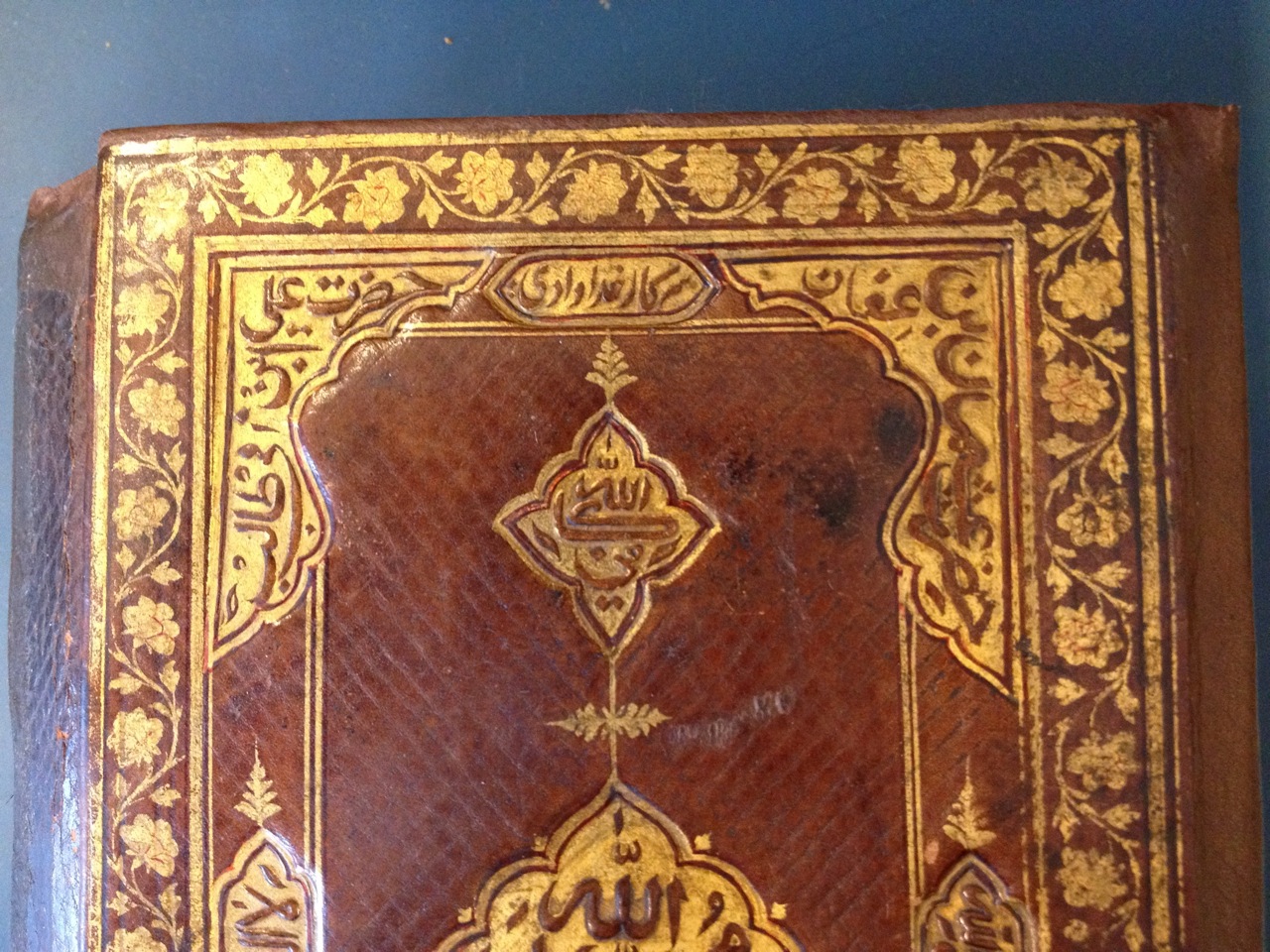
Once again, as with asadullah al-ghalib, the British medal turns Tipu’s own words against him: Allah has shown his true favour by taking Seringapatam away from Tipu, and giving it to the deserving British.
What I find fascinating about this medal design is how far Tipu Sultan, dead and buried, continues to set its terms. The symbolic argument of the medal, particularly as it’s made in the Arabic and Persian texts, presents the capture of Seringapatam in pointedly Islamic terms, in language and thought: the British are doing Allah’s work, and this in itself suggests how fragile Britain’s position in India was in 1799, thoroughly dependent on Indian allies and Indian manpower in its armies. It’s important to realise that the most important targets of the messages of this medal were Indian, not British.
But what the medal also conveys is what an incredibly potent propagandist Tipu had been. We know that Sir Charles Wilkins was closely involved in designing the medal, and it’s certainly Wilkins, the first Englishman to master Sanskrit (an achievement which assumes, in eighteenth-century India, complete fluency in Persian), who provided the Arabic and Persian text. He did a good job, too: it’s a witty and in one sense devastating contradiction of Tipu’s claim to authority.*
And yet in that imagery of big cats, in the panorama of Tipu’s glorious capital at Seringapatam, but especially in those words, it’s all done in Tipu’s own language of self-promotion. The respect for Tipu that the medal betrays, despite itself, gives the lie to the demonization of Tipu as a cruel and fanatical Muslim despot that a lot of British accounts of the time indulged in, and that Tipu’s Tiger particularly seemed to embody. (His legacy remains controversial to this day, as these responses to this Republic Day float (representing the state of Karnataka) in Delhi make clear.)
Tipu was no Tigger, for sure, a ruler as ruthless as any other in eighteenth-century India, but he also presided over a court of culture and sophistication, something that the British again tacitly recognised by looting his artistic masterpieces and shipping them and his extensive library back to their big houses and museums in Britain. (Tony Theaker reminds me that one of the most famous fictional treasures, Wilkie Collins’ Moonstone, came into British hands at the capture of Seringapatam, “an ornament in the handle of a dagger” belonging to Tipu, “who commanded it to be kept among the choicest treasures of his armoury.”) Sir Charles Wilkins later became librarian of the East India Company, where his role was mainly to look after the Company’s collection of Eastern manuscripts–a large proportion of them also picked up in 1799 at Seringapatam, including the Quran we saw earlier. I’m not with William Dalrymple with everything he says in this polemic, drawing parallels between the Twenty-first Century and events 200 years ago, but where I think he’s absolutely right is on the true source of the fear that Tipu provoked in the East India Company. “What really worried the British was less that Tipu was a Muslim fanatic, something strange and alien, but that he was frighteningly familiar.”
And the fact a British medal marking a famous victory speaks Tipu’s symbolic language tells us that just as clearly.
A. Buddle, The Tiger and the Thistle: Tipu Sultan and the Scots in India;
S. Stronge, Tipu’s Tigers;
M. Archer, C. Rowell & R Skelton, Treasures from India: The Clive Collection at Powis Castle.
* Wilkins is best known for an enormously influential translation of the Bhagavad Gita: here, for example, is Thoreau reading it beside Walden Pond. Eric Sharpe ends his study of Western responses to the Bhagavad Gita, The Universal Gita, with the arresting claim that “it was on the appearance of Charles Wilkins’ Gita translation in 1785 that “Hinduism”, all unawares, took its first step towards its present identity.”
Polo on Alexander on Polo
This New Year I’m going to ask you to watch a bit of Shakespeare, which is no huge imposition. We’re in the first act of Henry V, and the Dauphin of France has dramatically misjudged the new king Henry’s character, responding to his claims on France with a gift “meeter for his spirit”, a box of tennis balls. Henry is just a child and should stick to childish things, the implication is. But Henry proves how mature and resolute an opponent he will be by turning the jibe back on the French.
Brian Blessed making the most of a limited script there. As an O-level student many, many moons ago I studied Henry V (and sniggered at the “turn his balls to gun-stones” line, yes), but it was only very recently, when I was reviewing a very interesting book on the “Alexander Romance” (which I’ll come back to), that I realised that the whole scene is actually based on an episode from the life of Alexander the Great. Shortly after I realised this, I discovered (a common occurrence this, for academics) that someone else has realised the very same thing more than a hundred years before me.
Shucks. But it’s still interesting.
The episode in question was when Alexander, contemplating his invasion of Persia, received an embassy from the Persian king Darius, bearing gifts. The precise character of the gifts varies with the telling, as we shall see, but what is a constant is that the gifts that Darius sends to the Macedonian king imply that Alexander is still just a boy (and so shouldn’t bother himself with grown-up things like conquering the Persian Empire); and that in response Alexander offers his own, opposite interpretation of the gifts, as signs that his campaign against Persia will, on the contrary, be overwhelmingly successful.
So an early telling of the story has Darius send to Alexander a whip, a ball, and a casket full of gold, with a letter explaining their meaning: the whip indicating the discipline that the boy Alexander could still benefit from, a ball for him to play with, and gold to indicate the wealth and power of Persia. But Alexander answers Darius with his own interpretation of the gifts (here in an Armenian version, translated by Wolohojian):
you sent me as gifts, a whip, a ball, and a chest of gold. You gave me this present to make fun of me, but I have received it and taken it as a good omen. I took the whip to mean that by my valour and arms I shall thrash the barbarians and, having given them a mighty beating, shall subjugate them into slavery. And I took the ball, which you had designated for me, to mean that I shall master the world and hold it in my power–for the world is ball-shaped, a sphere. And the chest of gold was a great omen you sent me; for in sending it you announced your obedience to me. For having been defeated by me and fallen into my power, you shall humbly pay tribute to me.
The similarity to Shakespeare’s scene is obvious enough, and the first thing to say is that this is a very meaningful reminiscence: throughout the play Shakespeare is keen to associate Henry with Alexander (“Turn him to any cause of policy,/ The Gordian knot of it he will unloose,” etc.; my namesake Fluellen has something to say on it, too), two unexpectedly but spectacularly able young warrior-kings, and to lend Henry’s righteous invasion of France the status of Alexander’s conquest of Persia. So even though the story of the tennis balls had been told of Henry V for a long time before Shakespeare (who found it in sources stretching almost as far back as Henry V’s actual reign), it clearly retained its original association with Alexander.
Secondly, though, and I should probably have made this clear earlier, the episode of Darius’ gifts was not a historical event in the real Alexander’s life, but one of a host of fanciful stories that came to be attached to Alexander in popular tradition in Antiquity and the Middle Ages, and are collectively known as the Alexander Romance. This tradition began with a novel, now lost, written in Greek in Egypt quite possibly only shortly after Alexander’s death, but the story, rewritten and embellished but always recognisably a single tradition, proved astonishingly resilient, ultimately travelling as far as Iceland in one direction and China in the other: Muslim merchants seemingly ensured the presence of these stories in Chinese geographical texts. This mythical Alexander has very little in common with his historical counterpart. He explores the ocean in a diving bell, and the sky in a flying machine; protects the world from the Unclean Nations, Gog and Magog, with a great wall; and goes in search, unsuccessfully, of the water of eternal life.
Here’s just one example of the astonishing diffusion and persistence of the Alexander Romance: the tales that Marco Polo encountered when he passed through Badakhshan, northern Afghanistan, on his way to China in the thirteenth century (Yule’s translation):
Badashan is a Province inhabited by people who worship Mahommet, and have a peculiar language. It forms a very great kingdom, and the royalty is hereditary. All those of the royal blood are descended from King Alexander and the daughter of King Darius, who was Lord of the vast Empire of Persia. And all these kings call themselves in the Saracen tongue Zulcarniain, which is as much as to say Alexander; and this out of regard for Alexander the Great.
What Polo had heard were stories that we find across the Islamic world in Arabic, Persian, Mandinka and Malay. In this fictionalized version of Alexander’s life his bride Roxane (who in fact came from Bactria, not far from Badakhshan) became the daughter of the Persian king Darius, and Alexander himself was identified with the mysterious figure of Dhu’l-qarnayn, the “Two-horned”, described in Sura 18 of the Qur’an. According to Richard Stoneman, author of a brilliant survey of the Alexander Romance, Alexander’s “legend lived on in oral tradition in Afghanistan perhaps longer than in any other part of the world except Greece.” The stories were certainly alive and kicking when the West renewed its acquaintance with Afghanistan: the Alexander folklore that British soldiers encountered in Afghanistan in the nineteenth century, for example, fed their delusion that they were in a familiar and welcoming place. But the same essential tradition of stories was found in Muslim Mali, Christian Ethiopia, in Mongolia, and in England, and pretty much everywhere in between, subtly adapted to suit the host culture, so that in Islamic versions Alexander becomes a thoroughly Muslim figure, in Christian Christian, and in Jewish Jewish. In Mongolia Alexander takes on the attributes of a Mongol Khan.
But I want to concentrate on the scene picked up by Shakespeare, Darius’ gifts, partly because it illustrates the dynamics, but also the essential consistency, of the Alexander tradition, and partly because the way this scene gets elaborated over time and across cultures is simply fascinating.
By the time we get to a tenth-century Latin version of the story by Leo the Archpriest of Naples (translated from a Greek version he found during a diplomatic mission to Constantinople), which became the major vehicle of the Alexander myth in Europe, Darius’ whip and ball have become a ball and a “curved rod”; and in expanded versions of Leo, in the twelfth century, known as the Historia de Proeliis, we find a pila ludrica, “a ball for playing,” and a zocani, an obscure word which in Byzantine Greek is tzukanion but is originally the Persian word چوگان, chowgan, used in the traditional Persian game of guy-o-chowgan, “ball and mallet,” better known as polo.

Over time, it seems, the general implication of childish play borne by Darius’ gifts hardens into a more precise evocation of a formal game. In the Persian tradition, apparently echoed in Leo, Darius encourages Alexander to go and play polo; and in Henry V the young king’s advised to stick to tennis. But what’s the relationship between the Persian versions of the Alexander Romance and the version that feeds into Henry V? Have the two traditions just developed naturally, and quite independently, in the same direction, from generic play to formalized sport? If so, the sports in question are remarkably similar, in England one “royal” sport, Real (i.e. Royal) Tennis, and in Persia the proverbial Sport of Kings, polo.
That’s interesting enough, but the more exciting possibility is that in the fiendishly complex and convoluted history of the Alexander Romance currents from the Persian East fed into European versions of the story, in other words that in the tennis balls received by Henry V of England we have a distant echo of the Persian game of polo.
Well, Shakespeare’s audience knew that they were seeing Henry built up as a latter-day Alexander, but they wouldn’t have had a clue that this story of Henry/Alexander had been forged in the most remarkable international storytelling crucible, the tradition of the Alexander Romance, perhaps with a crucial contribution from Persia.
And as an example of cross-cultural interaction in the Middle Ages, that would frankly take the entire packet of digestives.
Aurel Stein on timelessness
On April 26, 1907 Aurel Stein wrote to his old friend P.S. Allen, in Oxford, from Dunhuang in north-western China. He describes the tricks played on his mind by the archaeological material he was finding in the ancient borderlands of China, as much as two millennia old but perfectly preserved, as if just that moment discarded:
… I feel at times as I ride along the wall to examine new towers, etc., as if I were going to inspect posts still held by the living. With the experience daily repeated of perishable things wonderfully preserved one risks gradually losing the true sense of time. Two thousand years seem so brief a span when the sweepings from the soldiers’ huts still lie practically on the surface in front of the doors or when I see the huge stacks of reed bundles as used for repairing the wall still in situ near the posts, just like stacks of spare sleepers near a railway station. I love my prospecting rides in the evenings, especially when the winds have cleared the sky. That is the time to see many things, the white brick towers glittering far away on the commanding ridges they usually occupy; the track within the wall line trodden by the patrols of so many years as the slanting rays show it up on the grey gravel soil, —and weak points along the marsh edge where prowling Hun freebooters might have lurked for a rush.
Stein’s was a peripatetic life, born in Hungary, by now a British subject based in India, but already embarked on his second ambitious expedition into Chinese Central Asia. Like all travellers, he had his strategies for finding the comforts of home in inhospitable places: reading Horace in the Kunlun mountains, for example, in the course of his first expedition in 1900. Here the place itself makes him feel at home, and he’s not sure why: is it the tangible history he finds around him, the thoughts his environment provokes of his native Hungary, and his father (there’s a jokey hint also of nineteenth-century ideas that connected the Huns of antiquity with the origins of the Hungarian people), or is it some intimation of a past life? It was lost Buddhist cultures he was rediscovering in Central Asia, and the religion held at least a sentimental appeal for him:
I feel strangely at home here along this desolate frontier—as if I had known it in a previous birth. Or is it, perhaps, only because I heard my beloved father tell so often of the Roman walls traversing parts of Southern Hungary. He had spent many a hot day in tracing their lines; but, alas, the day never came when he could show me what had puzzled and fascinated him. The people against whom they were built, may after all have been distant relations and forerunners of those Huns who had haunted these parts about the time of Christ.
I often return to this letter of Stein’s, and I in turn can’t really explain why. Maybe I share his nostalgia for a strange and ancient place, and find in it some kind of essence of what I do as a Classicist, thinking my way into the lives and minds of two-thousand-years-dead Romans. It’s probably not a memory of a past life.