Serpentine verse
An enquiry to “The Academy” literary magazine in 1904 (30th April, p. 502) concerning a memorial with an indecipherable inscription in St. Dunstan-in-the-East, now a public garden after the church was destroyed in the Blitz:

A variant of the same, also from “The Academy” (17th September 1904, p. 203) this time set out by Percy Selver (if this (Percy) Paul Selver, at the age of 16) to make the solution to the riddle clear:

The top and bottom lines share the word-endings in the middle line, so this one reads, Quos anguis dirus tristi dulcedine pavit,/ Hos sanguis mirus Christi mulcedine lavit, two dactylic hexameters meaning, “Whom the dreadful serpent fed with baneful sweetness,/ these the miraculous blood of Christ has bathed with consolation.”
And the original in St Dunstan’s reads, Quos anguis tristi diro cum vulnere stravit,/ Hos sanguis Christi miro tum munere lavit, “Whom the serpent laid low with grim and dreadful wound,/ These thereafter the blood of Christ has bathed with its miraculous gift.”
These might be described as two lines bound together by the ultimate in rhyming systems. Every single word rhymes with its counterpart in the other line. But when laid out as they were at St Dunstan’s, the relationship between the lines is more interesting, I think, and theologically meaningful. The fall of man described in the first line is bound up with, is actually inseparable from, the redemption described in the second, and vice versa. It makes me think of George Herbert’s perfect, alliterative lyric expressing the felix culpa in “Easter Wings”, “Then shall the fall further the flight in me.”
The origins of this Latin couplet seem pretty obscure to me, although having spent a sum total of two hours investigating this phenomenon, I’m prepared to be told they’re actually as clear as clear can be. Francesco Pipini (13-14th century), at Chronicon 1.47 (Muratori IX.628) attributes the verses to Hugh Primas (12th century), and presents them as an encapsulation of the Old and New Testaments achieved in the shortest possible space–which I think, in my theologically untutored way, amounts from a Christian perspective to the same principle as addressed in the last paragraph, fall and redemption. Pipini also records that these intertwined lines were called versus intercalares, “intercalary verses”, which I like.
Pipini offers yet another variation, Quos anguis tristi virus mulcedine pavit,/ Hos sanguis Christi mirus dulcedine lavit, “Whom the serpent’s venom fed with baneful temptation,/ These the miraculous blood of Christ has bathed in sweetness.” Other accounts (e.g. this one, and obliquely this one) of the St. Dunstan version, I should say, locate it in another City church hit during the Blitz, St. Anne and St. Agnes on Gresham Street.

(manu propria) Arth. Jam. Balfour

I’ve been proofreading for most of this month. A three-volume text and annotated translation of a Latin-language newspaper is not a simple thing to check, it’s fair to say, and at the best of times the checking is not the most stimulating part of producing a book. Of all proofreading I’ve ever done, though, this for Karl Heinrich Ulrichs’ Alaudae is by far the least painful, and for the simple reason that I’m reminded, page after page, how incredibly interesting the material is.
An illustration follows, a single paragraph taken from the middle of somewhere approaching 400 pages in total. I’m not sure I can properly explain why I like it so much, and only partly because I am seriously shattered, but it captures how Ulrichs, an impoverished exile in the middle of the Apennines, managed to leave behind him, the work of his very last years, such a remarkable, oblique document of late nineteenth-century European history.
But some background is required.
Ulrichs has sent two issues of his newspaper to Arthur Balfour, future Prime Minister of Great Britain and Ireland, whose honorary degree ceremony at Trinity College, Dublin in February 1891, when Balfour was Chief Secretary for Ireland, Ulrichs had described across two issues in March 1891 and April 1892. Ulrichs was in the habit of sending copies of his newspaper to significant people who had featured in it, an obvious way of garnering some publicity for his publication. The ceremony at Trinity had fallen at the end of Balfour’s time in Ireland, a tenure which both established him as a major force in British politics and damned him as “Bloody Balfour” among Irish nationalists. There were not a whole lot of nationalists at Trinity at this time, but Ulrichs’ source for the event was the editor of Freeman’s Journal, the leading contemporary Irish newspaper which supported the dominant nationalist aspiration at the time, Home Rule for Ireland. For the aftermath of the degree ceremony, the Journal’s pointed account repeated and embellished in Ulrichs’ Latin, see here.
Balfour is a figure whose significance is hard to overstate. Barbara Tuchman has ten pages (pp. 45-54) in The Proud Tower that make of him something like the very embodiment of Britain at the end of the nineteenth century, its “Splendid Isolation” at the heyday of Empire. Prime Minister from 1902 to 1905, he was for forty years one of the very leading figures in British politics, for 28 of those years in some form of ministerial role. The Balfour Declaration of 1917, when he was Foreign Secretary under Lloyd George, is of course one of the most momentous documents of the twentieth century. It is rather less well known that we have Balfour largely to thank/blame for the popularity of the game of golf.
That Balfour and Ulrichs had any contact at all is bordering on the surreal; the form it took truly so, as the Italian postal authorities refused to recognise the official government franking of Balfour’s letter, and Ulrichs as a consequence had to pay for the cost of its postage and the same again in a fine. If Balfour by this stage was Leader of the House of Commons, effectively Deputy Prime Minister, Ulrichs was so short of resources when John Addington Symonds visited him in Aquila in October 1891 that he had “no shirt and no stockings on.” But Ulrichs knew how to write a Latin newspaper that people would want to read, and the engaging writing and content was programmatic—proof of Ulrichs’ passionately held belief that Latin could be a practical modern language that would overcome the ever sharpening divisions between the ethnic and linguistic communities of late nineteenth-century Europe.
Anyhow, here is one of my favourite paragraphs in Karl Heinrich Ulrichs’ Alaudae, in Latin and English, and then in English and English:


I believe that Balfour’s papers for this period are held by the Bodleian library. When I’m not up to my ears in proofreading or admin, which may coincide with the next blue moon, I shall head over and investigate whether there are among his papers the issues of Alaudae that Ulrichs sent to him. If so, and you never know, they will no doubt be addressed to Balfour in Ulrichs’ very finest Latin calligraphy.
Feedback
There’s an exceptionally generous review of Horace: A Very Short Introduction by Chris Trinacty here; and I might as well link, a bit belatedly, to a similarly nice one here from Katharina Volk for Ovid: A Very Short Introduction. It’s probably about time I tried my hand at composing something lengthier, a three-volume edition of Ulrichs’ Alaudae, perhaps…

So hold und schön und rein
A strange story, this one.
Working on the end of the nineteenth century, one is always aware of an aftermath. The First World War is just around the corner, the Europe familiar to late-Victorians shortly to reshape itself dramatically. Baltic Germans would have more reason to feel dispossessed than most.
In the very last issue of Alaudae from February 1895 (see Lugubelinus passim) Ulrichs includes a translation into Ancient Greek of a poem by Heinrich Heine:

“You are the very image of a flower,/ graceful and fair./ When I look at you a great sadness/ seizes my heart./ I would place my hands/ on your head,/ praying that God may save you,/ graceful and fair.” This is a variation on a tradition in Germany that generally leaves me pretty cold, the practice of translating classics of German lyric poetry into Latin. But I like this Greek version of “Du bist wie eine Blume”. It manages to be a faithful translation of Heine’s original and also match its rhyme and accentual iambics and the simplicity of expression that carries its subject so well:
Du bist wie eine Blume,
So hold und schön und rein;
Ich schau’ dich an, und Wehmuth
Schleicht mir in’s Herz hinein.
Mir ist, als ob ich die Hände
Auf’s Haupt dir legen sollt’,
Betend, daß Gott dich erhalte
So rein und schön und hold.
You are like a flower,
So fair and fine and pure;
I look at you, and sadness
Steals into my heart.
I feel as if I should lay
My hands upon your head,
Praying that God preserve you
So pure and fine and fair.
As Ulrichs indicates underneath, this Greek version was composed by Wilhelm (Guilielmus) Christiani, from Dorpat in Livland, or in present-day terms Tartu in Estonia. Christiani was at the time (1894/5) a student in Altklassische Philologie, Classics, at the Kaiserliche Universität zu Dorpat, a German-language university within the Russian Empire mainly serving the Baltic Germans who formed a ruling class within the modern-day Baltic states. I am not sure how Ulrichs came by Christiani’s poem (the author may have sent it himself), but Ulrichs certainly had contacts in Dorpat/Tartu, and perhaps a prize-winning student composition was sent to him by one such source.
Sixty years later, in the early 1950s, Wilhelm Arnold Christiani, by this time an octogenarian, was in correspondence with the Austrian academic Josef Matl, with whom Christiani shared some letters sent him some years before by Vatroslav Jagić (1838-1923), an important scholar of Slavic studies and Matl’s own teacher.* After his first degree in Classics Christiani had also turned to Slavic studies, hence his correspondence with Jagić. He offered Matl a sketch of his own career along with Jagić’s letters, explaining how he had originated in the Saint Petersburg circle of Slavists (he drops some names of contemporary Slavists at the University of Saint Petersburg) and was “subsequently active in Posen (Poznań) and Berlin as teacher, censor or editor (at the Foreign Office) in Polish and Russian.”
This is a selective curriculum vitae, to say the least. A fuller account is to be found in Wer ist’s (the German pre-war Who’s Who) for 1935. He was born in Testama, present day Tõstamaa in Estonia on November 27th, 1871, his father a Lutheran pastor. After Dorpat he had studied in Berlin and Saint Petersburg, and worked as a journalist in Berlin, St Petersburg and Strasbourg, then as a librarian in Saint Petersburg, back in Dorpat, and in two libraries in Posen (Poznań) for as long as the city was a Prussian possession (that is, until the First World War), the Kaiser-Wilhelm-Bibliothek (now the University Library) and the Raczyński Library, of which he was Director in 1913-14. After the Great War there was a move into public service as Press Attaché and Vice-Consul in the German Embassy to Warsaw, capital of the newly reconstituted country of Poland, and more than a decade in the Government Press Office during the Weimar Republic as Polish editor. Then the bombshell: “Since 1933, Polish editor in the Reichsministerium für Volksaufklärung und Propaganda“, an institution which played a central role in the Nazi regime’s efforts to control German public opinion.
Other sources fill in details:** that Christiani’s first degree at Dorpat had lasted from 1891 to 1895; that his turn to Slavic languages took the form of a doctorate written between Berlin, Dorpat and Saint Petersburg (1904-1906) on foreign words in written Russian in the seventeenth and eighteenth centuries, and that shorter publications followed, mainly in the journal Archiv für slavische Philologie, (founded and edited by Vatroslav Jagić and the leading journal in the field). Meanwhile his publication in 1942 on a branch of a German mercantile family in Warsaw strongly suggests, by the series in which it was published, Nordostberichte, by its publisher, Publikationsstelle Berlin-Dahlem, and by its apparent interest in Germans settled beyond the pre-war borders of the Reich to the east, that Christiani was fully engaged in Nazi generation of propaganda.
We started from a sensitive response to a poem of Heinrich Heine. What makes Christiani’s life trajectory a little more striking still is that Heine, a Jewish poet, was a figure of some controversy in the German-speaking world of the 1890s. A plan to install a statue commemorating Heine in his hometown of Düsseldorf in time for the centenary of his birth in 1897 had since 1887, when it was first proposed, become mired in the intensely nationalist politics of the late nineteenth-century German Empire. Heine’s Jewishness was not the only point at issue–the poet had favoured Napoleon, and could certainly not count as a German patriot–but antisemitism rapidly became a major part of the mix. A statue of the Lorelei which had been intended for Düsseldorf, alluding to Heine’s celebrated poem on this Rhenish siren, was eventually erected in a park in the Bronx. A statue of Heine himself set up by the leading supporter of the Düsseldorf campaign, Empress Elisabeth of Austria, at her villa on Corfu, is the subject of Tony Harrison’s poem Gaze of the Gorgon. It was removed from the villa by Kaiser Wilhelm II when he bought it and is now in a park in Toulon, in southern France.
Yet Wilhelm Christiani, who had translated another poem of Heine so very well, would end up working for Joseph Goebbels.
Christiani had written to Matl from Pörtschach, and he died in this pleasant Austrian resort on Wörthersee, at the age of ninety, in 1962.

************************
* J. Matl, “Varoslav Jagić an Dr. Wilhelm Christiani (unveröffentlichte Briefe)”, Wiener Slavistisches Jahrbuch 2 (1952), 161-170, at 162.
** C. L. Gottzmann and P. Hörner, Lexikon der deutschsprachigen Literatur des Baltikums und St. Petersburgs (2007), I.330; E. Eichler et al., Slawistik in Deutschland von den Anfängen bis 1945. Ein biographisches Lexicon (1993), 87 (G. Schröter).
How not to say “cricket” in Latin
A few words to mark the final submission of pre-proof material to Bloomsbury for our three-volume edition of Alaudae, the remarkable Latin-language newspaper published by Karl Heinrich Ulrichs from 1889 until 1895 which I may have mentioned a couple of times. I am just as I release this post into the wild back home after walking the dog on Port Meadow. Many skylarks, alaudae, which must be a good omen.
In my very first encounter with Ulrichs, translating Alaudae Issue 27 a couple of years ago, I found myself not only turning his Latin into English and explaining what he was telling us about Latin at the end of the nineteenth century but also trying to understand his mistakes, which in a strange way I found as compelling as anything else. At the time I described it as like peering over Ulrichs’ shoulder as, for instance, he struggled to read a Cyrillic signature.
What follows is along similar lines. If Ulrichs was unfamiliar with the Russian language and script, and indeed with Russia in general, though also very keen to learn what he could about it, his view of Britain wasn’t so very different. The occasional remarks about Britain that we encounter in Alaudae offer a fascinating impression of a European’s perception of this island in the period of “Splendid Isolation”, the confident aloofness from the European continent that Great Britain cultivated at the zenith of Empire. It interests me that Ulrichs’ origins in Hanover–until the age of 12 his monarch was the same as Great Britain’s–seem to make no difference here: Britain remains to him an essentially strange, inexplicable place.
One thing Ulrichs is particularly intrigued by, albeit still quite uncomprehendingly, is the British love of sport. He is amused and bemused by the information that Arthur Balfour, the future British Prime Minister with whom Ulrichs exchanged letters, used to relax with a round of golf. Elsewhere Ulrichs observes how British sports had accompanied the British to far-flung colonies like New Zealand, but in the process he gets seriously confused between golf and another ball game played by the British home and colonial elites, lawn tennis.
Today, however, our concern is cricket.
In the penultimate issue of Alaudae from January 1895 Ulrichs published four Latin speeches by the long-serving Public Orator of Cambridge, John Edwin Sandys. He had been sent them by Sandys himself, and they were speeches marking honorary degrees bestowed upon significant individuals in the summers of 1893 and 1894. Sandys had in fact sent Ulrichs all twenty-one speeches he had delivered for honorands in ceremonies on June 13, 1893 and June 27, 1894, and from them Ulrichs selected four for the international readership of Alaudae. The first of these four, from June 1893, marked the award of an honorary LL.D. to the monarch of a princely state in India, the Maharajah Raol Sir Takhtsinhji Jaswantsinhji of Bhavnagar. Bhavnagar was located in the Kathiawar peninsula in north-western India and was one of many nominally independent princely states in India over which the British nevertheless exerted significant influence. Sandys’ Latin oration for the Maharajah can be found in The Academy, published four days later, and in Sandys’ collection of his Latin compositions for Cambridge, Orationes et epistolae Cantabrigienses,1876-1909 (Cambridge, 1910), p. 105—and will of course be available in Volume III of our edition.

But the speech as presented in Alaudae diverges somewhat from Sandys’ original. The last couple of sentences in Ulrichs’ version run as follows:
Juvat regem, de populo suo erudiendo tam praeclare meritum, titulo academico hodie decorare. Juvat etiam unum e popularibus eius inter alumnos nostros numerare.
I’ll hold off from a translation for a moment, but if you compare these two sentences in Alaudae with those in The Academy (above) and in Sandys (1910), you’ll notice that Ulrichs has missed out a bit. The full, original version reads, “It is our pleasure to adorn with an academic title a king who has registered such exceptional achievements in the education of his own people. It is our pleasure also to number among our students one of his fellow-countrymen who has distinguished himself in the game of the open field.” The underlined part, “in ludo campestri insignem” in Latin, is what has failed to make it into Ulrichs’ version. Now, Ulrichs had no qualms about abbreviating any Latin text he published. The finances of Alaudae were such that he had to be pretty ruthless to keep himself to his self-imposed length of, latterly, 16 pages per issue. This is in fact not the only part of Sandys’ speech for the Maharajah that he cut, but this omission was one that caused me no little difficulty when editing. Who was this fellow-countryman of the Maharajah, presented with no further identifying detail?
Consulting the Public Orator’s original proved to be something of a revelation, particularly with the notes Sandys helpfully provides in his 1910 collection. The Maharajah’s fellow-countryman “who has distinguished himself in the game of the open field” turned out to be quite a significant personage, the celebrated cricketer Ranjitsinhji, at the time of this ceremony a student at Trinity College, Cambridge, and in the cricket season of 1893 making his first major splash as an unorthodox and high-scoring batsman in the Cambridge University eleven.
Meanwhile “the game of the open field” was a way of expressing “cricket” in Latin favoured by Sandys whenever the need arose (and in Cambridge orations that was quite frequently: on pp. 88, 130, 143 and 225 of his 1910 collection, and there’s one example at least in a later collection of Sandys’ speeches and letters from 1909 to 1919). I should add that Sandys also uses “ludus campestris (or campester)” for polo and golf, but with suitable qualification. Thus he describes Pratap Singh, at the time Chief Minister of Jodhpur, as “in ludo campestri eques egregius”, “an outstanding horseman in the game of the open field” (p. 130), and credits the lawyer Robert Finlay with notable talent “ludi campestris Caledonici in certamine”, “in playing competitively the Scottish game of the open field” (p. 190). We can only imagine what he would have done with football or rugby.
Restoring those four words to the speech for the Maharajah and consulting Sandys’ explanatory footnotes doesn’t iron out all the difficulties, I should say. The phrase “unum e popularibus eius”, “one of [the Maharajah’s] fellow-countrymen” is tricky. “Popularis”, “belonging to the same country or people”, would most naturally imply that Ranjitsinhji was a subject of the Maharajah of Bhavnagar, but in fact he was from a separate princely state in Kathiawar, Navanagar–of which, furthermore, Ranjitsinhji would later become ruler. I don’t believe that Sandys would have allowed himself to confuse these two adjacent states, or for that matter that identifying a “popularis” in the broader sense of a “fellow-Indian” would have had any point as a conclusion of his speech. My preferred explanation is that Sandys perceives that Ranjitsinhji and the Maharajah shared a common origin in Rajput states in Kathiawar–and there was a certain cohesion between those states: both the Maharajah and Ranjitsinhji had attended the same school, for instance, Rajkumar College in Rajkot, a school established by the rulers of the Kathiawar states, with the encouragement of the British authorities, to educate the Kathiawar elite along the lines of British public schools. The Maharajah had in fact been its very first student. The phrase “unum e popularibus eius” thus perhaps means something like “one of his fellow Kathiawar Rajputs.” I am open to other explanations.
But it’s Ulrichs we’re really concerned with here. His version of the speech, lacking as it did “in ludo campestri insignem”, gave very little clue as to the identity of a student who was in Alaudae simply one of the Mahararajah’s fellow-countrymen. And it makes the speech fall rather flat as a consequence, I think. But it’s easy enough to explain why he left it out. Ulrichs found the British obsession with sports fascinating, but golf and tennis and cricket were never anything but a mystery to him, and “in ludo campestri insignem” might just as well have been in Russian. On Balfour’s love of golf Ulrichs had commented with some irony, “The road that leads to public glory seems mixed in your country with a wonderful kind of pleasure, a pleasure unknown to those mere mortals whom a harsher destiny has set down on this side of the English Channel.” Bemused by a politician playing golf, confused by multiple ball games played enthusiastically by the British on grass, and generally foxed by the British devotion to their eccentric leisure activities, Ulrichs thus simply omitted the great Ranjitsinhji from his newspaper.
Which I think you’ll agree just isn’t cricket.

Latin for losers

We’re often asked these days to think about the role of Classics in Empire, the ways in which the classical educations and general conditioning enjoyed by many colonial officials shaped their perceptions and practice. I’ve written about such things myself, here for instance, and here, and here. But studying Europe in the 19th century, as I’ve been spending a lot of time doing this last year, has alerted me to something like the direct opposite. Step away from the colonial powers of Western Europe, as Mateusz Stróżyński has explained of Polish national self-expression, and the role of Latin in particular can get a bit more complicated.
In what follows I offer some examples of Latin deployed to resist imperial power. I’ve encountered them in Karl Heinrich Ulrichs’ Latin-language newspaper Alaudae (1889-95), and it’s fair to say that, even though it is an explicit aim of Alaudae to promote Latin as a language that can overcome differences and inequalities between the peoples of Europe, he sometimes seems not to appreciate the full implications of what he is describing.
It would certainly have been grist to Ulrichs’ mill if he had appreciated what he was looking at. There’s a powerful moment in Issue 23 of Alaudae, from April 1892, where Ulrichs has reproduced the conclusion of a Latin oration delivered by Arthur Palmer marking the conferment of an honorary degree (from Trinity College Dublin) on Arthur Balfour, Chief Secretary for Ireland and later PM. The first part of the speech had featured in an earlier issue back in March 1891, just a month after the actual ceremony. Ulrichs’ source for the event was the Freeman’s Journal, a leading Dublin newspaper edited by William H Brayden, a regular correspondent of Ulrichs who is later spotted in the Aeolus chapter of Ulysses. Freeman’s Journal deployed its powerful voice in support of Home Rule, a kind of qualified independence for Ireland vigorously opposed by Balfour.
The conclusion of the Journal‘s account follows Balfour out of the gates of Trinity, a bastion of Unionism, and onto the streets of Dublin. Here are Ulrichs’ Latin version and a translation, at the end of which Ulrichs editorialises interestingly. By way of explanation: Charles Stewart Parnell had been the leading proponent of Home Rule, but was in fact at the time of the Journal‘s report already caught up in a scandal that would undermine his dominance of nationalist politics. By the time of Alaudae 23 he was dead at 45. Dublin Castle, meanwhile, just a couple of hundred yards up Dame St. from Trinity College, was the seat of British administration in Ireland:

“With the conclusion of the ceremony, Balfour left the University premises in a carriage to return to Dublin Castle, accompanied by a great throng of students. Seeing this, passers-by stopped and began to shout ‘Long live Parnell’!
We have in front of us the newspaper Freeman’s Journal, dated Dublin, Feb. 11, 1891, which describes these events and presents the whole speech in Latin, without translation.
Thus has Latin served the ruling party. Who knows whether tomorrow it may be destined to serve those who struggle and toil? Why indeed should honours not be conferred in this universal tongue upon those also who earn them in the national cause of the Irish people?”
Why indeed not? Vivat Parnell certainly has a ring to it. For Ulrichs Latin is a language that belongs to no one, and thus can as well celebrate the underdog as the powerful. In two moments at least in Alaudae we can see Latin doing pretty much that, I think, even if Ulrichs doesn’t quite realise it.
The first is some information Ulrichs has received from Istanbul, and the recollection it provokes of two medical students he had met during his residence in Würzburg, thus 1867-70:

“Not even in Constantinople is the Latin language spurned. In a high school in the Greek suburb of Pera, whose headmaster is Ch. Hadjichristou, Esq., it is taught by two masters. And years ago in Würzburg I knew two young men studying medicine there originating from Asia Minor, Greek speakers who had been taught Latin. “I have read,” said one of them, “beta of the Aeneid” (Book 2 of the Virgilian poem). Moreover, I remember they said, “We are Romi”. (Romii, that is, ‘We are Romans’.) They declared themselves to be Romans, not Hellenes, Romans of the eastern branch, descendants of those Romans who fought under the Comneni and the last of the Palaeologi.”
Ulrichs is talking about Greeks within the Ottoman Empire, whose identity was very much bound up with the continuation of the Roman Empire in East until the Ottoman capture of Constantinople/Istanbul in 1453. Maintaining that Roman identity even extended to learning the Latin language and reading Virgil’s epic of the foundation of Rome. What is this if not a minority community resisting the majority imperial culture by recourse to the Latin language?
My second example is from another empire to the north. Ulrichs has received a communication concerning a professor at the Universität Dorpat, a German-language institution in what is now Tartu, Estonia, at this stage well within the borders of the Russian Empire:

“At the Universität Dorpat Prof. Hoerschelmann has been teaching several subjects in Latin since 1892. Others he does still continue to teach in German; but he has decided, from Jan. 1, 1895, to deliver all of them in Latin. (So I was informed by letter on Dec. 9, 1894, in German.)”
In fact neither Wilhelm Hoerschelmann, a professor of Latin and Greek, nor Ulrichs would survive 1895. Ulrichs I think understands Hoerschelmann’s decision to teach in Latin as reflecting a recognition on the professor’s part of Ulrichs’ ideal of Latin as a universal language. But a more likely explanation is that a German-language university like Dorpat, which dispatched Lutheran pastors and well-educated German administrators across the Russian Empire, was at this point in history under pressure to Russify, a policy pursued by the last two Tsars Alexander III and Nicholas II (who assumed the throne in November 1894). What does a German-speaking classical philologist do in these circumstances? To avoid teaching in Russian, he adopts a language to which the authorities cannot object (Ulrichs provides evidence elsewhere of the high status Latin could claim in Imperial Russia) and which is neither German nor the demanded alternative. Again, it seems, a beleaguered minority reaches for Latin to defend its identity.
There are other moments in Alaudae comparable to this, among them my favourite passage in the whole run of issues, and almost the first bit I translated, the account of the pharmacists’ ball in Brno (Brünn), now in the Czech Republic but then in the Austro-Hungarian Empire, where an awkward choice between Czech and German—and the default option was presumably German—was sidestepped by composing the dance card entirely in Latin. It is a beautiful, and in retrospect deeply poignant, anecdote. I wrote about it back here, at the very start of my involvement with Ulrichs.
I owe to Kresho Vuković my familiarity with Lav Subaric, “National identities and the Latin language in Hungary and Croatia: Language conflicts, 1784-1848”, in Th. D’haen, I. Goerlandt & R. D. Sell (eds.), Major versus Minor? – Languages and Literatures in a Globalized World (2015), pp. 53-66. Let me just quote part of Subaric’s summary of his fascinating account of developments within the Austro-Hungarian Empire:
“Confronted with the threat of the imperial politics of Germanization under Joseph II, the elite of the lands of the crown of St. Stephen [roughly Hungary and Croatia], united in their Hungarian identity, reacted by insisting on the use of Latin. After the threat was removed, the emerging Magyar identity saw Latin as a problem and tried to replace it with the national language. Other inhabitants of Hungary and Croatia, faced with the Magyar aspirations, initially held on to Latin, but the Croatian national movement soon saw Latin as a problem and tried to abolish it. Finally, inside Croatia, those who opposed the new national language saw Latin as a safeguard of their political identity.”
I did suggest that the historical role of Latin is complicated. But Subaric’s next observation is hard to dispute: “The dual role of Latin in this series of language conflicts, and especially its role as a defence for the national identity, has faded from collective memory.”
Domitian frag. 1

There’s a peculiar moment early in Martial’s first book of epigrams.
Martial’s first book of epigrams, I should start off by saying, though he himself entitled it Book 1, is not the first book of epigrams Martial wrote, not by any means. Book 1 was probably published in AD 86, and we think that a book of epigrams on the games in the Flavian Amphitheatre (Colosseum), and two books of poetic “gifts” at the Saturnalia, the Xenia and Apophoreta, predated Book 1.
And then there is the very first poem of Book 1: “Here he is! The poet you’re reading, the poet you request,/ Martial, famous the world over/ for his witty little books of epigrams;/ to whom, eager reader, you have given/ while alive and conscious such glory/ as precious few poets get post-cremation” (Hic est quem legis ille, quem requiris,/ toto notus in orbe Martialis/ argutis epigrammaton libellis/ cui, lector studiose, quod dedisti/ uiuenti decus atque sentienti,/ rari post cineres habent poetae.)
How can Martial claim to be so successful and famous at the start of his first book? Well, it can’t just be on the basis of those earlier books we know about, so we have to assume that he had produced a lot of poetry already, and that Book 1 represents some kind of new departure; and further books did follow regularly up until Book 12 in 101/102. The important point, though, is that at the start of Book 1 Martial could already claim celebrity status.
The peculiar moment I’m concerned with comes shortly after that opening poem. In 1.4, still in introductory mode at the start of the book (his books tend to run to about a hundred poems), Martial commends his epigrams to the emperor Domitian, asking him to approach them not with the severe expression of a ruler of the world (flattery will get you everywhere) but with the tolerance he would bring to a performance of mime, a notoriously unsophisticated (and often obscene) form of comedy which was nevertheless extremely popular in Rome.
In the next poem, 1.5, the emperor Domitian apparently replies to Martial: Do tibi naumachiam, tu das epigrammata nobis:/ uis, puto, cum libro, Marce, natare tuo (“I give you a sea battle, and you give me epigrams:/ I think you and your book have an ambition to go swimming, Marcus.”)
“Domitian” threatens to throw Martial along with his worthless Book 1 into the water. The sea-battle meanwhile (presumably providing the water in question) was a spectacular show staged by Domitian in the Colosseum for thousands of rapt spectators to which a book of short, funny, often smutty poems can’t begin to compare. But it’s a playful ticking off. “Domitian” uses an intimate form of address to Martial (M. Valerius Martialis), his praenomen (pre-name, first name) Marcus.
I’ve put Domitian in scare quotes there, and that reflects the scholarship. No one, to my knowledge, has suggested that this really was Domitian talking, that the emperor Domitian had composed a response to 1.4. Friedlaender, the great nineteenth-century commentator on Martial, describes Martial putting words in the emperor’s mouth (and never doing the same thing again), and as far as I’m aware Martial scholars have followed him in this.
But I wonder…
Domitian was a populist; every emperor had to be, and you don’t stage a sea battle in the Colosseum if you’re not. That Domitian had a good sense of humour, meanwhile, was definitively established by Ll. Morgan (remember the name) in Classical Quarterly in 1997. We also know he wrote poetry (Suetonius, Life of Domitian 2.2; Quintilian, Inst. Or. 10.1.91-2; Martial 5.5, and others), and he could certainly bash out a two-line elegiac epigram if he needed to. A further thought is whether it’s sensible to pretend to be an emperor who, despite that sense of humour, had a reputation as somewhat unpredictable and kinda ruthless.
Isn’t it actually more likely that Martial shared the poem with Domitian (we have evidence that this happened in poem 101 of the first book, a scribe of Martial whose handwriting was known to Domitian and his brother, and predecessor as emperor, Titus), and Domitian wrote a (slightly plodding) reply? We know that both Titus and Domitian showed favour to Martial, and it wouldn’t be the first or the last time a politician sought to harness the popular appeal of an artist, and I don’t need to embarrass anyone with toe-curling reminders of Cool Britannia. Domitian himself had between AD 83 and 85 put a celeb on his coins, as you can see at the top, the rhino (an impossibly exotic creature) that he had introduced to the Roman audience at the Colosseum. The denomination of coin with the rhino image is the lowest, a quadrans, so had the widest distribution. Domitian did not want the Roman people to forget the rhinoceros.
To Domitian, joining in the fun of Martial’s epigrams brought popularity (though with a slightly different demographic than the rhino coin, perhaps); to Martial it offered a brilliantly disruptive, eye-catching moment as he relaunched his poetic career. As for me, I am presenting you with a quite unprovable hunch, but that’s what blogs are for.
This would, though, be the only surviving poetry of the emperor Domitian, and indeed, modest as it is, a whole poem.
Post post
This is blogging as stress reduction, which it has been once or twice in the past. But it’s also an exercise in sorting my thoughts out, and illustrates, for what it’s worth, the peculiar difficulties of reading not just nineteenth-century Latin, but nineteenth-century Latin that is consciously promoting the language as equal to the demands of the modern day: the Latin of Karl Heinrich Ulrichs’ newspaper Alaudae, needless to say. As I’ve mentioned before, Ulrichs was interested in the post in any case, but had a professional interest in its workings while producing and broadcasting his newspaper across the world in the last years of his life, 1889-95.
At the point I’m going to talk about here (in issue 17-18, March 1891), he’s in the process of arguing that the administration of the Austro-Hungarian Empire would be better done in Latin, thereby removing the unfair advantage enjoyed by German, and by German-speakers within the Empire. Tongue somewhat in cheek, Ulrichs goes on to coin Latin equivalents for common contemporary postal terms, and here in a nutshell is the challenge (and appeal) of understanding and translating Alaudae, since it requires not only understanding Ulrichs’ Latin but also knowing what kind of postal items were in circulation in late nineteenth-century Europe. I can claim some limited expertise in the former.
Back in that earlier blog I mentioned one such postal item that I hadn’t encountered before, the newspaper wrapper, but once I did encounter it, it made a whole lot more sense of a couple of passages in Alaudae (Ulrichs’ Latin for this wrapper is fascia). Insight there had come with this video from the philatelists of Lancaster County, PA. But since then I’ve found a marvellous resource for understanding Victorian postal stationery: a series of six short articles by Colin Baker in the British Philatelic Bulletin issue 32 (1994-5) which are scanned and hosted on the Collect GB Stamps website and available here (1), here (2), here (3), here (4), here (5, including newspaper wrappers) and here (6). These are primarily concerned with developments in the UK, but postal practice was effectively developing in parallel across the nations signed up to the Universal Postal Union, established in 1874, and Baker notes what countries the UK imitated and how slow or fast the Post Office was to adopt innovations from abroad.
On the back of these articles, here is Ulrichs’ text at the relevant point, my translation, and the postal items that I think Ulrichs has in mind, with links to descriptions and illustrations where I have them. WordPress plays havoc with formatting, but it still should be fairly clear what goes with what. My interpretation of Ulrichs’ Latin is embodied in the translation as much as anything, and I welcome corrections.
Ecce, quem in modum fingi possint verba postalia Latina:
Chartula epistolaris duplex. Huic parti adjuncta appendix respondendo destinata est. Appendix responso scribundo. In hoc latere praeter inscriptionem nil poni licet.
Epistola curae praecipuae commendata. Epistola ad certam summam cautione postali munita. Epistola chartas continens aeris vice fungentes.
Mandatum de solvendo postale. (Assignatio postalis.) Appendicula separabilis. Quam resecandi et sibi habendi accipienti jus est.
In chartula duplici conglutinabili recentissimae inventionis: Chartula epistolaris clausa. Quam ut aperias, secundum foraminum seriem avelle marginem.
En, res facillima.
Witness how postal words may be fashioned in Latin:
‘Two-fold letter card.’ ‘The attachment joined to this part is intended for a reply.’ ‘Attachment for writing a reply.’ ‘On this side nothing beside an address may be put.’
‘Letter entrusted to special care.’ ‘Letter protected by postal insurance to a set sum.’ ‘Letter containing sheets serving in place of cash [cheques].’
‘Postal order for payment. (Postal assignment.)’ ‘Detachable counterfoil, which the recipient has the right to cut off and keep.’
On the sealable two-fold card recently invented: ‘Closed letter card. To open, tear the edge along the line of perforations.’
There, nothing easier!
Reply Card: development of the simple postcard (one side for the message & one for the address) with two cards folded together, one detachable for the reply. Description & image pp. 80-81 here.
Various forms of registered post, which included compensation for loss or damage calculated according to a table of fees: see here.
Still today a reasonably familiar item, but shouldn’t the counterfoil be for the sender, mittenti, not the recipient, accipienti?
A development of the first item known as a Letter Card and designed for messages requiring privacy, a sealable double card: pp. 208-209 here, confirming that in 1891 it was indeed a recent invention.
To err
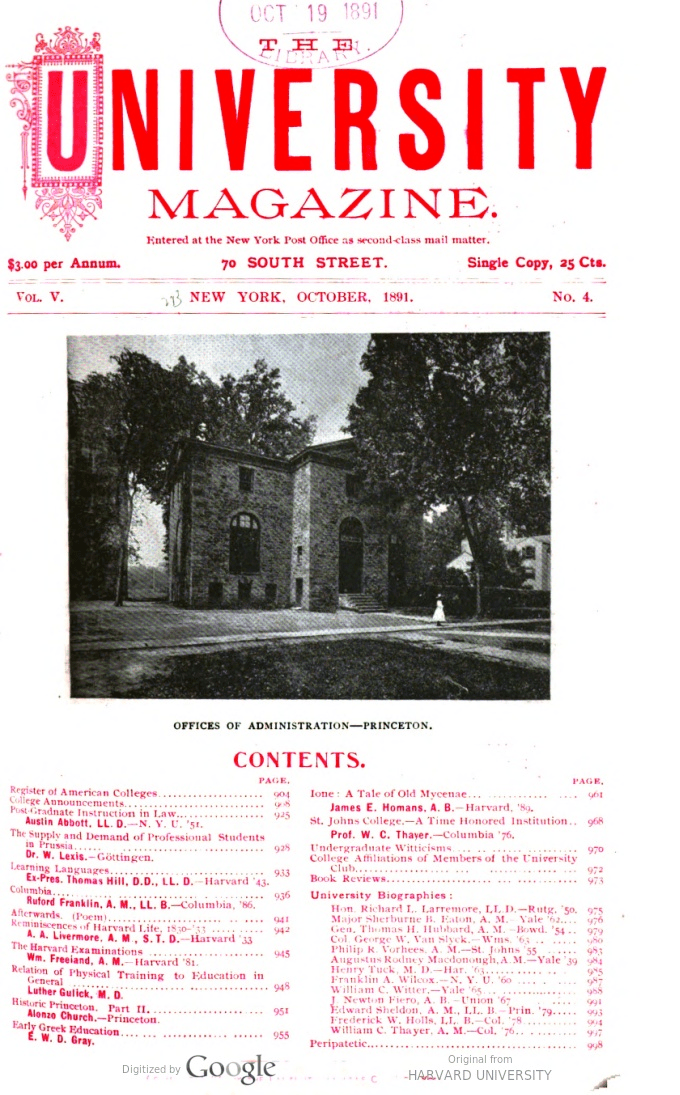
A joke in Karl Heinrich Ulrichs’ Alaudae. Probably not worth a blog (though what is these days?), but it’s a good one, I think: donnish and thus my favourite kind.
In Issue 22 of Alaudae (from January 1892) Ulrichs has got hold of an American publication called The University Magazine, a rather waspy exercise focussed on the elite US institutions of higher education. He spends a bit of time in this and subsequent issues sharing, in Latin of course, a description of the physical monuments of the College of New Jersey, Collegium Neo-Caesariense in Latin, shortly to be renamed Princeton University in 1896, but he also refers to some of the other articles in the issue.
One he mentions is an odd little narrative, “Ione: A Tale of Old Mycenae”. It’s hard to summarise, but the story basically comes down to Aristocles, the husband of the divinely beautiful Ione, being tempted by the gods, Aphrodite in particular, by way of a test of his professed devotion to his wife. It features some exceptionally affected dialogue, for instance:
“‘My Aristocles, thou doth distrust me. Dost thou wonder that for thee my beauty is divine? Love is blind only because, forsooth, it doth o’erlook all blemishes in its ideal! Whatso’er doth move a man is divine for him. Dost thou forget that Love is very godfulness?’ ‘I mistrust thee not,’ he answered,” etc. etc.
I’m delighted to report that the author of “Ione”, James E. Homans, seems to have made his living after graduating from Harvard writing the last word in practical guides to everyday stuff: ABC of the Telephone: A Practical and Useful Treatise for Students and Workers in Telephony (1901); Self-propelled Vehicles : A Practical Treatise on the Theory, Construction, Operation, Care and Management of All Forms of Automobiles (1902); New American Encyclopedia of Social and Commercial Information: A Practical and Educational Compendium Suited to the Needs of Everyday Life (1905); and Homans’ First Principles of Electricity (1916).
But Ulrichs has his own way of puncturing this overheated prose. By manipulating Ione’s name into the genitive case, and retaining its Greek inflection in his Latin text, and by doing the standard thing back then of writing a consonantal i as a j, well, it becomes narratio ficta, sumta ex antiquis Mycenis, sub titulo puellae Jones, “A tale of old Mycenae with the title, the Jones girl.”

Ulrichs Bodleianae d. d.

As some of you will have gathered, I’m spending much of my time at the moment editing translations of Karl Heinrich Ulrichs’ Latin newspaper Alaudae, which he published with considerable, perhaps surprising, success, from 1889 until his death in 1895.
Somewhat late in the day it occurred to me to investigate what my local Bodleian Library possessed in the way of original Alaudae material. I had an idea it held original copies of Ulrichs’ Latin newspaper, but I only got round to calling them up from the stack two days ago. What I found, bearing in mind I’ve been working through the 33 issues of Alaudae since September, was rather special.
First the disappointing news, though. The Bod doesn’t seem to have a full run of issues, 1-33, but rather 1-15 and then 25. As we’ll see, what the Bodleian has depends on what Ulrichs thought to send it.
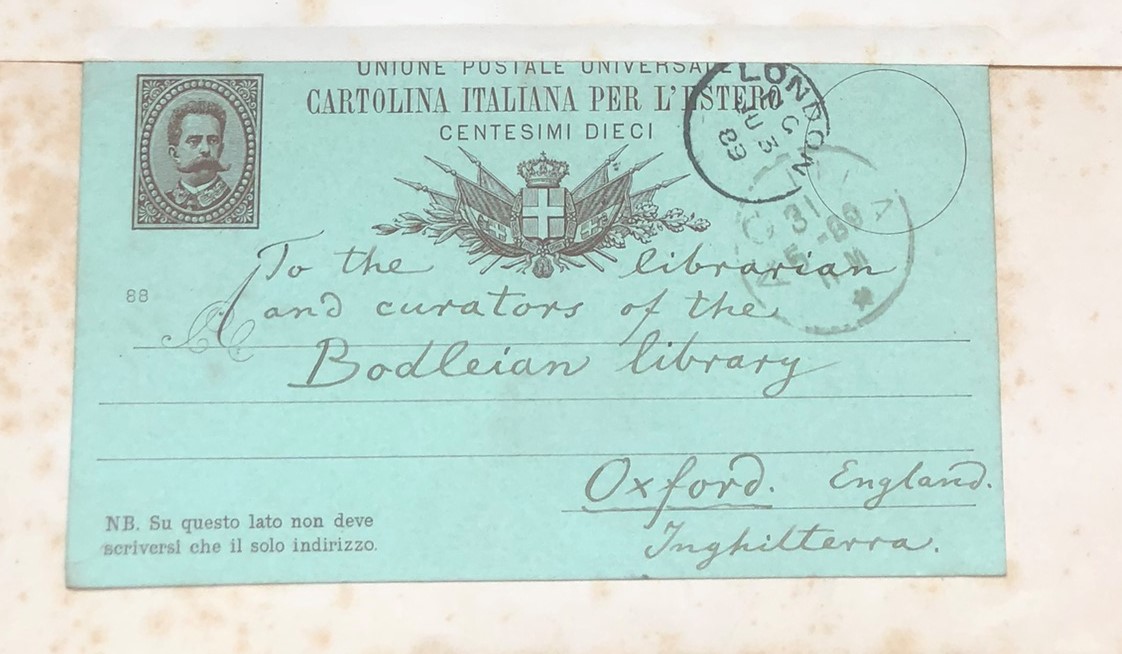
Issues 1-15 are bound together in the Bodleian copy, with Issue 25 loose and tucked in the same volume. Glued in the front of the volume is a postcard (front and back in the photos below) with a handwritten note from Ulrichs in Aquila, the Italian town (now L’Aquila) where he spent his final years, and where he composed all those issues of Alaudae:
“Dear Sir!
You have had the kindness (the 20 May) to thank me for having sent my little journal périodique Latin Alaudae I & II. With the present lines I would ask, the Bodleian library might accept an abonnement gratuit of Alaudae and, in consequence, accord me the honour to send, in quality of donum auctoris, also the following numbers.
Yours very sincerely,
Carlo Arrigo Ulrichs
Aquila degli Abruzzi
Italia
31 May 1889.”


Most of the readers of Alaudae were paying subscribers: the terms of subscription (in Latin, like everything else) precede every issue. What Ulrichs is offering the Bodleian here is a free subscription, a gift of the author, and he is committing himself, if the offer is acceptable, to sending “the following numbers”, which I take to mean all the issues to come.
I shan’t show all my workings, as that might get a bit dull, but from a combination of postmarks, accession notes added by Bodleian librarians, and in particular Ulrichs’ own elegant autograph inscriptions on some numbers, it emerges that Ulrichs fulfilled his generous offer up to a point, sending issues periodically in batches. Thus a postmark and half of a five-cent stamp (and all of King Umberto I’s substantial moustache) at the end of 2, plus the fragment of what I think is a newspaper wrapper (there’s another fragment of a newspaper wrapper attached to Ulrichs’ note; more on wrappers below), testify to Ulrichs’ posting of Issues 1-2 as mentioned on the postcard. (King Umberto was a bit of a philistine, incidentally. But Queen Margherita subscribed to Alaudae, as well as allegedly lending her name to a pizza.)

At the end of Issue 4 we find the same postmark, AQUILA (ABRUZZI), and in the newspaper itself, in Issue 3, there is a personal communication (Ulrichs likes to include such communications to subscribers & sim. at the end of his issues) to “E. B. Nich.” at the “Library of the University of Oxford”: Verba tua benevola accepi. Ecce hic, quod obtuleram, “I have received your kind words. Find here what I had offered.” Ulrichs seems to refer back here to his own note and its offer quoted above, while “Nich.” is Edward Nicholson, Bodley’s Librarian at the time, who has evidently replied to Ulrichs’ postcard. At the end of Issue 6 there’s another address and postmark, and accession notes by the library indicating that 7-8 arrived along with 5-6 (in Issue 10 Ulrichs records the Bodleian’s thanks acceptis lib[ellis] 5-8, “for the receipt of Issues 5-8”); at the start of 9 a very elegant address including Nicholson’s name (image at the top) accompanies issues 9-13; and again at the start of 14 (below) there is an indication that 14-15 are being sent, though accession notes indicate that 14-15 were sent before 9-13. Finally, 25 (also below), not bound with the rest, was apparently sent individually.
Were the other issues ever sent by Ulrichs? The accession of these issues was so meticulous at the Bodleian end (judging by the accession dates) that I doubt it. I can also understand why he might not have done. Ulrichs struck up productive relationships with readers in Spain, the US, Britain, Finland, Egypt, the Ottoman Empire and the Russian Empire, and much of his content is generated from material shared or sent by these contacts. There’s no evidence that I’ve yet encountered of anything similar with Nicholson or the Bodleian, so perhaps no strong reason for Ulrichs to keep the library in mind, more’s the pity.


One thing I have to develop in the next few months is a greater understanding than I can currently claim of postal habits at the end of the nineteenth century. (I seek the Bozi Mohacek of circa 1892 self-sealable pre-paid postcards.) I already know much more than I once did about newspaper wrappers, the means by which newspapers reached their intended destination, thanks to this video, and I was more delighted than I would ever have expected to be to find traces of such wrappers among these Bodleian issues.
Ulrichs has a special interest in matters postal, having written in the past about the postal service in his native Hanover, and being faced with a pressing need to despatch to the four winds a Latin newspaper on which, he calculated, the sun never set, so remarkably far-flung was its readership. This generates some exceedingly tricky passages as he translates contemporary postal realities into Latin, but also some excellent content. He recounts, for instance, the peregrinations of some Romanian newspapers sent him from Constanța, Ovid’s place of exile (he contrasts the existence of a statue of Ovid in Constanța with the lack of any such statue, in his day, in Ovid’s hometown of Sulmona, not far from Aquila, the regrettable neglect of Latin in contemporary Italy being a regular theme in Alaudae). The Romanian newspapers had been bound in two newspaper wrappers, with the address to “Aquila” written across both. When the wrappers became separated, and “Aqui” from “la”, the parcel went to Acqui (Terme), which is a very long way from Aquila.
We also hear of the wrapper for issue 17-18 (a single issue) arriving in Lima, New York without the newspaper, and then of the postcard sent to Ulrichs by the subscriber in Lima reaching Aquila via Bombay, having somehow been misdirected to the Indian Mail. That card had taken 68 days to get from New York State to Aquila, but in general the speed of the post from Aquila to Oxford at this time, and also the efficiency with which the Bodleian accessioned the material it received, if I’m interpreting correctly what I’m looking at, was impressive.
Ulrichs’ Latin addresses in full:
6: Alaudarum auctor: Carlo Arrigo Ulrichs, “The author of Alaudae, Karl Heinrich Ulrichs”;
9: Viris clarissimis bibliothecae universitariae Bodlejanae curatoribus, ad manus Viri Clarissimi Eduardi Nicholson, bibliothecarii, “To the most esteemed gentlemen, the curators of the Bodleian University Library, for the attention of the most esteemed gentleman Edward Nicholson, Librarian”;
14: Bibliothecae Bodlejanae universitatis Oxfordiensis; Misit D(ono) D(edit) D(edicavit) hasce duas Alaudas Alaudarum moderator, auctor, “To the Bodleian University Library of Oxford”; “These two issues of Alaudae have been sent, given and dedicated as a gift by the editor and author of Alaudae”;
25: Misit Alaudarum auctor, “Sent by the author of Alaudae“.
Do I need to add that encountering Ulrichs’ handwriting, both informal and calligraphic, and recognising in it that glorious eccentricity and charm that emerges from every issue of Alaudae; tracing in detail his dealings with Nicholson and the Bodleian; and gaining some sense at least of how he managed to broadcast his Latin newspaper from a tiny garret in Aquila to Mexico City, Madras and a remarkable number of places in between, is simply the kind of thing I became an academic to do?