Zeus in Tokyo
(July 2016)
 (Image from P. Bernard, “Quatrième campagne de fouilles à Aï Khanoum (Bactriane),” CRAI 113 (1969), 313-55, at 339.)
The foot is as beautiful as a foot can be, which it turns out is very beautiful. It is a left forefoot, strictly speaking, a piece of marble 21 cm across and 27 cm from its perfectly modelled toes to the strap of its sandal. “The sculptor worked well à la grecque,” wrote its excavator, Paul Bernard, “and I would go so far as to say, faced with the perfection of the work, that he could only have been Greek.” Yet it was found in the principal temple of Ai Khanum, a site beside the Oxus on the northern frontier of Afghanistan, and I am contemplating it in a display case in Tokyo.
It was unearthed in what had been the inner sanctuary of the temple. In a brilliant few pages of his report of the season’s excavations to the Academie des Inscriptions et Belles Lettres in Paris, Bernard, Director of DAFA, the French archaeological mission in Afghanistan, extrapolated from this fragment to the full statue. It was two to three times life-size, probably seated, and an “acrolith,” the head, hands and feet rendered in marble with the rest of the statue modelled in clay over a wooden framework. As for the god’s identity, the sandal he was wearing is decorated with a palmette, rosettes and a third symbol that offers a powerful clue, two winged thunderbolts at either extremity of the strap. Thunderbolts point to Zeus, chief of the Greek pantheon, perhaps as depicted on contemporary coins with a sceptre grasped in his left hand (fragments of the statue’s left hand seemed to be closed around something cylindrical,) and an eagle or victory in his extended right.
But this most Hellenic deity sat in a temple emphatically un-Greek in architectural form, and the ritual it hosted must have been comparably syncretic. This was Zeus assimilated to an eastern deity, the Iranian god Mithra most likely (coin images also give Zeus a solar crown, Mithraic iconography), but maybe the god of the river beside which he sat enthroned. Oxus was worshipped along his banks from the time of the Persian Empire up to and beyond the advent of Islam.
In its palpable Greekness the marble foot encapsulated one aspect of this remarkable, disorienting dig deep in Central Asia. The DAFA excavations at Ai Khanum extended from 1964 until 1978; the foot was found in 1968. What they had uncovered was “a Greek city in Afghanistan,” clear physical evidence, long but vainly sought by the French archaeologists, of a Greek presence in Central Asia in the aftermath of Alexander the Great’s campaigns in the fourth century BC. In fact it was more than just “a Greek city”, as the architecture of the temple already indicates, but Ai Khanum did offer remarkable insight into Greek colonisation of the east. Evidence of such Greek cultural staples as drama, philosophical dialogues and olive oil contributed to a picture of Greek colonists doing all they could to convince themselves they were still Greek, 2,500 miles from their homeland.
The foot of a syncretic deity, carved by a Greek in Afghanistan, has already covered some metaphorical distance. But this particular piece had a great deal further to travel. Its next stop was the National Museum of Afghanistan in Kabul, which by the 1970s, enriched by stunning discoveries at Begram (seemingly a merchant’s stock from the first century AD), Hadda (a series of richly embellished Buddhist monasteries) and Surkh Kotal (a dynastic cult centre of the Kushans, the dominant power in Central Asia in the first centuries AD) as well as Ai Khanum, had become one of the most celebrated collections in the world. (The National Museum of Afghanistan could also claim, refreshingly, that all its holdings originated in Afghanistan.)
In the anarchy of the 1990s, however, when the Soviets had evacuated Afghanistan and the forces of the anti-Soviet mujaheddin were fighting among themselves for control of the country, the museum found itself on the front line between government and opposing factions. The exhibits judged most valuable, including the “Bactrian gold” grave goods found at a nomadic burial site at Tillya Tepe in the late 1970s, were removed to secure locations in government buildings. Frantic efforts were made by staff and foreign volunteers to secure what remained in the museum, but the building was isolated, unstaffed, and hopelessly vulnerable to militias in need of funds.
One of the foreign volunteers, the architect Jolyon Leslie, described in the May 1996 issue of the SPACH newsletter (SPACH had been established to protect Afghanistan’s cultural heritage) the targeted nature of what followed:
“It is clear that once the news of the state of the Museum surfaced, the demand abroad for pieces from the collection, to a large extent, drove the looting. From the very beginning, it was evident that the intruders knew exactly what they were looking for. As the most portable objects (coins) and those of the highest value (including the ivories) disappeared, the looters have become ever-more audacious in their search for riches. Only months ago, a large schist Buddha (which we had presumed safe due to its weight) was hacked off the wall and spirited out of the lobby of the Museum overnight.”
Zeus’ foot was already long gone.
The logistics of transporting a solid stone sculpture from a warzone to a private collection in the developed world are complex, needless to say, but expertise was at hand. The bazaar in Peshawar, across the border in Pakistan, played a key role in the trade. International dealers had the contacts there, and were happy to shell out exorbitant sums to representatives of militia groups in the confidence that collectors in the West and Japan would give them a 100 per cent mark up. Export licenses were forthcoming from officials in various transit countries for the right price.
No doubt dealers and collectors consoled themselves with the thought that they were rescuing precious antiquities from the perils of war. As it transpired, they probably were: neither Zeus’ foot nor an image of the Buddha would have escaped the attention of the Taliban when they entered the museum with sledgehammers in February 2001. But back at source in the mid-1990s, the price fetched by an image of the Buddha was funding a savage conflict for control of Kabul.
Another item looted to order was a fine second/third-century AD relief, also solid schist, of the Buddha converting the Kashyapa brothers, staunch Brahmans sceptical of the Buddha’s new doctrine. It was excavated by a DAFA team at the monastery site of Shotorak north of Kabul in 1937, and stolen from the first-floor corridor of the museum on 31st December, 1992. It is a striking example of “Gandharan art,” the meeting of a Greek aesthetic and Buddhist worship. At the far right of this relief stand images of the couple, Kushan elite, who dedicated it. “The man, although wearing garments of Kushan style, has a Hellenistic cast of features,” we read in David Snellgrove’s great compilation The Image of the Buddha, “while the woman has adopted an entirely Greek costume,” striking evidence of the continuing “vitality of the classical tradition” half a millennium after Alexander.
The ultimate destination of this relief was Japan; Zeus’ foot and the Buddha mentioned by Leslie (unearthed by farmers at Sarai Khuja north of Kabul in 1965, and again second or third-century AD) soon followed it. An exhibition of the “Bactrian gold” and other material placed in secure storage before the looting began, has been circling the globe, in various guises, since 2006. When it came to the British Museum in 2011, the Sarai Khuja Buddha was restored to the National Museum of Afghanistan’s collection with some fanfare by an anonymous London dealer, who had purchased it from a collector in Japan. This year, when the exhibition arrived in Japan, it was supplemented by a small collection of items “rescued” from the antiquities market, some of which also originated in the museum in Kabul. They include fragments of wall paintings from the monastic caves at Bamiyan, stucco figures, the relief of the Kashyapa Brothers—and the star exhibit, Zeus’ foot. The publicity for the exhibition in Japan stated that with the conclusion of the exhibition in the Tokyo National Museum all these items, like the Sarai Khuja Buddha, would be restored to the National Museum in Kabul.
How Zeus’ foot made its way from the National Museum of Afghanistan to the National Museum of Japan is clear enough in outline, less so in detail. It appears that the dealer who secured it in Pakistan and sold it on to a Japanese collector was British. Thereafter we’re dependent on a narrative that was first pitched in 2001 and to which the literature of the exhibition in Japan adheres very closely: it was the passion and commitment of one man, Ikuo Hirayama, that recovered these pieces from private ownership. Hirayama was a successful and wealthy nihonga (neo-traditionalist) painter. A native of Hiroshima, he was a hibakusha, survivor of the Bomb, and as well as that formative experience, his art reflected both a deep Buddhist faith and a personal interest in the origins of Japanese Buddhism. Afghanistan in the Gandharan period had a special place in Hirayama’s affections, a critical stage in the transmission of Buddhism to east Asia, and hence (to Hirayama’s mind) the source of much of what made Japan what it was. Bamiyan with its giant Buddhas, first visited by Hirayama in 1968, was a particular focus of his interest and a regular subject of his painting. His model and inspiration was the seventh-century Chinese monk Xuanzang, who travelled to India in pursuit of sacred texts and left us the first and fullest account of Bamiyan when it was still Buddhist.
Hirayama was a generous benefactor, reflected in the Hirayama Conservation Studio at the British Museum, which specializes in the preservation of Asian paintings, funded by Hirayama and the Five Cities Art Dealers Association of Japan. In Tashkent, Uzbekistan one can visit the Ikuo Hirayama International Caravanserai of Culture. The Ikuo Hirayama Silk Road Fellowship Program supports academic research. He enters the saga of Zeus’ foot when, in 2001, he established the Japan Committee for the Protection of Displaced Cultural Properties, its aim to safeguard art and antiquities displaced by conflict from their country of origin, with Afghanistan again the focus. The Committee collected a total of 102 artefacts smuggled out of Afghanistan with a view to returning them to Afghan ownership. Now in 2016 (Hirayama died in 2009) 15 of these illicitly trafficked antiquities are on display alongside the exhibition in the Tokyo National Museum, the foot among them, and the promise of repatriation is finally, it seems, to be honoured. [It was: in August 2016 the foot and other artefacts were returned to Kabul.]
What complicates this picture is that Hirayama was also a collector, and a voracious one. Two private museums in Japan survive him, one near Hiroshima concentrating on his painting, and another, the Hirayama Ikuo Silk Road Museum in the mountains of Yamanashi Prefecture, which showcases his collection of artefacts from the Silk Road. The Gandharan material he managed to collect is of staggeringly high quality, quite comparable to the holdings of famous national museums, though only a fraction is on display in his museum.
As for the sources of his collection, some of it must originate in illicit digs, and some of it must come from Afghanistan: the lack of provenance makes it hard to be certain. The sculptures are exquisite but deracinated, strictly objets d’art in the absence of any information about the monastic environment for which they were created. Zeus’ foot is of course a vastly richer survival for the ritual context in which Paul Bernard and his team were able to set it. Nor is it self-evident by what principle the items in the Tokyo exhibition are being returned to Afghanistan, even though some of them did not originate in the National Museum, while ostensibly Afghan pieces in Hirayama’s private collection are not.
We are informed that Hirayama secured these items from Japanese collectors or dealers, but that no money changed hands. The aim is presumably to distance the operation from the antiquities market, but it’s hard to know how else it could have been managed. In any case, it all rather presupposes an expert understanding of the trade on Hirayama’s, or his advisers’, part: only a seasoned collector could have had the requisite connections or access. The exculpatory psychology, however, is familiar enough. Dealers and collectors of antiquities, like the rest of us, need to see their activities as culturally beneficial, protective rather than acquisitive. Given recent Afghan history, artefacts from that country have been especially easy to style as recipients of cultural rescue, and collecting as disinterested guardianship: the date of the establishment of the Japan Committee for the Protection of Displaced Cultural Properties, 2001, when the Buddhas of Bamiyan were blown up and antiquities that remained in the National Museum smashed by Taliban, was, a cynic might suggest, an excellent moment for dealers and collectors to present themselves as heroes. Nevertheless, Hirayama’s work on behalf of these “cultural refugees”, as he called them, brought him honours from UNESCO; and by his good offices Zeus’s foot, lost without trace since its theft from Kabul, was exhibited in Tokyo in the same year, clearly identified as a piece of Afghan cultural heritage.
If the ethical contradictions of collecting are on display in Tokyo, a more profound oddity of the commercial network in which Zeus’ foot was caught up is captured by a simple glance at a map of the Eurasian landmass. At one extreme is London, base of the dealer who apparently sold it; at the other, Japan, where he, and other dealers, found a ready market. Equidistant between the two, four thousand miles from each, lies Afghanistan. A market of course entails a taste for an artistic style. In the West Gandharan art commands top dollar at major auction houses, but the source of its appeal deserves greater attention. When Kipling, early in Kim, describes Gandharan sculpture in the Lahore Museum, “done, savants know how long since, by forgotten workmen whose hands were feeling, and not unskilfully, for the mysteriously transmitted Grecian touch,” he captures the thrill that Europeans found in Gandharan art, like Ai Khanum a beguilingly displaced piece of the familiar. As such, the Raj collectors of Gandharan buddhas, whose heirs donated them to British museums, were part of a larger colonial phenomenon, the identification in the traces of the Greek presence in north-west India of a charter myth justifying their own presence in a space where Europeans—and the archetypal European, Alexander—had left so potent a mark before them.
To find, as one does, that Gandharan art possesses a comparable mystique in Japan is thus intriguing, and nowhere embodies the phenomenon better than Hirayama’s own museum in Yamanashi. The visitor literature insists on the relevance of this material to Japanese identity: talk of origins is much in evidence. Hirayama’s trips to Central Asia, and Afghanistan especially, were undertaken “in search of the sources of Japanese culture”; the Silk Road art showcased here, Gandharan especially, illustrates how “what we now proudly call Japanese culture has been blessed with the cultures of many other countries.” Elsewhere Hirayama had described his first visit to Afghanistan in 1968, “to seek the origins of Japanese culture and to follow the way that Buddhism diffused” out of India and towards Japan. The physical setting of the museum reinforces this message. The Yatsugatake mountains around the museum, according to the pamphlet, were one of the centres of the prehistoric Jomon people, “the origin of Japanese Culture.” Most strikingly of all, the Hirayama Ikuo Silk Road Museum is so orientated as to capture from its upper terrace a perfect view of Mount Fuji, for Japanese and non-Japanese the ultimate symbol of the country. The implication is that art from Central Asia belongs, somehow, in Japan.

Hirayama’s tastes were his own, but his preoccupation with Afghanistan reflects a wider Japanese interest in central Asian art and history. This is not independent of western cultural tastes, but is additionally motivated by Japan’s perception of its special relationship with the early Buddhist cultures of Asia. Since the Second World War this has driven an active humanitarian engagement with Afghanistan, but also archaeological activity. The focus of Japanese archaeologists has been Buddhist sites, although far from limited to them, and Bamiyan in particular. A project by Kyoto University in the 1970s, led by Professor Takayasu Higuchi, created a comprehensive photographic record of the site of Bamiyan, with its hundreds of monastic caves dotting the cliffs around the giant Buddhas. This, needless to say, has proved a precious resource since 2001, and indeed Japan was of all countries the most active in trying to dissuade the Taliban from destroying the Buddhas of Bamiyan.
The trade in Gandharan art is the dark side of this academic involvement, and the symmetry with the West again arresting. Perhaps inevitably, Japan’s taste for Gandharan art encapsulates in its own way the country’s modern history, a process involving both intense emulation of the industrialized West and energetic assertion of a unique Japanese identity. Insisting on Japan’s obligation to assume a leading role in safeguarding Asian cultural properties, Hirayama had asserted that “Only Japan can carry out such a task because it has close spiritual and cultural ties with Asian countries. Western countries cannot do that job.” One might counter that the Japanese attachment to Afghanistan, at any rate, is every bit as wishful and romantic as the western; it’s just that Alexander the Great has given place to Xuanzang.
We should be grateful that Zeus’ foot is returning to Afghan ownership, by whatever means, and applaud UNESCO’s pragmatic approach to the problem. As for the deeper reasons for the travels and travails of this particular antiquity, at the root of its discovery by French archaeologists at Ai Khanum, no less than its adventures in the international art market, is the aesthetic appeal of the fusion of east and west in a Gandharan Buddha, or in Zeus-Mithra’s foot. I for one travelled all the way to Tokyo to see it.
 Back home in the National Museum, Kabul in August 2016 (photo courtesy of Zardasht Shams)
Exsecratio

Some flamens, photo by Sophie Hay
A curse is a spooky enough topic for Christmas, I reckon. But this blog about curses (exsecrationes in Latin) is really for me to get some thoughts straight in my head. I am still investigating a Roman priest known as the flamen dialis, a priest of Jupiter (as I touched on here, a strange figure who could be considered a kind of animate statue of the god), and one thing I want to understand better is how this priesthood was regarded during Augustus’ reign. (All ultimately with a view to deciding on a possible role for it in Virgil’s Aeneid, but that’s another matter.)
The most important thing to appreciate about this priesthood and Augustan Rome is that for the first half of Augustus’ reign there was actually no flamen dialis in post. This office, a crucial intermediary between Rome and its most powerful patron, the chief god Jupiter, had remained unoccupied since the death by his own hand of the flamen L. Cornelius Merula in 87BC. My assumption is that the absence of the flamen dialis from Rome was a cause of significant anxiety: the Romans were deeply superstitious people, setting great store by the pax deorum, the harmonious relations between them and their gods which could only be maintained by meticulous observation of their religious obligations.
If maintaining this special relationship with the divine realm was a priority, it was because the favour shown their city by the gods was for Romans the best explanation of their rapid rise to power in Italy and the wider Mediterranean. Equally, however, when their fortunes turned sour, and Rome shifted from seemingly unlimited expansion to a traumatic century of internal conflict (only finally brought to an end by Augustus), the Romans could only conclude that they had somehow offended the gods, and this was their punishment. A key element of Augustus’ project to restore Rome after this crisis was mending this all-important relationship, renovating temples, restoring neglected religious practices, in general returning Rome to what he could claim to be the lifestyle that drew the gods’ approval in the first place.
In the event, a new flamen dialis, Ser. Cornelius Lentulus Maluginensis, was at length appointed in (probably) 11BC, shortly after Augustus had finally secured the role of pontifex maximus for himself. The pontifex maximus or chief priest was responsible for selecting the flamen dialis (though he was also subordinate to the flamen in status, interestingly enough), but Augustus had had to wait to assume the role of pontifex until the death of the previous incumbent, the humiliated and sidelined former triumvir M. Aemilius Lepidus. A natural reading of this sequence of events would be that one of Augustus’ very first acts on becoming pontifex maximus in 12BC was to fill the yawning gap in Rome’s religious fabric, the office of flamen dialis. But there is some debate about the date of Maluginensis’ appointment, and the order of events is not so certain.
My hunch, as I’ve suggested, is that Rome could not bear the absence of such an essential religious figure with equanimity; and that when Augustus did select a new priest of Jupiter, a lifetime after the last flamen dialis had died, it would have been a very impressive gesture, a powerful contribution to the climate that Augustus sought, a perception that Rome, after all the trauma of the Civil Wars, was back on its feet; a profound crisis on the divine plane had been resolved.
Merula, the last flamen dialis, had been a particularly prominent victim of those wars, and that’s really all I need to have to argue for the research I’m doing. But an article by Bernadette Liou-Gille (“César, ‘Flamen Dialis destinatus’,” Revue des études anciennes 101 [1999], 433-459, to which I was alerted by Professor Roberta Stewart) opened up a new and weirder dimension to this story.
Liou-Gille is interested in the circumstances and immediate aftermath of Merula’s death in 87BC. The context is the furious rivalry for control of Rome between L. Cornelius Sulla and L. Cornelius Cinna, the latter supported by the great general C. Marius. In simple terms, Cinna, who was consul, had been driven out of Rome, and Merula, the flamen dialis, had been appointed consul in his place (Professor Stewart suggested to me, because no one would dare to harm a hair on the head of the priest of Jupiter). When Cinna and Marius proceeded to recapture the city, Merula resigned the consulship, and then, faced with efforts by Cinna to bring him to trial (Appian, BC 1.74), took his own life.
The most detailed account of his death is by Velleius (2.22.2):
Merula autem, qui se sub aduentum Cinnae consulatu abdicauerat, incisis uenis superfusoque altaribus sanguine, quos saepe pro salute rei publicae flamen dialis precatus erat deos, eos in exsecrationem Cinnae partiumque eius tum precatus optime de re publica meritum spiritum reddidit.
Meanwhile Merula, who had resigned his consulship in anticipation of the arrival of Cinna, slit his veins and drenched the altars with his blood, praying to the gods, to whom he had often as flamen dialis prayed for the wellbeing of Rome, to curse Cinna and his party. In this way he yielded up the life that had served Rome so well.
After that (and this is the main focus of Liou-Gille’s article) a teenage Julius Caesar (who was close to Cinna, married to his daughter, and a nephew of Cinna’s ally Marius) was designated flamen dialis in Merula’s place, but never actually assumed the priesthood, no doubt mainly because both Cinna and Marius were dead within a short time, and when Sulla recaptured Rome at the end of 82BC he promptly rescinded all the measures they had taken.
Liou-Gille takes Velleius’ account of Merula’s death literally, not as a historian’s rhetorical flourish: as Merula died, he drew down a curse upon his enemies, offering his own life to the gods in return for divine punishment of “Cinna and his party”. The way Velleius puts it suggests a polar reversal of the flamen‘s power, from promoting the good fortune of the Roman res publica to becoming an agent of vengeance. The effort to make Caesar flamen dialis in Merula’s place, Liou-Gille argues, was actually an attempt to neutralize the malign influence of this exsecratio, to mend relations with the hostile gods by making a close confederate of Cinna the priest who devoted himself to serving Jupiter.
I think what I like most about Liou-Gille’s reading of these events is her assumption that Romans, including the notoriously cerebral Julius Caesar, were motivated by superstition, by a genuine terror of the gods. It’s easy to misjudge the Romans, by some of the things put on paper by Cicero or Ovid, as rational types whose religion was lightly worn. But in fact it was their scepticism that was only skin-deep.
Caesar never did become flamen dialis, and perhaps Sulla had particular reason to block his appointment: Sulla was undoubtedly a superstitious man, and he had no interest in diverting the wrath of the gods away from his enemies. But my particular interest, as I say, is how all this might have looked from the standpoint of Augustus’ principate, sixty or seventy years after Merula’s death. In other words, what are the implications of a hiatus in the office of the priest of Jupiter that lasted for a human lifetime, and might entail a curse still unpropitiated twenty years into the Pax Augusta? Certainly the lack of a flamen dialis cannot have increased Romans’ sense of security. But if we do suspect that Merula’s curse still exerted an influence, at whom would that divine wrath at “Cinna and his party” be directed in the Augustan age? The least we can say is that, if Julius Caesar had felt himself a target, it was in important respects Caesar’s legacy that was embodied by Augustus. Augustan Rome not only lacked that hotline to its greatest benefactor, Jupiter Optimus Maximus, then; it could also not be confident that Merula’s ancient curse was not still targeted at them.
Well, I’m very sure that Augustus’ appointment of a flamen dialis in 11BC was more than just a piece of political theatre. In the absence of a flamen dialis for over half a century (and what a dreadful half-century it had been), Rome had lacked a fundamental means of maintaining relations with the gods, the bedrock of its success as a nation. Until that rupture was healed, Rome’s recovery under Augustus’ direction could never be complete.
As for the rest of it, I can’t be so sure, but it would seem to me very true to the Roman mindset if something altogether more primitive was in play, the raw dread provoked by a ghastly death and priestly imprecation generations before, a suspicion that the gods’ wrath at their appalling crimes, the bloodletting of the Civil Wars encapsulated by the death of Merula, persisted, unappeased. For as long as the role of Jupiter’s “animate statue” remained unoccupied, Rome was still cursed.
Merry Christmas!
Vulgaria

Photo courtesy of Sophie Hay
Two thoughts on Roman city dwelling here, first shared a couple of years ago, retooled for the world of COVID-19. They originate in a weekly graduate seminar I was helping to coordinate on Ovid’s Epistulae ex Ponto 4, the very last poems composed by Rome’s second- or possibly third-greatest and most influential poet, and some research I was doing on Aeneas and Roman priesthoods, forthcoming later this year in Classical Quarterly (a publication on Ovid is on its way, too, feel free to pre-order). So what follows concerns a passage that particularly struck me from Ex Ponto 4.9 and a piece of priestly equipment I had hitherto not been aware of. The common factor is something like personal space and keeping one’s distance.
The city of Rome was loud, smelly and crowded: Horace talks of the beatae/ fumum et opes strepitumque Romae, “the smoke and riches and hubbub of prosperous Rome” (Odes 3.29.11-12). One’s capacity to enjoy a comfortable existence within it essentially depended on one’s wealth and class. The satirist Juvenal gives a splendidly exaggerated account of what it was like for the little guy (3.243-8):
nobis properantibus obstat
unda prior, magno populus premit agmine lumbos
qui sequitur; ferit hic cubito, ferit assere duro
alter, at hic tignum capiti incutit, ille metretam.
pinguia crura luto, planta mox undique magna
calcor, et in digito clauus mihi militis haeret.
“As I hurry along, the wave ahead impedes me/ and the people that follow me in a massed rank crush my kidneys./ One smacks me with his elbow, another with a hard pole./ This guy bashes my head with a beam, that guy with a wine cask./ My legs are caked with mud, and now I’m trampled by huge feet on every side,/ and a soldier’s hobnail boot is planted on my toe.”
The rich man, according to Juvenal, avoids all this hassle by riding in a litter the size of a ship, and reads or writes or even sleeps as he’s effortlessly conveyed over the crowd.
Another way of keeping your distance from other people was the commoetaculum, an item that might be of some considerable use in our current circumstances. You can see a commoetaculum, a kind of wand, in the hand of the figure in the middle of the image at the top: the man holding it is a flamen, a variety of Roman priest, and may well be the most important flamen, the flamen Dialis who was the priest of the chief god Jupiter.
The flamen Dialis and his wife the flaminica (the priesthood really consisted in the family group as a whole) were obliged to live a life that segregated them from the rest of humanity. Their lives were dedicated to the gods they served, to the extent that they came to be regarded as offerings to the god or as their embodiments on earth: the flamen Dialis was “a sacred and animate statue” of their deity, as Plutarch memorably puts it (Roman Questions 111). Other taboos laid on the flamen (we typically hear more about him than the flaminica), a prohibition on oaths, on knots in his clothes, on seeing humans at work, all served to distance the priest from the domain of profani, ordinary people, and to make him sacer, sacred, the possession of the gods.
The commoetaculum was a practical aide to this end: people were kept at a physical remove from the priest with a judicious prod of his wand. There might not seem an obvious class dimension to all this, except that the character of this priesthood was felt to reflect in important ways the behaviour and lifestyle of the ancient elite of Rome, a kind of ideal original family. You could only be flamen or flaminica Dialis if you were a patrician, a member of the ancient Roman aristocratic class, and if you and your parents and your spouse’s parents had all been married by an arcane ritual called confarreatio, a ceremony that was again restricted to the patrician class. So there is in fact a very aristocratic quality to this implement designed to maintain a proper distance between a Roman of high status and the general populace.
Ovid was posh, too, perhaps the most socially elevated of all the Roman poets. But by the time he was writing Ex Ponto 4, he couldn’t afford such scruples. Ovid has been banished, partly for obscure reasons seemingly related to conspiracies against Augustus, and partly for his risqué poem The Art of Love, to the edge of the Empire, Tomi on the Black Sea in modern Romania. A consistent theme of the poems he writes back to men who might help him overturn or mitigate his exile (superbly crafted and moving poems, as I’ve also suggested before) is how desperately he misses his home city. In general Roman authors could always conjure up a bit of ambivalence about Rome, as we’ve seen. Ovid had no such qualms, delighting unapologetically in the vibrant society and culture of Augustan Rome.
To send such a man away from Rome was unusually vindictive, and that’s no doubt partly why Augustus did it. In exile Ovid dwells obsessively on the city from which he is banned, to the extent that, as a colleague put it during the seminar, we get a lot more detailed information about the city of Rome from Ovid far away on the Black Sea than we do from authors actually domiciled there.
In Ex Ponto 4.9 he celebrates the consulship won by Pomponius Graecinus, another old associate he hopes will be able to make his case with the Emperor (Tiberius by now, as Augustus had recently died; but Tiberius proved no more sympathetic). Ovid imagines being on the spot as Graecinus goes through the elaborate ritual of inauguration, and it could not be more different from that fastidious priest with his pointy stick (4.9.21-8):
nec querulus, turba quamuis eliderer, essem,
sed foret a populo tum mihi dulce premi.
prospicerem gaudens quantus foret agminis ordo
densaque quam longum turba teneret iter,
quoque magis noris quam me uulgaria tangant,
spectarem qualis purpura te tegeret.
signa quoque in sella nossem formata curuli
et totum Numidi sculptile dentis opus.
Nor would I complain, though bruised by the crowd;/ at such a time it would be pleasant to feel the crush of the people./ I would behold with joy how long was the line of the procession/ and how dense the throng all along its route./ And that you may know how trivial things appeal to me,/ I would examine the texture of the purple you wear./ I would even inspect the figures carved on your curule chair,/ all the sculpted work of Numidian ivory.”
What “touch” (tangant) Ovid are uulgaria, a wonderfully suggestive word: trivial things, ordinary things, popular things. Ovid the toff rejoices here in exactly what Juvenal would later complain so bitterly about, getting manhandled by crowds, emerging physically battered from a walk through the city. But it is the touch, the sensation of Rome that Ovid yearns for: Graecinus’ consular robes with their purple border, and the ivory carvings on his official consular chair–in his imagination Ovid seems almost to be running his fingers over them. He cannot get enough of the city of Rome, cannot get too close to it.
But the poem to Graecinus may be the very last poem that Ovid ever wrote. This Roman never did emerge from his confinement.

The late, lamented P. Ovidius Naso
Very, VERY busy this term, and no time to blog. But one of the things making me busy is at least a pleasure to do, and that’s a graduate seminar on a book of Ovid’s exile poetry: Epistulae ex Ponto 4. This was the last book of poetry written by Ovid from exile, and thus the last poetry issued under his name, its sixteen poems ranging in date from AD 13 to 16, shortly before the poet’s death, in Tomis, modern Constanța in Romania, far away from the Rome for which, in five books of Tristia and four books Ex Ponto, the exiled poet had since AD 8 expressed his yearning.
My colleague, once upon my time my tutor, Stephen Harrison has done almost all of the organising of this seminar, and for an hour and a half every Thursday morning a mixture of graduates and teachers ponder the last poetry of perhaps the most influential of all ancient poets. Ovid’s exile poetry has always had a bit of an image problem, encouraged by Ovid himself, who constantly insists that his talents are on the wane in exile (he’ll be a much better poet if restored to Rome!). But what we’ve found ourselves reading in the last few weeks are as sophisticated as anything Ovid wrote, or so it seems to me. And something else: Ovid’s swan songs can also be extremely moving in their evocation of the experience and psychology of a Roman exile.
This last week we were looking at Ex Ponto 4.8, a poem addressed to the husband of Ovid’s step-daughter, P. Suillius Rufus, through whom Ovid also makes an appeal to Germanicus, by now (it is shortly after the death of Augustus in AD 14) heir apparent to the imperial throne. There is a Latin text and a translation of Ex Ponto 4.8 here.
I don’t think there’s anything I enjoy more than reading Roman poems for the first time, especially when they’re good. I need to keep this short (I’m still perfecting the art of writing a blog in two hours on a Sunday morning), but here are four thoughts I had about this poem when I first read it last Wednesday night, in the hopes they’ll illustrate some of the qualities I find in Ovid’s last poems.
Fine composition in the opening
The poem opens with the information that Suillius has written to Ovid, thereby providing Ovid with the pretext to write an answer in the shape of this poem. He begins,
Littera sera quidem, studiis exculte Suilli,
huc tua peruenit, sed mihi grata tamen
(“The letter you wrote, accomplished Suillius, was late/ in reaching here, but brought me pleasure.”) The lines contain a clear note of reproach: the letter Suillius wrote is welcome, but he took his time to write it. And Ovid subtly reinforces both the lateness (sera quidem) and the welcomeness (mihi grata tamen) of his son-in-law’s letter in his word placement: tua, “your”, is delayed until the second line, and placed next to huc, “[to] here.” This is Ovid exploiting the vastly more flexible word order of an inflected language (an English translation just can’t capture it): the displacement of key words portrays the arrival of the letter (in the juxtaposition of huc and tua), but the peculiar separation of tua from the noun it qualifies, littera, also conveys what a very long time it took to get to Tomi.
A vintage piece of Ovidian wit
By the time we get to lines 35-6, Ovid has moved from addressing Suillius to addressing Germanicus: strictly speaking, he’s telling Suillius what Suillius should in turn say to Germanicus, but it very quickly turns into a direct address to Germanicus (and after a while we probably forget he’s writing to Suillius at all). Here Ovid is asking Germanicus to relieve the harsh conditions of his exile. He will repay any kindness with all he can offer in return, his poetry, but in the presence of this powerful man he is self-effacing about its comparative value:
Parua quidem fateor pro magnis munera reddi,
cum pro concessa uerba salute damus.
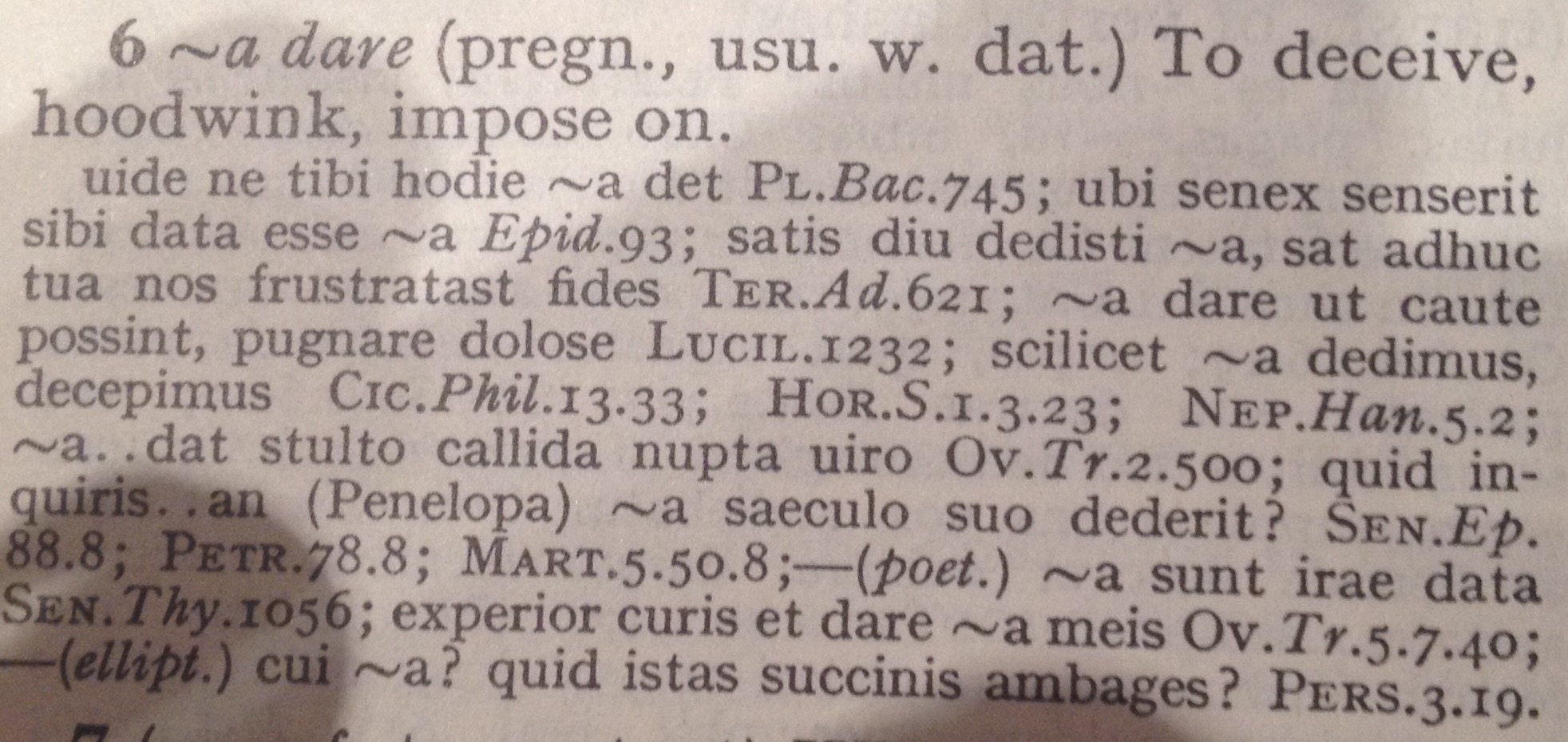
(“Small indeed, I confess, is the gift given in return for great kindness,/ when I give words in return for a grant of salvation.”) “I give words” (uerba damus) is already an unglamorous way to describe writing poetry (no mystical inspiration here), but the expression uerba dare has another meaning (see the image at the top, from the Oxford Latin Dictionary), to cheat or swindle. Ovid is implying that poetry can only represent a dishonest exchange for tangible kindness, and that is quite typical of how sceptical this superlative poet became about the value of poetry after his exile. Clever, then, but also rather sad.
A bold illustration
By 51-4, Ovid has warmed to his theme, and is making more confident claims to Germanicus about the capacity of poetry. While physical memorials moulder, he insists, poetry, and the praise of men it contains, persists for all time. (Which happens, in this case, to be true.)
Scripta ferunt annos: scriptis Agamemnona nosti
et quisquis contra uel simul arma tulit.
Quis Thebas septemque duces sine carmine nosset
et quicquid post haec, quicquid et ante fuit?
(“Writing endures the years: through writing you know of Agamemnon,/ and whoever bore arms against him or with him./ Who would know of Thebes and the seven leaders if not for poetry,/ and whatever went after that, and before it?”) There is clarity in the first and third lines here: we are aware of two very specific mytho-historical phenomena, Agamemnon and the Seven against Thebes, because of poetry. But the second and four lines are as nebulous as the first and third are precise, and it seems to me that Ovid is provoking his readers (Germanicus especially, he hopes) to imagine how things would be without poetry: his vague “whoever” and “whatever” might be their state of knowledge about iconic stories like the Trojan War and the events surrounding the attack of the Seven. But in fact they had the Iliad to inform them of the first, and Sophocles among others to fill in the second (in Oedipus Rex and Antigone). In other words, we read the second and fourth lines, and in discovering that we can, in fact, fill in the blanks that Ovid leaves, we realise forcefully that it’s only poetry that makes it so.
Finally, real pathos
Ovid’s reputation is as a poet very good at provoking laughter, but too irreverent to be capable of pathos. But I’ve been regularly moved reading Ex Ponto 4, and the end of this poem is an example. My colleague Gail Trimble was leading the discussion of this part of the poem on Thursday, and described the last two lines as Ovid abruptly remembering that he’s writing to Suillius, not Germanicus. That’s spot on, I think. After 30 lines addressed to Suillius, and 58 to Germanicus, it is only in the very last couplet, almost as an afterthought, that he turns back to Suillius again:
Tangat ut hoc uotum caelestia, care Suilli,
numina, pro socero paene precare tuo.
(“That this prayer may touch the heavenly powers, dear Suillius,/ pray on behalf of him who is almost your father-in-law.”) This is Ovid standing back, and capturing his own psychology. He was so carried away with his desperate appeal that he forgot he wasn’t talking directly to Germanicus, only to Suillius. At the very end, though, all the more effectively for being unexpected (we have forgotten too), he remembers, and the return to reality is poignant. So far from being anything Germanicus may ever hear, let alone respond to, all this is just what Ovid hopes Suillius will communicate to him. And even Ovid’s power to influence Suillius in placed in doubt here: through the paene that Ovid drops into the final line, he is only nearly, not really, Suillius’ father-in-law.
It’s the same tenuous thread linking Ovid to his beloved Rome that we started with, a letter that came, but came late; a source of support that may not feel as much responsibility as the poet passionately wishes he would.
Cat people
The undigested thoughts that follow are provoked by a rare trip to Wales last week, on the one hand, which had me thinking about my dad, and on the other by this moving BBC report about Mohammad Alaa Aljaleel, who runs a shelter for abandoned cats in the besieged city of Aleppo. Part of me watching it was thinking, “Typical: to get people to care, show them anything but the real human cost.” But one detail of the report clarified that this fluffy animal story was, actually, all about the human tragedy of Syria. Aljaleel explains how a little girl had brought her cat to him before her family fled to Turkey, and how she begs for news about the cat, and Aljaleel sends her photos by phone.
That girl may just be missing her cat. But cats and dogs stand in very easily for family and domestic life, and at some level I’m sure that in her anxiety about her cat, the girl is also expressing the pain and dislocation of having had to leave her home. When she gets her beloved cat back, God willing, she will be back home again, life will be as it was, and she can resume her childhood.
That, combined with my day in Wales, reminded me of a story that my dad used to tell. It is the early 1920s, and he and his parents (he is only 2) are moving house, from a tenancy at Llanfihangel Aberbythych, near Llandeilo in Carmarthenshire, to a freehold farm in Newport Pagnell, Bucks. My grandparents were Welsh-speakers, and I’ve always felt that this relocation in the 1920s was not so different, in terms of the experience of the migrants, from more recent immigration from further abroad.
My dad’s story also involved the family cat. When the Morgans were setting themselves up in Newport Pagnell, the cat went missing, and turned up months later back in Llanfihangel, 150 miles away.
Now, I’ve no reason to disbelieve that the cat did in fact make that journey back to Carmarthenshire. There are plenty of parallels, both cats and dogs. But leaving aside the truth value of the story, it seems to me that this is a clear-cut piece of mythologising, in the sense that if myth is essentially just the expression of beliefs or attitudes in symbolic terms, then this oft-repeated story is the Morgan myth of migration: the cat rejecting the new home in England embodies the deep anxieties its human family felt about leaving that home for a very different kind of place.
It may be more personal than that: my dad remembered being very unhappy indeed about leaving Wales, especially missing Mamgu, his grandmother, who had stayed behind in Llanfihangel. Another story he told was about his own attempt to return to Wales, at the age of three. He didn’t get very far (though far enough to freak out his parents), but again it makes sense that the idea of the cat succeeding in getting home was so important to him because it did what he couldn’t.
The peripatetic pet: just a good story, or a proxy for our deepest human feelings about home and family? Pity the jackhuahua owned by an academic.
Horace on living
A rapid post, this, and topical in a way I wouldn’t have chosen.
I love the Latin language. I struggle to explain why. Something to do with its brevity, and the scope an inflected language gives to shift words around for maximum effect.
No Roman poet exploited these inherent characteristics of Latin more effectively than Horace, and a poem like Horace, Odes 3.29 has it all for me, and not just for me: formal beauty allied to profound ethical truths. I like this poem so much that when I fell over an inscription of a line of it at a charity auction once, I parted with rather a lot of money. Latin and stone go so well together.

There is so much that’s great about 3.29: the way Horace expresses the unpredictability of life through an image of a river in spate, his description flowing river-like from stanza to stanza; the image he uses to express a proper indifference to misfortune: “I wrap myself in my virtue,” he says, mea/ uirtute me inuoluo, as if virtue were a warm and waterproof coat.
But my very favourite thing in 3.29 is a single word, uixi, “I have lived,” at line 43. It is perfectly chosen and perfectly placed, and it represents the key principle of the poem’s philosophy.
Here are the two stanzas around it, with a translation much indebted to David West. Horace is explaining that what matters is the present moment, living life in the here and now. We cannot influence what the future will bring, but if we have lived life to the full when we can, what happens in time to come is of no significance.
… ille potens sui 41
laetusque deget, cui licet in diem
dixisse “uixi.” cras uel atra
nube polum pater occupato
uel sole puro. non tamen irritum 45
quodcumque retro est efficiet neque
diffinget infectumque reddet
quod fugiens semel hora uexit.
A man will be in control of his life
and happy, if he can say at each day’s end
“I have lived.” Tomorrow Jupiter can
fill the sky with black cloud
or with pure sunlight, but he will not cancel
whatever is behind,
nor reshape or unmake
what once the fleeting hour has brought.
Horace’s poem is written in a verse form called alcaics, a metre in four-line stanzas which Horace had inherited from the archaic Greek poet Alcaeus, but given a character all his own. Horatian alcaics have a very clear dynamic: in broad terms, there are two identical lines followed by a third that slows the flow of the poetry, and a much faster fourth. What creates the impression of drag in the third line is mainly its contrast with the previous two. The first two lines normally have a word break, a pause or caesura, after the fifth syllable, but while the third line starts off as if it is going to follow the same pattern, it then pushes on without a break. The second stanza here is typical: uel sole puro//, quodcumque retrost// in the first two lines, but diffinget infectumque in the third, no break until after the seventh syllable.
In slightly more technical terms, here is an alcaic stanza, with _ marking a long syllable, u marking a short, and // marking the normal/expected location of word breaks:
_ _ u _ _ // _ u u _ u _
_ _ u _ _ // _ u u _ u _
_ _ u _ _ _ u _ _
_ u u _ u u _ u _ _
The things to notice are the identical shape of the first two lines, and the way the third line also begins the same way, but has no break after the fifth syllable. Horace has a habit of placing in the middle of the third line a word needing emphasis, or suiting in other ways this expansive position. Here is an example from earlier in Odes 3.29 (ll. 9-12), where Horace urges Maecenas to abandon his obsession with the city of Rome, and join him for drinkies in the country:
fastidiosam// desere copiam et
molem propinquam// nubibus arduis,
omitte mirari beatae
fumum et opes strepitumque Romae.
Leave behind cloying abundance and
that pile that reaches to the high clouds,
stop admiring
the smoke and riches and racket of wealthy Rome.
In the first two lines there are word breaks after the fifth syllable. The word set in that expansive centre of the third line is mirari, “admire,” “wonder at,” and the placement is very effective: we dwell on Maecenas’ obsession with the city as he indulges his obsession. Meanwhile the frantic fourth line well suits the distracting sensory chaos of the big smoke. Given that practically all of Horace’s alcaic stanzas follow this dynamic of expansive third line and skittery fourth, of course, any exception becomes eye-catching.
At l. 43, dixisse uixi. cras uel atra, there is just such an exception to the rule, and it’s gorgeous. What we have in 43 is a third line that doesn’t expand, but stops short just like the first and second line. The word uixi not only introduces a pause after the fifth syllable, where we don’t expect it, but brings a very strong pause: Horace ends a sentence where we were anticipating continuation. The effect on the word uixi is to underline and isolate it.
I’ve suggested that “I have lived” is the essence of this poem. If you can say this to yourself today, Horace tells us, it simply doesn’t matter what happens tomorrow. I find that a beautiful sentiment in itself, but Horace has made it more beautiful, in the subtlest of ways, by detaching it from the rest of the poetic line by means of that unexpected pause. Vixi, “I have lived,” stands alone. Because there is nothing else that needs to be said.
Charlotte Easton died far too young. I only met her once, though we chatted from time to time on Twitter. She lived life to the full, with her love of cycling, her delight in teaching, her passion for Latin and Greek. If I love Latin, its chiselled clarity, the people I rate highest in the world are those who keep the study of this language I love alive, sharing my enthusiasm for it, but possessed of a precious capacity to communicate the joy of it that I can only wish I had.
Charlotte, uixisti.
kinaidology

I’ve had a busy summer composing an annotated bibliography. It’s a bibliography of Roman poetic metre, and I wrote a book tangential to that topic a few years back (how tangential, I now fully appreciate.) Not the most stimulating activity, it’s fair to say, and if there’s anything better gauged to play on academic insecurities, I can’t think what it is. There is so much I don’t know…
What this exercise has reminded me of, though, is what caught my interest all those years ago, the moments when an ancient poem’s metre is absolutely critical to its meaning. Catullus 11 falls into this category, I believe (I wrote about it here), and Statius’ Silvae 4.3, a poem about a road in which the poet makes it increasingly hard to distinguish road-building and versifying, or so I once argued. Then there was an epigram by Martial, 3.29, composed in a metre called “Sotadean”, quite a rare metre, but one of the most fascinating metrical phenomena that ancient poetry had to offer.
Here is Martial 3.29 in its entirety:
Has cum gemina compede dedicat catenas,
Saturne, tibi Zoïlus, anulos priores.
These chains with their twin fetters are dedicated
to you by Zoïlus, Saturn: the rings he used to wear.
Zoilus is a regular butt of Martial’s abuse, and here we are told that a man who now wears the insignia of high status, gold rings, used to be a slave. True to my topic, though, the Sotadean metre has its own contribution to make. I’ll get to that, eventually…
Greco-Roman metre is governed by quantities, the length of syllables, and Martial’s poem follows the structure of a standard version of the Sotadean ( _ is a long syllable, u a short):
_ _ u u _ _ u u _ u _ u _ _
Just a pattern of long and short syllables, then. But what makes the Sotadean so interesting is how the ancients responded to this particular pattern. Here is the ancient critic Demetrius (Eloc. 189) describing what happens when a poem is turned from another metre into Sotadeans:
“A composition <is described as affected when it is> anapaestic and like the emasculated, undignified metres, especially the Sotadean because of its rather effeminate rhythm, as in … ‘brandishing the ash spear Pelian right over his shoulder’ in place of ‘brandishing the Pelian ash spear over his right shoulder.’ The line seems to have altered its whole shape, like figures in myth who change from males into females.”
A bit of explanation. Demetrius identifies the Sotadean as an especially “effeminate” metre, then quotes by way of illustration two versions of a line from Homer’s Iliad, 22.133: Homer’s original, in the epic metre of dactylic hexameters, and (before that) a reworking of the same line in Sotadeans. Demetrius then records his feelings about what has happened when a line written in hexameter is converted into Sotadean: it is as if it it has metamorphosed from male to female.
Here are the two versions of the line, Sotadean first, then the Homeric original in hexameter:
σείων μελίην Πηλιάδα δεξιὸν κατ’ ὦμον
σείων Πηλιάδα μελίην κατὰ δεξιὸν ὦμον
Both these lines mean “brandishing the Pelian ash spear over his right shoulder”, but while the second one scans as a hexameter, _ _ _ u u _ u u _ u u _ u u _ _, the first follows the same scheme as Martial’s poem on Zoïlus, _ _ u u _ _ u u _ u _ u _ _. This may not look like much to you and me, but to Demetrius that reordering of long and short syllables is weird and unsettling.
The Sotadean version of this line was written by Sotades himself, the Greek poet who invented and lent his name to this metrical length. Very few certain fragments of his work survives. That one is Fragment 4 Powell; in a poem that included Fragment 1 he was so rude about the Greek king of Egypt, Ptolemy Philadelphus, and the king’s marriage to his own sister Arsinoe, that he was sealed in a lead jar and dropped in the sea, allegedly. In our Fragment 4 he seems to be engaged in “translating” Homer’s Iliad from hexameters to Sotadeans, and we need to ask why.
The first thing to say is that converting hexameters into Sotadeans was quite a popular activity in the ancient world. Quintilian (9.4.90) gives us a Latin hexameter, astra tenet caelum, mare classes, area messem (“Heaven holds the stars, the sea the fleets, the threshing floor the harvest”), which, if you read it backwards, messem area, classes mare, caelum tenet astra, turns into a Sotadean. Similarly, (Demetrius 1.516.29-30 Keil) esse bonus qui uis, cole diuos, optime Pansa (hexameter); Pansa optime, diuos cole, si uis bonus esse (Sotadean), “If you want to be respectable, worship the gods, excellent Pansa”. (Both of these lines vary slightly from Martial’s sotadean, ending _ _ u u.) In the fourth century Optatianus Porfyrius, trick poet par excellence (see Sarah Bond on the remarkable poetic creations of Optatianus here), included “reversible” hexameters/Sotadeans in his Poem 15 in praise of Constantine. William Levitan (reference at the bottom) explains how this poem contains every trick in the box, but this one strongly suggests that Romans of Optatian’s day had lost a sense of what the Sotadean had entailed earlier in antiquity.
I say this because, whatever the truth of the story about his death, Sotades’ poetry was seriously subversive stuff. Strabo gives us the clue when he tells us (Geog. 14.1.41, the same forwards as backwards) that ἦρξε δὲ Σωτάδης μὲν πρῶτος τοῦ κιναιδολογεῖν, “Sotades was the first to write as a cinaedus“, in other words that the main concern of his poetry was to describe what the ancients considered his perverse sex life. A κίναιδος/cinaedus was a man who assumed the passive role in a sex act with another man, behaviour which, according to ancient ethics, was reprehensible and shocking enough to exclude him from the category of true men.
This starts to explain Sotades’ interest in dactylic hexameters. If the Sotadean was the metre of the cinaedus, the hexameter represented its polar opposite: it was known as the “heroic” metre (herous in Latin, τὸ ἡρωικόν in Greek), the vehicle for epic and its praise of Great Men, models of normative masculinity. Varro expressed the relationship snappily: ᾿Αχιλλέως ἡρωικός, ἰωνικὸς κιναίδου (Men. Sat. 360 Cèbe), “the heroic hexameter is the metre of Achilles, and the ionic (the class to which the Sotadean belongs) is that of the cinaedus.” When Sotades converted hexameters into Sotadeans, and epic moments into cinaedic, what might seem to us a very intellectual exercise, transposition from one metre to another, amounts to an assault on the sexual mores of the ancient world. And as any Classicist can tell you, from their sexual ethics flowed much that was fundamental to Greco-Roman society.
Perhaps I don’t need to explain that the line of Homer changes more than its shape when it is converted into Sotadeans. Homer is describing the spear of Achilles, the massive ash-hewn weapon that is his defining accessory: when Patroclus dresses in Achilles’ armour in Iliad 16, the spear of Achilles is the one thing he does not (because he cannot) borrow (“Only the spear of the peerless son of Aeacus he did not take,/ the spear heavy and huge and strong; none other of the Achaeans could/ wield it, but Achilles alone was skilled to wield it,/ the Pelian spear of ash, that Cheiron had given to his dear father/ from the peak of Pelion, to be slaughter for heroes,” 16.140-144). This spear defines Achilles, in other words. It is the essence of his heroic character.
Well, what can I say? The long thin appendage in Sotades’ version of the line is not a spear, that’s for certain.
Turning back to Martial, there’s something broadly similar going on. The poem is presented as a dedicatory epigram, and that had a proper form closely related to the hexameter, the elegiac couplet consisting of a dactylic hexameter followed by a dactylic pentameter. Martial’s poem, converting elegiacs into Sotadeans, subverts the respectable act of dedication just as Sotades had the noble arms of Achilles, implying that Zoïlus and his dedication are morally corrupt, that he is sexually perverted, indeed that Zoïlus’ very rise in Roman society proves that society’s decadence: dedicating his fetters to Saturn, the Lord of Misrule, is an telling detail, too. (A parallel is Athanasius’ repeated attack on the Thalia of Arius, in which Arius set out his ‘heretical’ Christology, as a poem that is effeminate and imitates Sotades: Martin West explains how the metre of the Thalia might be felt to resemble sotadeans, and it’s fascinating to find these obscure metrical issues caught up in the formative conflicts of the Christian Church.)
In so many ways, a deeply unpleasant poem, Martial 3.29, but one that gets much of its force from associating its target with _ _ u u _ _ u u _ u _ u _ _ . For the ancients, that was metrical code for utter depravity.
C. Connors, Petronius the poet: verse and literary tradition in the Satyricon (Cambridge, 1998), 30-31;
W. Levitan, “Dancing at the end of the rope: Optatian Porfyry and the field of Roman verse,” Transactions of the American Philological Association 115 (1985), 245-69;
Ll. Morgan, Musa Pedestris (2010), 40-48;
R. Pretagostini, Ricerche sulla poesia alessandrina: Teocrito, Callimaco, Sotade (Rome, 1984), 139-47;
M. L. West, “The metre of Arius’ Thalia,” Journal of Theological Studies 33 (1982), 98-105.
A coin & a coup

In a new departure, a topical blog. In another new departure, a short one.
Here is a BBC article discussing the efforts of the Turkish coup plotters to seize control of the media. In a very contemporary twist, as they tried to secure TV networks and newspapers, etc., President Erdogan used his iPhone to make a critical intervention, phoning (and via FaceTime, physically appearing) on CNN. It’s still a confusing picture: Twitter and Facebook may have been blocked by the government, presumably to prevent the coup leaders from getting their message across, but other social networks, WhatsApp, Periscope, weren’t. All in all, it tells us how very difficult it is in 2016 to secure comprehensive control of information outlets, but also how crucial it remains to try to achieve that control if you have plans to usurp political authority.
In AD 271 there was a military coup somewhere on the Rhine frontier of the Roman Empire, and the evidence we have about it also suggests an attempt to control the media. The effect of the coup was to bring to power an emperor named Domitianus, or rather what our evidence tells us is that Domitianus claimed to be emperor, and as we know from Turkey, claims to be in control do not automatically amount to real control. Our evidence about Domitianus is simply this: there are coins bearing an image of him with the imperial motto around his head “IMP(ERATOR) C DOMITIANUS P(IUS) F(ELIX) AUG(USTUS).
The coins indicating that Domitianus was emperor also intimate that he wasn’t emperor for awfully long. In total only two examples of Domitianus coins have ever been found, one found during agricultural work in a vineyard near Nantes in 1900, and another found by a metal detectorist in 2003 at Chalgrove near Oxford. They are so rare that between the discovery of the first and the second coins, effective efforts were made to prove that the French example was a hoax. By this stage of the third century AD coins were being minted in massive quantities: if ever you find a Roman coin, it is very likely to be from this time. There are also lots of coin hoards from what was a very unstable period. Yet Domitianus features in just two of them. At Mildenhall in Wiltshire in 1978 a hoard of 55,000 “radiates” (as Domitianus’ style of coin is called) was found; at Normanby in Lincolnshire in 1985, 48,000 more of them: not a single Domitianus in sight. Even in the comparatively modest Chalgrove hoard, the Domitianus is one of nearly 5,000 coins in total.
Some historical context. Rome in the second half of the third century AD was in crisis. The emperor Valerian had been captured by the Persians in 260, a huge shock to the Empire. In the same year the Western Empire, Spain, Gaul, Germany and Britain, seceded under a rebel general named Postumus, and remained independent of Rome until 274, although Postumus’ successors ruled over a progressively smaller chunk of territory. Domitianus fits in after Postumus’ third successor Victorinus (269-71): plausibly Domitianus was involved in the putsch that removed Victorinus, seized control for a few days, and was then himself dispatched by Tetricus, who ruled the “Gallic Empire” until defeat by Aurelian in 274. Aurelian was the great reunifier of the Empire, bringing Zenobia’s Palmyra back into the fold as well. I hope that wasn’t too difficult to follow, but imagine living it.
About Domitianus himself we know practically nothing. Aside from the coins, there are scattered references in our sources to a general and a rebel by this name. To repeat, though, only the coins proclaim him emperor. Only the statement read out under pressure by the anchor on State TV TRT claimed the success of the Turkish coup, too. The point of similarity is what it takes in 2016, and what it takes in 271, to control the narrative. In the third century there was no TV, no mass media at all, but there was one medium which in its way did the same job of insinuating a message across the army and wider population. Coinage carrying the emperor’s image, and potentially other information too, could be used to communicate a claim to power. The other side of Domitianus’ coin carries an image of peace and plenty (a female figure carrying a libation bowl and cornucopia) and the legend CONCORDIA MILITUM, “Agreement among the Soldiers”, a more explicit claim of authority over the (crucial) armed forces.
So the equivalent of occupying the CNN offices in the third century was to secure the Royal Mint, and it looks like this was Domitianus’ first, and perhaps his only, act in pursuit of power. The evidence of the coins (the French and English examples are identical) seems to be that, while Domitianus managed to secure control of one of the Gallic Empire’s mints, in Cologne, he never controlled the principal mint in Trier. Trier, Augusta Treverorum, was Domitianus’s nemesis, or maybe his iPhone.
The coin of Domitianus found near Oxford is a rather unimpressive thing in the flesh, small and muddy-green, but it’s beautifully presented in the money gallery of the Ashmolean Museum, which is worth a visit for all kinds of other reasons.
Sylviane Estiot & Gildas Salaün, “L’usurpateur Domitianus”, Revue numismatique 160 (2004), 201-218.
Richard Abdy, “The Domitian II coin from Chalgrove: a Gallic emperor returns to history”, Antiquity 83 (2009), 751-757.
Larides/Thymber
Some thoughts about Virgil, and they bear no relation whatsoever to Brexit. If anyone feels that a blog about traumatic separation betrays deeper preoccupations, they’re wrong. As for the image of a severed hand desperately trying to get back to the body it belongs to, entirely coincidental. This is pure escapism and my id is locked in the cellar.
We’re in Book 10 of the Aeneid, and Virgil gets graphic in a manner more typical of epic successors like Lucan and Statius. Pallas, the young warrior son of Evander and Aeneas’ protégé, is enjoying his aristeia, an extended display of martial prowess characteristic of epic heroes; less technically, Pallas is on the warpath.
At 10.390-6, he comes upon, and promptly dispatches, a pair of Italian warriors, Larides and Thymber. They are in fact identical twins:
uos etiam, gemini, Rutulis cecidistis in aruis,
Daucia, Laride Thymberque, simillima proles,
indiscreta suis gratusque parentibus error;
at nunc dura dedit uobis discrimina Pallas.
nam tibi, Thymbre, caput Evandrius abstulit ensis;
te decisa suum, Laride, dextera quaerit
semianimesque micant digiti ferrumque retractant.
You also, twin brothers, fell in the Rutulian fields,
Larides and Thymber, offspring of Daucus, most alike,
indistinguishable to your own, a delightful source of confusion to your parents.
But now Pallas gave you harsh marks of difference:
your head, Thymber, Evander’s sword took off,
while you, Larides, your severed hand seeks for as its own,
its dying fingers twitching and clutching at its sword.
The closing image is especially unsettling, if for us slightly suggestive of Hammer House of Horror. There’s nothing tongue-in-cheek about it here, though. The war that Virgil is describing is a legendary counterpart of the Roman civil wars that had finally ended just a decade before Virgil’s writing, and this epic war in Italy has all the brutality and moral incomprehensibility of civil conflict. For me, there’s no book of the Aeneid more extraordinary than Book 10, a profoundly challenging account of conflict between two peoples, Trojans and Italians, who were both the ancestors of the first Roman readers of the poem. Those readers were forced to question the validity of their national hero Aeneas’ claim to settlement in Italy, and to view events as much through the eyes of Aeneas’ implacable enemies as those of Aeneas himself. That ambivalent treatment of the war extends to Pallas, Aeneas’ closest ally, whose character we are encouraged to admire and whose violent death at Turnus’ hands (not long after this passage) we are guided to deplore, but who has a disturbing capacity for shocking bloodshed himself.
Homer had described warrior twins dying simultaneously in battle, in Iliad 5 and 6: in Iliad 5 Aeneas is the killer, so here one effect is to style Pallas a potential Aeneas, if only he might have managed to live long enough. But in neither Homeric passage are the characteristics of twinhood exploited to the extent that they are in the Aeneid.
What are these “characteristics of twinhood”? From the inside, I have no experience. From the outside, identical twins pose problems to us of distinguishability, essentially: they are different people, but the normal means of establishing their different identity are not available to us. This is how Virgil represents Larides and Thymber, two distinct men indistinguishable to their own– in a poignantly contradictory expression, gratusque parentibus error (392), a sweet source of confusion to their parents: confusion should not be a positive experience, of course. But the previous line (391) is a fine piece of composition, too, Daucia, Laride Thymberque, simillima proles, “Larides and Thymber, offspring of Daucus, most alike.” The names of the two brothers are so different, yet pressed so closely together, and surrounded by words describing what they have in common, their fatherhood by Daucus, their preternatural similarity. This impression of their inseparability is achieved as much by the structure of the line, deploying all the resources of an inflected language (allowing words to be placed where their impact is greatest), as by its content.
If that line expresses the strange togetherness of twins, the following (393) is jarringly corrective. “But now Pallas gave you harsh marks of difference”: Pallas brings violent definition to these indistinguishable men, killing them individually, and with Pallas’ intervention the poet is able to distinguish them, too: there’s a sharp contrast between lines 390 and 391, all about the twins’ interchangeability, and the lines that recount their deaths, which carefully separate Thymber (394) and Larides (395-6), and which Virgil renders as distinct as he can, in rhythm, organisation, length. Death has untwinned them.
But if in terms of composition line 391 expressed the unity of twins, 395 is its antithesis. In the deaths of both twins the theme of severance and dislocation is developed beyond their separation from each other: words of rupture, abstulit (“took off”), decisa (“severed”), describe a horrific partitioning of Thymber and Larides themselves. Thymber is decapitated, and Larides’ sword hand is chopped off. The culminating lines, quite as gruesome as any that Virgil penned, describe the efforts of Larides’ severed hand to be reunited with the rest of him. In 395 Virgil once again uses the shape of the line, as well as its sense, to convey disintegration. In English we have to translate it, “while you, Larides, your severed hand seeks for as its own”, but a word-for-word version of te decisa suum, Laride, dextera quaerit would be “you )( severed )( as its own, Larides, your right hand seeks”, the word for severed, decisa, separating te, you, and suum, (as) its own, and itself separated from its noun dextera, hand, mimicking in the word order the distance between hand and owner. The notion of a hand seeking out an entity distinct from itself to which it also belongs is inherently weird, but so here is Virgil’s line composition.
These are just seven lines of Virgilian verse, but within their scope parents’ puzzled joy collapses into the repellent image of a twitching, severed hand, and the harmony of twins into their physical disintegration. The implications of this little episode don’t quite stop there. The salient issue with Larides and Thymber, to my mind at least, is unity and its dissolution, and this is something key to the later books of the Aeneid. Aeneas, it is strongly suggested, will bring unity to Italy, but the problem, or maybe paradox, is that this future unity after Aeneas’ ultimate victory will only be achieved by extreme discord between Trojans and Italians, the warfare that will only end with Aeneas’ impassioned slaughter of Turnus, in revenge for the death of Pallas, in Book 12.
Here Virgil presents us with the ultimate example of togetherness, the bond between twins, then shows it shattered into pieces. The short tale of Thymber and Larides, or is it Larides and Thymber, encapsulates in its own way the loss of peace and coherence that is apparently essential, in Virgil’s mysterious account of the origins of Rome, to Aeneas’ unifying mission in Italy.
Did Alexander wear my hat?

This is a pakool, پکول, or you might hear it called a Chitrali cap, or even just an Afghan cap. At any rate it’s an article of headwear from the Afghan/Pakistan borderlands with which we’re these days pretty familiar. If you visit that part of the world, it’s an obvious souvenir: I purchased this one, like generations of travellers before me, in Chicken St in Kabul in 2008.
More recently I’ve been surprised to discover the pakool at the centre of quite a heated academic debate, pursued in the pages of some very prestigious classical journals. It began with an article in American Journal of Archaeology in 1981, “The Cap that Survived Alexander”, in which Prof. Bonnie Kingsley made the arresting observation that the pakool closely resembles an ancient item of headwear, the kausia (καυσία):

This is a terracotta figure of a “Macedonian boy” (from Athens, about 300BC) in the British Museum: the kausia seemed to have functioned for Macedonians pretty much as the kilt does for Scots, the defining garment of a Macedonian man.
It’s true, too, that this Macedonian boy does look exactly like he’s wearing a pakool. Kingsley didn’t think the similarity was coincidental, and argued that the kausia, along with other characteristically Macedonian items of clothing, originated in the part of the world where the pakool is now worn. There were no clear references to the Macedonian kausia, in texts or artistic representations, before Alexander the Great, she claimed, and so the pakool/kausia must have been adopted by Alexander’s troops as they approached India through what is now Afghanistan and Pakistan in 327-6BC. (There is some reference to the adoption of native dress by the soldiers: Curtius 9.3.10-11, Diodorus 17.94.2).
In 1986 Kingsley’s article received an academic response, and quite a decisive one. In Transactions of the American Philological Association Ernst Fredricksmeyer, an Alexander specialist, proved beyond a shadow of a doubt that the kausia was just too established a staple of the Macedonian wardrobe for it to have been imported from Central Asia toward the end of Alexander’s campaigns. A nice illustration of the “Macedonianness” of the kausia is an epigram by Antipater of Thessalonica (in Macedonia), addressed to the Roman aristocrat L. Calpurnius Piso Caesoninus in around 11BC (Anth. Pal. 6.335):
Καυσίη, ἡ τὸ πάροιθε Μακηδόσιν εὔκολον ὅπλον,
καὶ σκέπας ἐν νιφετῷ, καὶ κόρυς ἐν πολέμῳ,
ἱδρῶ διψήσασα πιεῖν τεόν, ἄλκιμε Πείσων,
Ἡμαθὶς Αὐσονίους ἦλθον ἐπὶ κροτάφους.
ἀλλὰ φίλος δέξαι με· τάχα κρόκες, αἵ ποτε Πέρσας
τρεψάμεναι, καὶ σοὶ Θρῇκας ὑπαξόμεθα.
I, the kausia, once the Macedonians’ comfortable gear,
both shelter in a snow-storm and a helmet in war,
thirsting to drink your sweat, stout Piso,
have come, a Macedonian, to your Italian brows.
But receive me generously; maybe the wool that once routed
the Persians will help you too to subdue the Thracians.
So Fredricksmeyer scotched the idea that the pakool inspired the kausia pretty effectively, but he wasn’t ready to ditch the whole idea of a connection. He agreed that the hats were uncannily similar, and I think as a Classicist and Alexander expert he wanted the similarity to be significant. Kingsley had recorded an encounter in Afghanistan between a Californian and an Afghan (it’s not clear to me whether the Californian is Kingsley herself or someone else): “A Pashto-speaking Afghan living near the Khyber Pass, in giving a rust-colored cap to a young American from California, informed her that his tribal ancestors had received the cap from Alexander!” Kingsley had argued that the opposite was the truth: Alexander and the Macedonians had got their hat from the Afghans. But Fredricksmeyer was happy on this basis simply to reverse the direction of transmission. It was the Macedonians who had introduced the pakool to Afghanistan and Pakistan. In other words, in the pakool-wearing Mujahedin on our TV screens we were looking at a surviving relic of Alexander’s campaigns in the East.
That’s an intoxicating idea for a Classicist. Like a lot of intoxicating ideas, though, not very plausible. The debate between Kingsley and Fredricksmeyer rumbled on for a while (see the bibliography below; Kingsley’s last intervention was published posthumously), with Fredricksmeyer latterly slightly less confident about any connection between the pakool and Alexander the Great. The coup de grâce was administered by Willem Vogelsang of the National Museum of Ethnology in Leiden (under the not-so-catchy title of “The Pakol, a distinctive but apparently not so very old headgear from the Indo-Iranian borderlands”), who showed that the pakool is actually a simple adaptation of caps with rolled rims worn all over the borderlands of China, India and Central Asia.
It took a sober ethnologist to puncture the romantic ideas of the Classicists. To put that another way, it took a scholar who understood this part of the world on its own terms to correct a perception driven by obviously Western priorities. But this is what for me makes this academic tussle is the 1980’s quite timeless. Classicists, or at least the classically educated, have been indulging similar fantasies about Afghanistan and Pakistan ever since the first Europeans arrived there. When the French mercenary Claude-Auguste Court first set eyes on the valley of Peshawar, he “wondered how the necessity to make a livelihood had given me, a mere French officer, the possibility to go so far away and behold the most beautiful scene of Alexander’s exploits.”** When the British beheld this surviving fragment of a Buddhist monastery, it was again as a sign that Alexander had been there before them:

In this case the British were encouraged by the Afghans, in whose folklore Alexander figured large. The local name for the Pillar of Alexander was the Minar-e Sikandar, but neither that nor the man near the Khyber Pass was the result of folk memories of Alexander’s campaigns, but rather the continuing popularity in Afghanistan of the cluster of tales known for convenience as the Alexander Romance (an astonishingly widespread storytelling phenomenon you can, if you’re so inclined, read more about here). I’m pretty sure that another product of the encounter between Alexander-obsessed Europeans and Afghan folklore is the persistent idea, thoroughly debunked, that the non-Islamic people who survive in Chitral are descendants of Alexander’s soldiers.
Well, at this remove it’s obvious enough, I think, that the Kingsley/Fredricksmeyer exchange says more about the 1980s AD than the fourth century BC. When Kingsley wrote her first article, pakools were all over our newspapers and television screens, worn by people that back then we idolised, the Mujahedin fighting the Soviet-backed government in Kabul after the Soviet invasion in 1979. Since then the associations of the cap have been variable. In the fighting between the Taliban and Northern Alliance before 2001, the pakool was the mark of the northern forces (a black turban identifying the Taliban), but the 1980s had lent the hat a lingering jihadi chic (there are photos of Osama bin Laden wearing one): the Pakistani Taliban favour it, as do some ISIS fighters.
Back in 1981, though, the impulse to link the Mujahedin’s characteristic headwear to Alexander must have been hard to resist. To me that’s as interesting as any other theory, because if Alexander the Great isn’t influencing anyone’s style of hat, he remains the filter through which the West all too often seeks to understand Afghanistan.

B. M. Kingsley, “The cap that survived Alexander”, AJA 85 (1981), 39-46;
— “The ‘Chitrali’, a Macedonian import to the West”, Afghanistan Journal 8 (1981), 90-93;
— “The Kausia Diadematophoros”, AJA 88 (1984), 66-68;
— “Alexander’s ‘kausia’ and Macedonian tradition”, Classical Antiquity 10, (1991), 59-76;
E. A. Fredricksmeyer, “Alexander the Great and the Macedonian kausia”, TAPhA 116 (1986), 215-227;
— “The kausia: Macedonian or Indian?” in I. Worthington (ed.), Ventures into Greek History (Oxford, 1994), 135-158;
W. Vogelsang, “The Pakol, a distinctive but apparently not so very old headgear from the Indo-Iranian borderlands”, Khil’a 2 (2006), 149-156.
(**J.-M. Lafont, “Private business and cultural activities of the French officers of Maharajah Ranjit Singh”, Journal of Sikh Studies 10 (1983), 74-104, at 86)