A Mods Don at Ypres

I am a “Mods don”, or at least that’s one, rather old-fashioned way of describing me. What it means is that I’m a tutor at an Oxford college, Brasenose, who’s particularly concerned with preparing the Classics students for their first examinations, Honour Moderations (or Mods), in their second year.
That may all sound like the very definition of an ivory tower, and if so, on this occasion, good. Because this is the story of how deep into the charmed cloisters of academia the Great War penetrated, a story very relevant to the Mods don at Brasenose a hundred years later, but entirely unknown to me until ten days ago.
Mods dons at Brasenose, it’s heartening to learn, tend to have a good innings. My predecessor started here in 1957, his predecessor in 1922. Before him a man named Herbert Fox (remember that name) had held the job since 1889, having himself succeeded to Charles Heberden, who started in 1872. If I can only make it to 2022 I’m having a party, and you’re all invited, since it’ll then be a century since my predecessor-but-one took up his Fellowship, and 150 years since the arrival of my predecessor-but-three.
That much I knew, but it turns out I have another predecessor I was entirely unaware of. I owe this information to David Walsh, author (with Anthony Seldon) of Public Schools and the Great War, who has very generously written an article for the college magazine (which I edit) on the impact of the First World War on Brasenose College. An important theme, in the book and the article, is the disproportionate losses suffered by the privileged elite that attended public schools and Oxbridge in the early twentieth century, precisely because they were a privileged elite, and hence fed the junior officer ranks that found themselves most exposed to danger, and suffered predictably appalling casualties. The fatality rate for all British combatants was one in ten, Walsh and Seldon remind us, for products of public schools one in five.
Druce Robert (“Bob”) Brandt was one such product of a privileged education: Harrow (there’s an image of him at school here) and Balliol College, Oxford. He was a very talented Classicist and, something that seemed to count as much in Oxford in those days, a fine cricketer, too. After an operation for appendicitis almost killed him as he was about to sit Finals at Oxford in 1910, he took an aegrotat (a degree awarded when illness has prevented a candidate sitting the exams: Brandt features in a spoof of a Class List in Punch) and that was enough to secure a fellowship in Classics offered him by Brasenose. It’s slightly harder to get a fellowship here nowadays, but the whole game of academia was very different then. Brandt’s obituary in the college magazine acknowledges that “he would, perhaps, have never made a great contribution to written learning,” but argues that this isn’t the best way to evaluate an Oxford scholar, whose legacy lay, not in massive Germanic works of research, but in his influence on the students he taught: “That is the tradition of Oxford–her way with her biggest men: their work lives for posterity in their disciples: vitai lampada tradunt [‘They hand on the torch of life’, from Lucretius, cf. Sir Henry Newbolt].”

Why Brasenose felt it needed another Classicist in 1910 is quite hard to say. My guess is that it had something to do with the health of Herbert Fox, Fellow in Classics at Brasenose from 1889 to 1921. Fox was another cricketing Classicist, in fact his Wikipedia article gives half a sentence to his thirty years at Brasenose, and almost all the rest to cricket. But he seems to have suffered recurrent ill-health, and spent extended periods recuperating away from Oxford. Eventually in 1921 he took early retirement. I suspect Bob Brandt was brought in to support Fox, with a view, in the longer term, to taking over the role of Mods don fully.
If that was indeed the plan, it wasn’t to be. Brandt found the life of an Oxford academic too tame. “Under all,” he wrote to the Principal of Brasenose, “there lies the conviction that my proper place is not in the educational but in the industrial or political world–the feeling that I must be up and doing, not sitting and talking.” This was in his resignation letter, and in 1913 he left Oxford (though he remained a Fellow of Brasenose until the end of his life) and, according to his obituary, “plunged into social work in Bermondsey.” In other words, Brandt became involved in the Settlement Movement, an effort by university-based social reformers to break down the cultural barriers and massive economic discrepancies between social classes. Middle-class colonies like Toynbee Hall were established as centres for social work in the slums of Tower Hamlets and Bermondsey and elsewhere, desperately deprived areas in the late nineteenth and early twentieth centuries. Then again, I’ve just been sitting in a meeting discussing how to reconnect Oxford and the inner city, so plus ça change. Maybe Teach First is the reincarnation of the Settlement Movement.
Brandt was privileged but idealistic, then. It’s hard not to warm to this young man impatient to make a positive difference. He had also been in the Officers’ Training Corps at Oxford, which we should also consider a sign of idealism in its time, and in 1913 he joined the Special Reserve, something like the Territorial Army. When war broke out in August 1914, Special Reservists were mobilised immediately; Brandt was posted to the training depot at Sheerness, his deployment to France apparently delayed by a foot injury. For a while he was engaged in training up “Kitchener’s New Army”, men who had responded to the call for volunteers at the start of hostilities. Then, in May 1915, Brandt crossed to France with the 1st Battalion of the Rifle Brigade. (The details of his service I owe to Christopher Stray and the Balliol College Register; and there is a moving letter to his young godson as he prepared to set out for France here.) Near Ypres on July 6th 1915, at 27 years old, and leading a company all of whose officers “had been knocked out the day before,” Lieutenant Brandt was killed.

The Great War memorial in Brasenose Chapel: 1914 and 1915 (photo: Andrew Sillett)
His commanding officer wrote to his parents:
“Your son fell, wounded in two places, about 6.30 a.m. … during the successful assault on a line of German trenches. The attack had been gallantly led by your son with his company on this section of the front assaulted, and he had reached the German parapet and was engaged in cheering on his men to renewed efforts when he fell, and, it seems, died almost immediately.”
This particular assault may have achieved its aims, but the Ypres Salient was a focus of conflict from the beginning to the end of the war (Alan Palmer’s The Salient is a very readable history), and they were still fighting over Pilckem and Boesinghe, the location of Brandt’s death, in 1918. Officially, by July 1915, the Second Battle of Ypres was over, but “local actions took place from time to time without any appreciable result,” although still at immense cost in casualties, and this was one such essentially pointless action.
The official history of the Rifle Brigade makes depressing reading here. The attack was originally planned as part of a larger action, but was undertaken on July 6th even though the wider plan had been shelved. (A letter to this effect was sent by the Divisional Commander General Wilson to his superiors, but “there seems to have been no reply.”) The impression is strong of a date in the diary that a bureaucratic command structure was determined to honour, no matter the human consequences. “Within five minutes of zero all the officers were out of action,” including “Lieutenant Brandt of ‘B’ Company” “shot through the heart on the German parapet.” The action gained “some seventy-five yards of ground on a frontage of three hundred yards.” The fact that Brandt’s name is inscribed on the Menin Gate at Ypres indicates that he has no known grave.
Obituaries in general, and I suppose especially obituaries written in war time, accentuate the positive. Bob Brandt’s obituary in the college magazine stands out nonetheless. He seems to embody for the writer (Herbert Fox, I presume, although it isn’t attributed) an ideal of Edwardian Oxford, and the epitome of the disaster visited upon Oxford by the Great War:
“All the gifts of the gods were his. It is given to but few to combine intellectual brilliance with sanity of judgement; both were his in pre-eminent degree. It is given to fewer still, whilst maintaining an exacting standard of self-criticism, to enjoy life to the full. No one tried himself by higher ideals than Brandt, yet the grace and charm which sprang from the joyousness of his inner life made him the most delightful of companions and the most lovable of friends… He always looked straight into the heart of a question, and it was a real help to others to know what he saw. But in spite of this very unusual maturity of judgement, he retained to the end the most wonderful, the most seductive, boyishness. It never left him… When with the insight of a master of language he hit upon the exact rendering for some difficult phrase, or detected some spark of hidden fire in an unpromising scholarship candidate, the same thrill of boyish expectancy ran through him as when, with the enthusiasm of a novice, he went in search of an Irish trout, or for the first time opened a Basque grammar, or started in the freshness of the early morning to raid the Oxfordshire fritillaries.”
“He loved life, but he gave it,” the obituary concludes. “For many of us the simple old Greek line has gained a new meaning and a new beauty: Ὃν οἱ θεοὶ φιλοῦσιν ἀποθνήσκει νέος [‘Whom the gods love dies young’].”
Bob Brandt was missed. In 1926, W. T. S. Stallybrass, the future Principal of Brasenose, had an obituary to write for the college magazine of Herbert Fox, his colleague in Classics. Stallybrass reminisces about his early years as a Law Fellow (he joined Brasenose in 1911) in company with his closest friends Fox and Brandt: “Those were halcyon days, for Bob Brandt was still with us,” and he quotes from a letter Fox had sent him when his poor health forced him to retire: “The jolliest time I had at B.N.C. was when you and Bob and I were together.” Fox had taken the death of his colleague especially hard, even amid the tide of Brasenose casualties that faced him in the newspaper every morning: “I have just heard about Bob. It is the worst of all,” and later: “Bob’s death becomes more awful every day.” To men like Fox, it seemed the war would leave nothing left of Oxford. Harold Macmillan, wounded at the Somme, never completed his Oxford degree after the war: “I could not face going back to Oxford. Whenever I went there, it seemed to be “a city of ghosts.””
Others outside Oxford mourned Brandt, of course. I’ve spent a bit of time in the census and the Times Archive trying to fill out a picture of him, but he really died too young to leave much of a record. What I did find in The Times was a notice which appeared for many years in the In Memoriam section on the anniversary of his death, July 6. The details vary slightly from year to year, sometimes giving more detail of Brandt’s rank or affiliation (“LIEUT. DRUCE ROBERT BRANDT, The Rifle Brigade, 6th Batt. (attached 1st Batt.)”) or specifying the location of his death (“Pilckem, near Ypres”). A few early notices identify him as “our son” or “our dear son”. There’s a pattern if you look hard enough: notices for a few years immediately after his death in 1915, then a pause until 1925, but then until 1947 a notice every single year, on the 5th or the 7th if July 6th was a Sunday. After that, it becomes more unpredictable again.
I went to death records to shed some light, and reminded myself how evocative of real lives, and intensely moving, the dry facts of deaths and census records can be. It transpired that Brandt’s father died early in 1925, and his mother, Florence, in 1949: it was clearly a mother’s devotion that had ensured his name appeared in the newspaper every year without fail from 1925 to 1947, after which time, I fear, Florence (who died in February ’49) was too frail to make the arrangements. Thereafter the notices appear more fitfully, but it’s clear that Brandt’s surviving siblings, Edmund (d. 1965) and Florence Winifred (d. 1971) continued to honour their mother’s determination to commemorate Bob’s death, albeit less punctiliously with the passing of time.
Bob Brandt, as we’ve seen, was one of “The Missing”, men whose bodies were never found, or never identified, a fact which tempers rather the solicitous words of his commanding officer to his parents. The huge number of missing in this war was a trauma which exercised the post-war world greatly, and called forth some remarkable responses from creative minds: tombs of the Unknown Warrior, like the one in Westminster Abbey; Kipling’s exquisite formulation for their tombstones, “A soldier of the Great War, known unto God” (Kipling’s own son was among the missing); Lutyens’ Cenotaph in Whitehall, and his architectural masterpiece at Thiepval, the Memorial to the Missing of the Somme composed of interlocking arches in such a way as to create the wall space for 73,357 names. One grieving father mentioned by Seldon and Walsh bought some land on the Somme battlefield where his son, Lt. Val Braithwaite, had died, and erected a cross inscribed, “God buried him and no man knoweth his sepulchre.” The urge to commemorate is all the stronger when the dead have no known grave. It feels intrusive even to speculate, but that Florence Brandt’s son had no known place of burial makes her act of commemoration in print all the more explicable, and all the more poignant. (16.06.2014: in Ralph Furse’s introduction to D. R. Brandt: Some of his Letters, published in 1920, I have subsequently found the following: “The surge of heavy fighting swept back and forward over the spot where he fell, and an unknown grave adds to the grief of some who loved him best.”)

1961 saw Benjamin Britten’s War Requiem, with its settings of Wilfred Owen’s poetry; Joan Littlewood’s Oh! What a Lovely War was first staged in 1963, while in 1964 the BBC broadcast its Great War TV series. The First World War was returning to the public consciousness in the early Sixties. The very last notice I could find in The Times, coincidentally or not, appeared on July 6, 1965, the fiftieth anniversary of Bob Brandt’s death.
The Triumph of Chaos

This post is inspired by a Very Important Classicist saying something quite shocking. “I can’t stand Lucretius,” s/he admitted to me.
Actually, and to be fair, that’s not such an outlandish opinion. Lucretius is a Marmite poet, with passionate detractors and equally passionate devotees, and maybe that’s inevitable given what his six-book epic poem, the De Rerum Natura (“On the Nature of the Universe”), sets out to do. Lucretius was an Epicurean, a follower of a philosophical school established by Epicurus in Athens in the fourth century BC, and the De Rerum Natura aims to convert his readers to Epicureanism by explaining his theories of the nature of the physical world, which in turn underpinned Epicurus’ radical ideas as to how humans should live their lives. In other words, the DRN is essentially a pretty austere exercise in philosophical doctrine, albeit one managed by a genius (at least as far as his fans are concerned) who managed to locate the common ground between meticulous philosophy and exquisite poetry.
Well, the best way that I know to learn to appreciate Lucretius (and this happens to be the way an inspirational teacher at school switched me onto him) is a little book by the late, great Latinist David West. Another way is to read Emma Woolerton’s excellent series of articles on Lucretius in the Guardian. I can’t hold a candle to either of those Lucretius experts, but what I can do is try to explain my own enthusiasm for his poetry. I’ll do so with special reference to a short passage very early in the poem (DRN 1.62-79) that celebrates the achievements of Lucretius’ great mentor Epicurus. But what this passage also does, I think, is illustrate what an astonishingly radical and exciting project Lucretius considered his poem to be.
More precisely, this passage celebrates what Epicurus did to traditional religious beliefs. The Epicureans were not atheists, strictly speaking, but their view of the gods was still at dramatic variance with the god-fearing consensus of antiquity. They thought that while gods existed, they did not interfere in human existence, and instead lived a blissful, carefree life in the intermundia, the space between worlds (“playing ping pong on the other side of the Universe,” as Charlotte Easton put it to me). In fact the main use of the gods, as far as Lucretius is concerned, is as a model of the happiness humans can achieve if they can only free themselves from their irrational fears and superstitions.
We might pause here to imagine how well this philosophy was likely to go down among the Romans, a people convinced that the only explanation of their precipitous rise to power was that they were chosen people and the gods had made it so.
Here is Lucretius’ account of Epicurus v. Religion, in the translation of Ronald Melville (with notes by Don and Peta Fowler, another excellent introduction to the poem):
When human life lay foul for all to see
Upon the earth, crushed by the burden of religion,
Religion which from heaven’s firmament
Displayed its face, its ghastly countenance,
Lowering above mankind, the first who dared
Raise mortal eyes against it, first to take
His stand against it, was a man of Greece.
He was not cowed by fables of the gods
Or thunderbolt or heaven’s threatening roar,
But they the more spurred on his ardent soul
Yearning to be the first to break apart
The bolts of nature’s gates and throw them open.
Therefore his lively intellect prevailed
And forth he marched, advancing onwards far
Beyond the flaming ramparts of the world,
And voyaged in mind throughout infinity,
Whence he victorious back in triumph brings
Report of what can be and what cannot
And in what manner each thing has a power
That’s limited, and deep-set boundary stone.
Wherefore religion in its turn is cast
Beneath the feet of men and trampled down,
And us his victory has made peers of heaven.
Powerful stuff, and there’s lots to say about it. But Lucretius’ essential idea here is to imagine Epicurus’ debunking of religious belief as his scaling of Mt Olympus, the traditional home of the gods, from where he drags religio (“religion” or “superstition”) down to be trampled underfoot by humanity. Humanity, meanwhile, with Epicurus’ help, captures the high ground for itself, assumes the condition of gods, in other words.
Lucretius is actually playing here with a very well-established mythical model, the Battle of the Giants or Gigantomachy. This myth told how rebellious forces, the giants, revolted against the gods on Olympus, and tried unsuccessfully to overthrow them. It embodied ideas of order and chaos and political authority, and hence we find it represented in the great frieze that ran around the base of the Pergamon Altar, now the centrepiece of the Pergamonmuseum in Berlin: the giants are the figures with the snaky tails. This building was constructed by a Greek king of Pergamon (in modern Turkey) known as Eumenes II, and the frieze expressed in symbolic form the protection against forces of disorder that Eumenes claimed to provide to his subjects.
The gods’ defeat of the giants was a myth of civilization, then, but alongside statements of political legitimacy like Eumenes’ altar, the myth of Gigantomachy also became associated with the form of poetry with the most public, political character: epic poetry. Of all ancient genres of poetry, epic was the one with the greatest interest in issues of order and authority, and celebrating the achievements of political leaders, and hence it came about that the myth of Gigantomachy became effectively synonymous with the epic poetry written by such figures as Virgil, his great predecessor Ennius, and in his idiosyncratic way also Lucretius.
Let me illustrate how interchangeable epic poetry and Gigantomachy were to ancient minds with a very different kind of poet, Ovid. At the start of his second book of love poems, the Amores, Ovid pokes fun at this idea of epic-as-Gigantomachy in his typically irreverent way. He was planning to write a respectable epic poem, he claims, but then his girlfriend shut him out and the only poetry of any use to him in that situation was (his usual) love poetry. But that’s not quite how Ovid puts it. In fact he says that he was staging a Gigantomachy (an epic) when his girlfriend forced him in the role of an excluded lover: the locked-out lover is the quintessential scenario of Roman love poetry just as Gigantomachy is of epic. Here is Ovid (Am. 2.1.11-28), as translated by Peter Green:
One time, I recall, I got started on an inflated epic
About War in Heaven, with all
Those hundred-handed monsters, and Earth’s fell vengeance, and towering
Ossa piled on Olympus (plus Pelion too).
But while I was setting up Jove–stormclouds and thunderbolts gathered
Ready to hand, a superb defensive barrage–
My mistress staged a lock-out. I dropped Jove and his lightnings
That instant, didn’t give him another thought.
Forgive me, good Lord, if I found your armoury useless–
Her shut door ran to larger bolts
Than any you wielded. I went back to verse and compliments,
My natural weapons. Soft words
Remove harsh door-chains. There’s magic in poetry, its power
Can pull down the bloody moon,
Turn back the sun, make serpents burst asunder
Or rivers flow upstream.
Doors are no match for such spellbinding, the toughest
Locks can be open-sesamed by its charms.
Normality is restored to Ovid’s poetry, the epic is aborted, and the Romans get another book of love poetry from their favourite poet.
Ovid is notoriously self-aware, trading happily in stereotypes of his own and other genres to witty effect. But a more conventional poet like Virgil in the Aeneid is also acutely aware of the subtext of Gigantomachy that underlies his epic poem, even when its plot, Aeneas’ quest to found Rome, bears little obvious resemblance to that myth. The myth of Gigantomachy surfaces periodically in the Aeneid, for example in the fight between the hero Hercules and the monster Cacus which Evander, king of early Rome, recounts to Aeneas in Book 8. This is a moment where an Olympian figure (Hercules) wrestles and overcomes a giant-like force for disorder (Cacus); it’s also a passage which functions as some kind of (rather elusive) key to the story that fills the remainder of Virgil’s poem, the struggle of Aeneas and Turnus for the hand of the princess Lavinia and control of Latium.
Now Virgil is far too subtle and thoughtful a poet to play the Gigantomachy theme absolutely straight: in Book 10, for example, when Aeneas goes berserk after the death of his comrade Pallas (for me, as I said in my last blog, by far the most disturbing and challenging section of the Aeneid), Virgil describes his hero raging like Aegaeon, a monster with a hundred hands and fifty fire-belching mouths, who wielded fifty swords against Jupiter’s lightning–which is to say, Aeneas in his grief and anger has become like a giant, sworn enemy of the Olympian gods, a force of chaos and destruction. But what makes this moment so arresting, of course, is that Virgil is making his hero precisely the opposite of the Olympian, civilized figure we want him to be. Some thoughts on this, again, in my last blog.
The key point for understanding Lucretius is the intimate relation that held between Gigantomachy, with its message of providential order, and the poetic genre of epic. When we find Lucretius representing the achievements of his hero Epicurus, the guiding spirit of his poem, in the guise of the myth of Gigantomachy, one implication is obvious enough: Lucretius’ poem, despite its very unconventional contents, was indeed, as its length and metrical form suggested, an epic, a poem aspiring to the same central role in Roman culture as Ennius’ Annals had enjoyed in the past, and Virgil’s Aeneid would achieve in the following generation.
But there’s more to it than that, because the really radical thing about Lucretius’ version of the Gigantomachy is that here the force of Good takes the role not of the Olympian gods, but the giants: uncowed by Jupiter’s thunderbolts, Epicurus presses on and conquers the realm of religion. To a reader familiar with the conventions of Greco-Roman poetry, this passage, which sits early enough in the poem to carry a strong programmatic force for the whole work, implies not only that the De Rerum Natura is an epic, but that it is the strangest, most revolutionary epic you’ve ever seen, because in this epic the forces of disorder, the giants, will prevail.
I started off by acknowledging that a poem explaining in quite precise detail the scientific theories of a Greek philosopher might not add up to a very enticing recipe. But for me, what adds spice to it all is that the whole enterprise is just a tiny bit unhinged. Lucretius was aiming to convert Romans to a way of life, Epicureanism, which could hardly be less compatible with their traditional practices. To that end he was hijacking Rome’s cultural forms, epic poetry first and foremost, and using them to blazon a belief system which, if properly implemented, would mean in effect the end of anything recognizably Roman. All of that, I think, is embodied in Lucretius’ radical and brilliant twist on the epic myth of Gigantomachy: what you are about to read is an epic, but an epic the burden of which is the complete overthrow of established notions of civilization.
I think another detail of Lucretius’ Gigantomachy reinforces this impression of an epic poem with a revolutionary agenda. When Lucretius describes Epicurus “breaking apart the bolts of nature’s gates” he is suggesting the originality of Epicurus’ thought, and the boldness of his cosmological theories, but he also seems to be reminding us of a moment in the Annals of his great predecessor Ennius. In Book 7 of the Annals, Ennius’ epic of Roman history (now a very melancholy bundle of fragments), we encounter the hellish Fury Discordia, who “shattered the iron-clad gates and doorposts of War” (fr. 225-6 Skutsch). Discordia is the great-grannie of Virgil’s ghastly hell-hound Allecto, like Allecto a demon who makes it her task to disrupt the orderly plans of Providence. Here in Ennius’s poem Discordia is apparently reigniting conflict between Rome and Carthage after the treaty that had ended the First Punic War, before (again like Allecto) she disappears back into the Underworld where she belongs.
If there is indeed a hint of Discordia taetra, “ghastly Discordia”, in Lucretius’ Epicurus, well, that’s as stunning a move as his topsy-turvy Gigantomachy: once again, though in even more arresting fashion, the founder of Lucretius’ philosophical school is equated to chaotic, anti-Olympian forces. But Discordia, like the giants, communicates a key message about the De Rerum Natura, and an accurate perception on Lucretius’ part: the philosophical system of the Epicureans, properly realized, was a truly revolutionary creed, one that might, if the Epicureans were right, create individual happiness and a better world, but would certainly dismantle society and culture as the Romans knew it. The conquest of heaven is a bold metaphor, but what else could capture the enormity of Lucretius’ project?
Piety without the pity

As I may have mentioned, I’ve been marking a few exam scripts recently. I probably shouldn’t specify which exams I’ve been marking, but suffice it to say that I’ve had plenty of time to rue the essay questions I and my fellow examiners came up with a few months ago. A colleague described exam marking to me the other day as like being neither alive nor dead, and that’s about right. An inalienable rule seems to govern marking that candidates will home in en masse on just one or two questions. Which questions they will be, you never quite know in advance, but you can be sure that by the end of the process there’ll be certain topics you feel you never want to hear or think about again.
In 2014, for me, it’s pietas, a Roman virtue and the topic this year of a very popular question indeed. Pietas is the source of both our words piety and pity, and it’s a bit like piety and a bit like pity, but it’s best understood as a sense of duty (Jasper Griffin suggests it’s a sense of duty with added emotion, but I can get quite emotional about duties): a Roman man was pius if he honoured the moral duties he owed to members of his family, his country, the gods, and anyone else to whom he had incurred an obligation.
Pietas is the characteristic virtue of Aeneas, the heroic protagonist of Virgil’s Aeneid. At the very start of the poem he’s introduced (1.10) as insignem pietate uirum, “a man remarkable for his pietas” (which makes the poet wonder out loud why such a virtuous man could be so poorly treated by his great nemesis, the goddess Juno). Thereafter the hero is regularly referred to as pius Aeneas, in the poet’s words and in his own (this is how he introduces himself to a stranger at Carthage who turns out to be his mother Venus, for example: sum pius Aeneas, 1.378). When the Greek hero Diomedes reminisces about the Trojan War in Book 11, he recalls the two great Trojan champions he had faced there, Hector and Aeneas: “Both were remarkable in courage and martial excellence, but Aeneas was the foremost in pietas” (11.291-2). (Download this app, incidentally, and you can hear Diomedes say it…)
The perennial question about pietas and Virgil’s Aeneid is whether, for all Virgil’s determination to associate Aeneas with this virtue, the hero really can be considered to exemplify it. This seems to be one of the deep issues posed by Virgil in his poem, since it concerns the morality of the Roman project itself: no wonder students are drawn to it; no wonder also that they struggle with it. So do I: on the one hand an absolutely iconic image of pietas is Aeneas stooping to carry his father on his shoulders, and clutching his son by the hand, as he makes his escape from Troy in Book 2. The hero proves his worth by sacrificing himself for the interests of his father and son, themselves embodiments of the future of his people and their past. A version of the scene (with the hero also carrying a talismanic figure of the goddess Athena) had featured on a coin of Julius Caesar: Caesar’s family legend of descent from Aeneas, transmitted to his adopted son Augustus, provided Virgil with the topic of his poem.
 (source: http://www.cgb.fr/jules-cesar-denier,v34_0404,a.html)
(A more immediate source for Virgil’s interest in his hero’s pietas was Augustus’ own image as the dutiful son of Julius Caesar–who chased down and punished Caesar’s murderers, for example. On one flank of the great temple of Mars Ultor that Augustus built in Rome, a temple commemorating his defeat of Caesar’s assassins in the massive and bloody campaign of Philippi in 42 BC, there was a statue group of Aeneas, his father and son: this wall-painting from Pompeii gives us some sense of what it looked like. Here is a relief from Aphrodisias with another representation of the scene.)

On the other hand Aeneas’ pietas doesn’t always seem so secure. In Books 1 and 4 Aeneas allows himself to fall in love with Dido, queen of Carthage, and the god Mercury can present it as a dereliction of his duties to his son Ascanius, whose glorious future lies in Italy: Aeneas’ departure from Carthage, chivvied by Mercury (you can see a seventeenth-century realisation of the scene at the top of this post), is a reassertion of his pietas, to his son, his people, and his gods. That’s Mercury’s view of things, and an authoritative one, but there are other ways of looking at it. Aeneas’ leaving of Dido might also be seen not so much as a return to pietas on the hero’s part as a clash of pieties: Aeneas owes something to Dido, too (quite how much depends on whether you believe, as Dido does, that the couple are in some sense married).
Well, if Aeneas’ abandonment of Dido already complicates the morality of Aeneas’ mission to found Rome, in the second half of the poem, when Aeneas has landed in Italy and is fighting a bitter war to secure the Trojan settlement there (the ancestor of the city of Rome), his pietas comes under intense scrutiny, and again and again, it seems to me, Virgil goes out of his way to place his hero in situations where an act of pietas can also be read as a contravention of pietas.
One example comes in what may be the most disturbing stretch of narrative in the whole poem. In Book 10 Aeneas’ young protégé Pallas dies in battle at the hands of Aeneas’ rival Turnus. The loss of Pallas seems to send the hero quite berserk, and he cuts a terrifying figure, indiscriminately massacring his enemies, and even taking eight young men prisoner to sacrifice at Pallas’ funeral. This is a simply astonishing thing for the hero of a national epic to do, even taking into account the precedent set by Achilles in Homer’s Iliad after the death of Patroclus: human sacrifice appalled Romans as much as it would us, in fact the Romans thought of it as the kind of thing irredeemable people like the Carthaginians or the Celts got up to.
But what’s weirder still is that, even as he departs from any kind of recognisably civilized behaviour, Aeneas continues to be honoured with this epithet pius. For example, when he vaunts callously over his dying enemy Lucagus, before mercilessly despatching Lucagus’ brother, the introductory formula to his speech takes an incredibly jarring form: quem pius Aeneas dictis adfatus amaris, “Dutiful Aeneas addressed him with biting words” (10.591). And if we think about Aeneas’ human sacrifice, this act of the most morally trangressive kind is being committed in the furtherance of pietas, the honour Aeneas owes to his dead comrade Pallas. The very depths of impiety are the last word in piety.
Well, pondering as I marked the scripts, and sharing the bewilderment of the students, I went back to a strange and deeply intriguing moment in the work of Virgil’s contemporary, the elegiac poet Propertius. In the first poem of his fourth book Propertius talks of an oracle of the Sibyl at Cumae to the effect that “the land must be pianda (sanctified, literally “made pius“) by Remus of the Aventine” (Auentino rura pianda Remo, 4.1.50). The reference is to the myth of the foundation of Rome by Romulus, in the course of which (according to the dominant version of the story) Romulus slew his own twin brother Remus. What’s remarkable, terrifying even, about Propertius’ formulation is that it suggests the killing of Remus by Romulus was a pious religious act, a sacrifice at Rome’s foundation which would ensure the new city’s prosperity. We find a similar idea in the later historian Florus (Remus was “the first sacrificial victim, and sanctified the fortification of the new city with his blood”, 1.1.8), and earlier in Propertius’ poetry, where he talks of “the walls made strong by the slaughter of Remus” (caeso moenia firma Remo, 3.9.50). But if this is an act of piety, and a religiously sanctioned sacrifice is about as pious (or pius) as you can get, the killing of one twin by another twin is a comparably absolute trangression of the very essence of pietas, which is the observance of one’s obligations to kith and kin besides anything else. There is no closer bond of kinship than twin and twin. So according to Propertius, Rome was made pius by an act of unbounded impiety.
What makes the story of Romulus and Remus relevant to the Aeneid is that it’s generally recognised that this alternative myth of the foundation of Rome is designed to be felt through much of Virgil’s account of Aeneas’ exploits. Specifically, the conflict between Aeneas and Turnus, only finally resolved at the very end of the poem when Aeneas kills the Latin prince, owes a lot, alongside its many debts to Homer’s poetry, to the account of Romulus and Remus in the epic poem Annales written by Virgil’s great Roman predecessor Quintus Ennius. It’s worth adding that at other points in the Aeneid there’s a disconcerting tendency for antagonists, Aeneas and another, to resolve themselves into a twin relationship, before one of them is eliminated: in other words, to follow the pattern of Romulus and Remus. That’s one implication, for example, of the gorgeous matching similes describing Dido as the goddess Diana in Book 1 and Aeneas as Apollo in Book 4. At first blush they suggest the compatibility of the couple, the surpassing godlike beauty of each partner to this budding relationship. But ponder things a little longer and you realise that Apollo and Diana are brother and sister, indeed the twin children of Leto. Not a good recipe for a love affair, after all. But Dido will also die, Remus-like, at the end of it.
What the students find so difficult to make sense of is exactly this: that the hero Aeneas seems to be presented by Virgil as simultaneously impeccably pius and irredeemably impius. The end of the poem restages this dilemma in the starkest terms. Aeneas and Turnus fight their final duel, and Turnus falls. He admits his defeat and begs for his life; and Aeneas is inclined to grant it until he catches sight of a balteus, “shoulder band” or “baldric”, plundered by Turnus from the dead body of Pallas, the youthful comrade of Aeneas that Turnus had slain. In a fit of anger provoked by the sight Aeneas sinks his sword into Turnus, and the poem ends with his death.
Virgil seems to have staged this final act very deliberately to draw out its contradictions. For example, Turnus talks of his own father (and mentions Aeneas’ father Anchises) as he tries to persuade Aeneas not to kill him, working on Aeneas’ pietas, his respect for the ties between father and son. It works, as of course it should with pius Aeneas, and the hero checks his impulse to strike the fatal blow; in this context Aeneas’ fatal burst of temper, which then overcomes these scruples, seems all the more inexcusable. Yet of course to respond as sympathetically as Aeneas does to the reminder of the man that Turnus killed, his comrade and protégé Pallas, and indeed to set out to avenge Pallas’ death at all, is pietas through and through.
Whenever I read the Aeneid, what stands out for me is the extreme paradoxicality of its thinking. It presents us with violence that yields peace, brutality that is piety, poetry that is closely akin to malicious rumour, and I feel as strongly now as when I started working on Virgil that these illogical (in fact consciously mystical, I think) patterns of thought arise from the circumstances of the poem’s composition, the fratricidal civil war from which emerged the emperor Augustus and the (as yet, fragile) peace Rome was experiencing when Virgil wrote. “Fratricidal” is my metaphorical turn of phrase here, but it’s a metaphor the Romans also used of that dark period in their history. Indeed in the depths of the civil wars Horace (in Epode 7) traced what seemed to be Rome’s compulsion for self-destruction to its mythical origins, the fratricide of Remus by Romulus, the killing of twin by twin, with which Rome came into existence in the first place.
The hero whose pietas is realised in acts of the utmost impiety, and Rome the city sanctified by an act unimaginably transgressive. Was Virgil suggesting to contemporary Romans through his theme of pietas that what applied in mythical history also applied in their own time, that only through the moral extremities of civil war could a new and prosperous Rome be generated? That in some deeply mysterious way Aeneas’ pietas consists in acts of impietas? If so, we’re in a very, very strange place.
(Reasonable grasp of the text, & historical/archaeological material is interesting enough, though relevance not always self-evident; mulishly committed to pushing a highly idiosyncratic and implausible line of interpretation, however: 66)
The Rubaiyat of Mods
I haven’t blogged in far too long, and what’s mainly to blame is the examining I’m currently doing. In March every year Oxford Classics students take their notoriously challenging first examinations, Honour Moderations in Classics (or Classics Mods for short).This is the last year of my three-year stint as a Moderator, an examiner of Mods, and tomorrow is the final day of two weeks of examinations. Students will celebrate; and I and my fellow Moderators will get down to grading it all.
Well, to mark this important day, a very rare thing: a poem on the subject of Honour Moderations in Classics. It was written at the end of the nineteenth century by one of my predecessors as a Moderator, A. D. Godley.
Godley was a Classics don at Magdalen College, Oxford from 1883 to 1912, and although he produced some works of scholarship (Socrates, and Athenian Society in his Age, and you’re reading Godley if you’re reading the Loeb translation of Herodotus), he’s best known as the author of humorous verse, which he published in the Oxford Magazine and elsewhere, and issued in collections such as Verses to Order (1892 & 1904) and Lyra Frivola (1899). His most celebrated poem is “The Motor Bus”, in which he treats the words “motor” and “bus” as if they’re third and second declension Latin nouns: What is this that roareth thus?/ Can it be a Motor Bus?/ Yes, the smell and hideous hum/ Indicat Motorem Bum! etc.
But from Lyra Frivola comes the Rubaiyyat of Moderations, another extremely donnish (but also at times rather funny) parody of what was perhaps the most popular (and most parodied) poetic collection of the nineteenth century, Edward Fitzgerald’s Rubaiyat of Omar Khayyam, his version of the poetry of this eleventh/twelfth-century Persian polymath.
So you’ll find here Godley’s parodies of Fitzgerald’s
A Book of Verses underneath the Bough,
A Jug of Wine, a Loaf of Bread—and Thou
Beside me singing in the Wilderness—
Oh, Wilderness were Paradise enow!
and
The Moving Finger writes; and, having writ,
Moves on: nor all thy Piety nor Wit
Shall lure it back to cancel half a Line,
Nor all thy Tears wash out a Word of it.
There’s quite a lot of late nineteenth-century university slang here, so here’s a short glossary before you start:
“Schools”: the Examination Schools in Oxford, where students sat Mods in 1899 and still do today;
“plough”: a fail;
“gulf”: an unclassified result, i.e. below a third but not a fail: a “pass”;
“mucker”: a heavy fall; “to go a mucker” is to come a cropper, to come to grief;
In stanzas II and III I think the joke hangs on the examination fee paid by candidates in order to enter the exam, but I’d welcome any better ideas.
RUBAIYYAT OF MODERATIONS, by A. D. Godley
I
Wake! for the Nightingale upon the Bough
Has sung of Moderations: ay, and now
Pales in the Firmament above the Schools
The Constellation of the boding Plough.
II
I too in distant Ages long ago
To him that ploughed me gave a Quid or so:
It was a Fraud: it was not good enough;
Ne’er for my Quid had I my Quid pro Quo.
III
Yet–for the Man who pays his painful Pence
Some Laws may frame from dark Experience:
Still from the Wells of harsh Adversity
May Wisdom draw the Pail of Common Sense–
IV
Take these few Rules, which–carefully rehearsed–
Will land the User safely in a First,
Second, or Third, or Gulf: and after all
There’s nothing lower than a Plough at worst.
V
Plain is the Trick of doing Latin Prose,
An Esse Videantur at the Close
Makes it to all Intents and Purposes
As good as anything of Cicero’s.
VI
Yet let it not your anxious Mind perturb
Should Grammar’s Law your Diction fail to curb:
Be comforted: it is like Tacitus:
Tis mostly done by leaving out the Verb.
VII
Mark well the Point: and thus your Answer fit
That you thereto all Reference omit,
But argue still about it and about
Of This, and That, and T’Other–not of It.
VIII
Say, why should You upon your proper Hook
Dilate on Things which whoso cares to look
Will find, in Libraries or otherwhere,
Already stated in a printed Book?
IX
Keep clear of Facts: the Fool who deals in those
A Mucker he inevitably goes:
The dusty Don who looks your Paper o’er
He knows about it all–or thinks he knows.
X
A Pipe, a Teapot, and a Pencil blue,
A Crib, perchance a Lexicon–and You
Beside him singing in a Wilderness
Of Suppositions palpably untrue–
XI
‘Tis all he needs: he is content with these:
Not Facts he wants, but soft Hypotheses
Which none need take the Pains to verify:
This is the Way that Men obtain Degrees!
XII
‘Twixt Right and Wrong the Difference is dim:
‘Tis settled by the Moderator’s Whim:
Perchance the Delta on your Paper marked
Means that his Lunch has disagreed with him:
XIII
Perchance the Issue lies in Fortune’s Lap:
For if the Names be shaken in a Cap
(As some aver) then Truth and Fallacy
No longer signify a single Rap.
XIV
Nay! till the Hour for pouring out the Cup
Of Tea post-prandial calls you home to sup,
And from the dark Invigilator’s Chair
The mild Muezzin whispers “Time is Up”–
XV
The Moving Finger writes: then, having writ,
The Product of your Scholarship and Wit
Deposit in the proper Pigeonhole–
And thank your Stars that there’s an End of it!
Sappho, a Roman twist
It’s a rare and exciting moment when new fragments of ancient poetry are found. That would apply with any ancient poet, but when it’s a poet with instant name recognition far beyond academic circles, like the seventh/sixth-century-BC Sappho of Lesbos, we can all share the excitement. I have to confess, though, that this excitement, which I feel as much as anyone (Sappho has been very important in my research), troubles me. It’s not, as I say, that I don’t share it. But that’s the point. As Classicists we try to reconstruct a literary culture the vast majority of which, perhaps 90%, has vanished without trace. That raw fact has given our discipline what I can’t help seeing as a neurotic fixation with the stuff we don’t have, at the cost of what we do.
I am a case in point. In fact I’d say that my major vice as an academic and researcher is that I spend too much time hankering after literature that we can’t really know about, and in all likelihood never will. I’ve just sent off an article to a journal on a poem about the great Roman general Scipio Africanus the Elder by Quintus Ennius, written in the early second century BC. Very little of the Scipio survives. In fact, scholars can’t even decide how much of it does survive: some say we have three fragments of the poem surviving, others seventeen. But it seems I can’t resist the appeal of that superlatively brilliant nine-tenths of Classical literature that’s lost beyond recovery. Then again, I’ve also written a book on the Buddhas of Bamiyan, so I do have form.
Today I’m going to show immense self-discipline. I’m going to talk about Sappho, since she’s in the news, but my subject is poetry of Sappho that (more or less) survives, and its impact on some Roman poems that also survive. There will be, if I can hold the line, a minimum of that lovely speculation about stuff we can only speculate about. Watch me closely, though, and see if this dyed-in-the-wool fragment-fixated Classicist really can resist wild speculation.
Two, possibly three, poems of the Roman poet Catullus (11, 51 and 51b) are composed in the same metre as one of the new poems of Sappho, a system which came to be considered Sappho’s signature metre, and are named after her “sapphics” or the “sapphic stanza”. When Greek scholars long after Sappho’s death came to divide her poems into books, Book 1 of Sappho was entirely in sapphics, and that reflected and reinforced a strong association between the poet and this particular verse system. When Catullus, for the first time in Roman poetry, composes Latin sapphics, he’s consciously evoking the memory of Sappho.
Now, what I won’t do is hit you with the technicalities of this metrical system. Instead, here are two stanzas of English sapphics written by Timothy Steele, from “Sapphics against Anger” (in his collection Sapphics and Uncertainties: Poems 1970-1986). It’s actually a pretty simple scheme, three identical lines rounded off by a shorter fourth:
Better than rage is the post-dinner quiet, The sink’s warm turbulence, the streaming platters, The suds rehearsing down the drain in spirals, In the last rinsing. For what is, after all, the good life save that conducted thoughtfully, and what is passion if not the holiest of powers, sustaining Only if mastered.
Poem 51 of Catullus, one of his poems in sapphics, is in fact a close imitation of a poem of Sappho. Very little of Sappho survives (hence the excitement when more is found), but we do have Catullus’ model, or most of it. It is now known as Sappho fragment 31, and it’s a remarkable poem in which Sappho describes her tortured emotions as she watches a woman she loves in intimate conversation with a man:
He seems to me equal to the gods, the man who sits opposite
you and listens up close to your sweet voice and lovely laughter. Truly that sets my heart trembling in my
breast. When I look at you, even for a moment, then it is no
longer possible for me to speak; my tongue has snapped, at once a delicate fire has stolen
under my skin, I see nothing with my eyes, my ears hum, sweat pours down me, trembling seizes me all over, I am
greener than grass, and it seems to me that I am little short of
dying. But all can be endured, since…
Catullus’ imitation of this poem in 51 seems to launch his anguished account, pursued over many poems, of his love affair with a woman whose real name was apparently Clodia (she came from a very senior aristocratic family), but whom he calls, in deference to Sappho, “Lesbia”, the woman of Lesbos. The term Lesbius, “Lesbian,” had many associations, some of which it still has now, but the women of Lesbos also had a reputation for being surpassingly beautiful, and that may be another implication here. But perhaps the main effect of giving the opening of a love affair this Sapphic character comes from the fact that Sappho was by general consensus the greatest love poet of antiquity. Catullus is making major claims for his affair with Lesbia.
If Catullus 51 marks the beginning of this relationship with Lesbia, poem 11 (his other poem in sapphics) seems to mark its end: Catullus’ poetry is not organised chronologically! Poem 11 is an embittered address to the poet’s friends Furius and Aurelius, in which Catullus asks them to deliver a short, blunt message to his faithless lover Lesbia. Here are the last three stanzas of the six-stanza poem:
Prepared as you are to face all these things alongside me, whatever the will of the gods will bring, deliver to my girl a short, unpleasant message: let her live, and good luck to her, with her adulterers, holding three hundred at a time in her embrace and loving not one truly, but again and again bursting the guts of all, and let her not count, as once she could, on my love, which by her fault has fallen like the flower on the edge of the meadow when touched by the passing plough.
It’s been noted that Catullus’ poem reflects one version of the Roman process of divorce, the diuortium per nuntium, “Divorce by messenger”: Catullus’ friends deliver a verbal equivalent of his divorce papers to Lesbia. Now this relationship between Catullus and Lesbia was not a marriage but an affair. But just as Catullus builds it up at its onset as a love worthy of the inspiration of the greatest of all love poets, so also in Poem 11 he elevates it into something that can only be ended by the formality of a divorce.
Two more thoughts may help us appreciate what a devastating poem Catullus 11 is. One is that, to the Romans at least, Sappho seems to have been associated not just with love, but with marriage. There is a lot of debate about this among modern scholars of Sappho, but one suggestion might be that Sappho’s poem about the woman in intimate contact with a man is a oblique way of celebrating a bride at the point of marriage, in effect a form of public praise of the qualities that make her an ideal bride. If the Romans shared that understanding of Sappho’s poetry, and I think there’s reason to believe they did, it of course reinforces one implication of Catullus’ sapphic poems we’ve already mentioned. If Catullus 11 is couched in the language of divorce, it seems that Catullus 51, by virtue of its direct imitation of a poem of Sappho, carries implications of marriage. Some wild speculation there…?
My second point is a bit more firmly grounded. Sappho had a reputation in antiquity for the special character of her poetry. Like all lyric poets, but to an special degree, she’s associated with the quality of χάρις, charis, ‘charm’, which is simultaneously a quality of her poetry and a quality of the material her poetry (typically) dealt with. So one ancient commentator claims that Sappho “devoted all her poetry to Aphrodite and the Loves, making a girl’s beauty and charm the pretext for her songs”, and another says that Sappho, “when singing about beauty uses beautiful words.” In actual fact Sappho’s poetry would have been more diverse than this suggests, but what matters is the poetry for which she was most celebrated. Incidentally, charis is a quality the Greeks particularly associated with marriageable girls (the women of Sappho’s acquaintance married young), coincidentally or not.
Well, all of that may help us to understand the effect of Catullus 51, the opening poem of his affair, with its description of the effect on Catullus of Lesbia’s beauty and his intense desire for her. But it also helps us to appreciate the shattering power of the divorce-poem 11. Because the poem that describes the end of Catullus’ affair is in many ways as far removed from Sappho’s interests in “Aphrodite and the Loves” and “a girl’s beauty and charm” as one could imagine. The stanza containing Catullus’ message to Lesbia, his non bona dicta, “unpleasant words,” features adulterers, graphic sexual imagery, and an implication that Lesbia, far from being Catullus’ ideal woman, is a prostitute. Here’s the most offensive stanza, in Latin and English:
cum suis uiuat ualeatque moechis, quos simul complexa tenet trecentos nullum amans uere, sed identidem omnium ilia rumpens, let her live, and good luck to her, with her adulterers, holding three hundred at a time in her embrace and loving not one truly, but again and again bursting the guts of all,
The content is unpleasant enough, but the style of this stanza is comparably rough, with language that has no place in respectable poetry (the ancients had strong views on this kind of thing) and lots of nasty collisions between words, nullum and amans, identidem and omnium, and across the line division between omnium and ilia: that last example would be pronounced something like omniuwilia, which apparently sounded as ugly to Romans as to us. And although these may seem quite subtle effects to us, a Roman reader would feel that the poetry here has a grubby, slovenly character, which is on the one hand true to the brutal picture of Lesbia he paints in it, but is also the absolute negation of the characteristic virtues of Sappho’s poetry, beauty and charm of expression and content.
It’s important to remember that here in Poem 11, as in Poem 51, Catullus is writing in sapphic metre, a poetic form that cannot fail to evoke the poet who gave the metre her name. But what is Catullus doing to this exquisite poetic form, so evocative of romantic love? It seems to me that by populating it with Lesbia and her three hundred lovers he’s doing the equivalent of what he says in another poem (37) he will do to Lesbia’s house, scrawling obscene graffiti all over the front of it: Catullus 11 is a brutal act of vandalism against the sapphic stanza and everything that it represents.
But then, I’m not sure there’s any better way to convey the bitterness of the breakdown of a love affair than by vandalizing the legacy of the greatest of all love poets, Sappho.
Big Cat Hunting at Seringapatam
They do say that teachers learn as much from their students as vice versa. Well, this began with an image posted on Twitter by Aymenn Jawad.

I’d never come across the Seringapatam Medal before, but when I read more about it, it reminded me of Greek and Roman coins: small discs of metal which, partly because they are so small and the messages they carry so concentrated, can convey a huge amount about the historical context that produced them.
Aymenn’s photo was of what is technically known as the “obverse” of the medal. After some tough negotiations, He was kind enough to post the other side (the “reverse”):

The medal commemorated the storming of the island city of Seringapatam (more correctly known as Srirangapatna) by the forces of the British East India Company and their allies in 1799. Seringapatam was the capital of Tipu Sultan, ruler of Mysore, and its capture ended the reign, and the life, of an Indian ruler who had been a thorn in the side of the British for some time.

There’s a very full description of the medal in Nidhin Olikara’s interesting blog The Seringapatam Times. It was produced at the famous Soho Mint in Birmingham, and two names are especially important, Conrad Heinrich Küchler, the engraver, and Sir Charles Wilkins, a famous academic and orientalist who seems to have been the brains behind the design. Olikara explains how a vast number of these medals were issued, all the troops involved in the capture (for the first time) receiving one, with a gradation of metals (gold, silver-gilt, silver, bronze and tin) from highest to lowest rank. Aymenn’s example is bronze, and would originally have been awarded to an Indian officer or Indian or British non-commissioned officer, or someone considered to have comparable status. See W. A. Steward, War Medals and their History (1915), 11-14 for the details of the issue, but here’s a slightly less glamorous specimen, tin and by now much corroded, such as would have been given to the lower ranks:

What caught my interest most about this medal was the writing on it, which I think is extremely clever, but also very revealing about Tipu, and about the difficulties the British faced in India at the close of the eighteenth century. I’ll try in what follows to explain what I mean, but let’s start off with the design.
On the obverse (the first image) there’s a lion overcoming a tiger, the lion’s tail wrapped around a penant with a Union Jack and some text in Arabic, اسد الله الغالب, asadullah al-ghalib, “The triumphant lion of God.” In the exergue of this side of the medal there is a Latin date, IV MAY. MDCCXCIX, 4th May 1799, the day of the capture of Seringapatam.
On the reverse (second image) there’s a depiction of the actual assault. The sun high in the sky indicates the time of the attack, 1 pm. Soldiers storm the city, some carrying flags, others scaling-ladders. The city’s landmarks, a Hindu temple, its central mosque and monumental flagstaff, are visible amid billowing smoke. The capture of this heavily fortified city was predictably bloody for the attackers, and we have an account of its aftermath by Col. Arthur Wellesley, the future Duke of Wellington:
Nothing… can have exceeded what was done on the night of the 4th. Scarcely a house in the town was left unplundered, and I understand that in camp jewels of the greatest value, bars of gold, etc. etc., have been offered for sale in the bazaars of the army by our soldiers, sepoys, and followers. I came in to take the command on the morning of the 5th, and by the greatest exertion, by hanging, flogging etc. etc., in the course of that day, I restored order among the troops, and I hope I have gained the confidence of the people. They are returning to their houses and beginning again to follow their occupations, but the property of everyone is gone.
In the exergue of this side, again, there’s writing, but this time it isn’t Arabic or Latin but the lingua franca of princely India at this time, Persian. It is the longest text on the medal: srirangapatan ra khoda dad 28 ziqa’dah 1213 hijri (سری رنگپتن را خدا داد ۲۸ ذیقعده ۱۲۱۳ هجری), “God gave Seringapatam the 28th of Ziqa’dah [the eleventh Islamic month] 1213 by the hijri calendar.” 28th Ziqa’dah or Dhu’l-qa’dah in 1213 hijri converts tidily into Saturday 4th May, 1799. The organization of this Persian text gives strong emphasis to the words khoda dad (خدا داد) at the bottom: “God gave…”
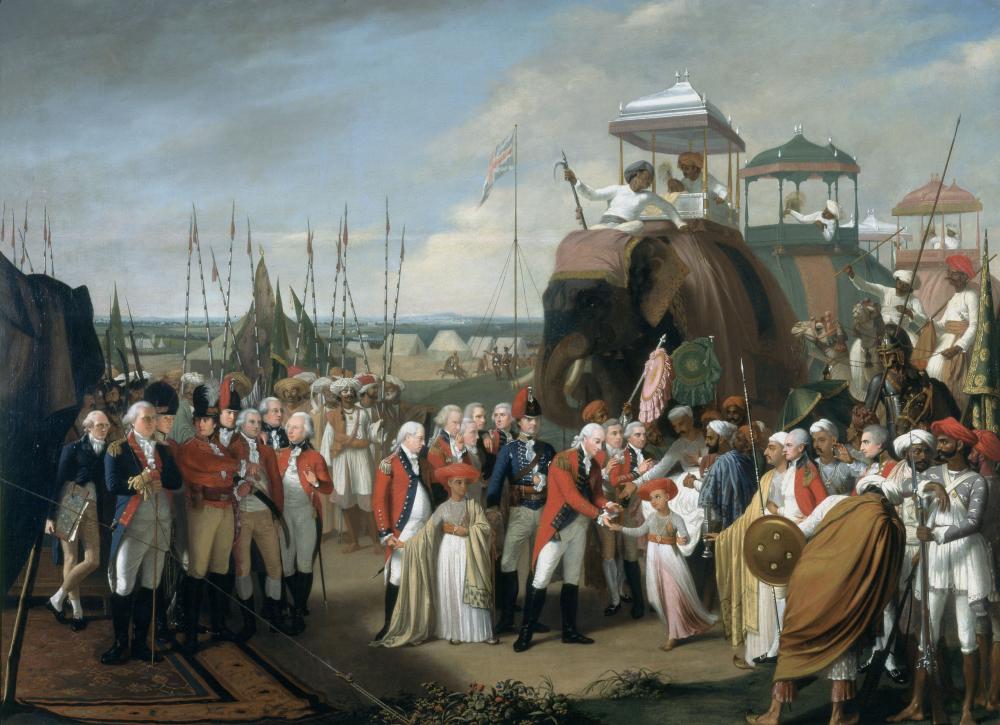
The overt message of this medal is clear enough. Tipu Sultan was very keen on tigers: tigers decorated his furniture and his firearms, like this cannon at Powis Castle; tiger stripes featured in the decor of his palaces, and his troops wore tiger-stripe uniforms (on the right of this painting); he even had tiger watermarks in his books (my thanks to Ursula Sims-Williams for that beautiful image). Here Bonhams publicise some gorgeous Tipu items at an auction, tigers prominently to the fore.
Most notoriously, “Tipu’s Tiger” is a near-life-size mechanical model of a tiger mauling a prostrate Briton, which contains a concealed pipe-organ simulating the tiger’s growling and its victim’s cries as he moves his arm up to and away from his mouth. A contemporary note explains the symbolism, makes a proposal, and gives us some further information which will be useful later on. Tipu, it says,
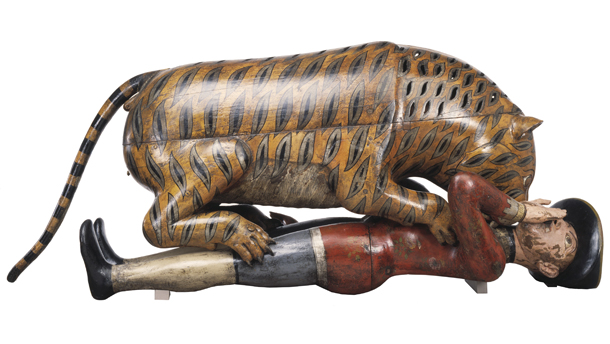
frequently amused himself with a sight of this emblematical triumph of the Khodadad over the English Circar [or Sircar: government/authority]… It is imagined that this characteristic memoreal… of Tippoo Sultaun may be thought deserving of a place in the Tower of London. Tippoo called his dominions the Sircar e Khodadad or god-given Sircar.
Tipu’s Tiger is now in the Victoria and Albert Museum, and there’s lots of interesting information about it on the V&A website. But what’s obvious enough is that the tiger was Tipu’s special emblem. As the “Tiger of Mysore”, Tipu could present himself both as a courageous and powerful Muslim sultan (the tiger being an age-old symbol of Persian royalty), and as a figure that also appealed to his many Hindu subjects through the tiger’s associations with the god Shiva.
On the medal, of course, the tables are turned, and a British lion overcomes Tipu’s tiger. The penant above the two big cats drives the point home. Alongside the Union Jack, the message: the lion of God is triumphant.
But there’s a bit more going on here. In Tipu’s symbolic language, lions and tigers were pretty interchangeable. In other words, Tipu was equally happy to call himself a lion, and the implications were essentially the same. In actual fact, the Arabic expression used on the British medal had been a motto favoured by Tipu. If you look at these images from Bonhams of a gun made for Tipu, you’ll see at the far left of the written decoration on the barrel the face of a tiger, but that face is actually composed of the very same Arabic words, asadullah al-ghalib, “The triumphant lion of Allah,” in mirror image. Here’s a close-up of this exquisite calligraphic tiger:

Asadullah al-ghalib was a name of Imam ‘Ali, the cousin and son-in-law of the Prophet who is especially celebrated by Shi’a Muslims: Tipu trod a fine line between Shi’a and Sunni Islam, as well as keeping his Hindu subjects on-side. On the medal, though, when the British claim to be the “triumphant lion of Allah”, they’re using Tipu’s own words against him.
And I think we can see something very similar happening on the other side of the medal. The important words here are srirangapatan ra khoda dad, “God gave Seringapatam”. Khoda dad means “God gave…”, but khodadad can also be an adjective, “God-given”. And as we learned from that contemporary account of Tipu’s mechanical tiger, Khodadad, “The God-given”, was the name that Tipu used for his Kingdom of Mysore: Tipu was its divinely ordained ruler. From the British Library, and the ever-generous Ursula Sims-Williams, comes an image of the front cover of a gorgeously bound copy of the Quran taken from Tipu’s library at Seringapatam. The script at the centre-top reads Sirkar-i Khodadadi, “the God-given government”:
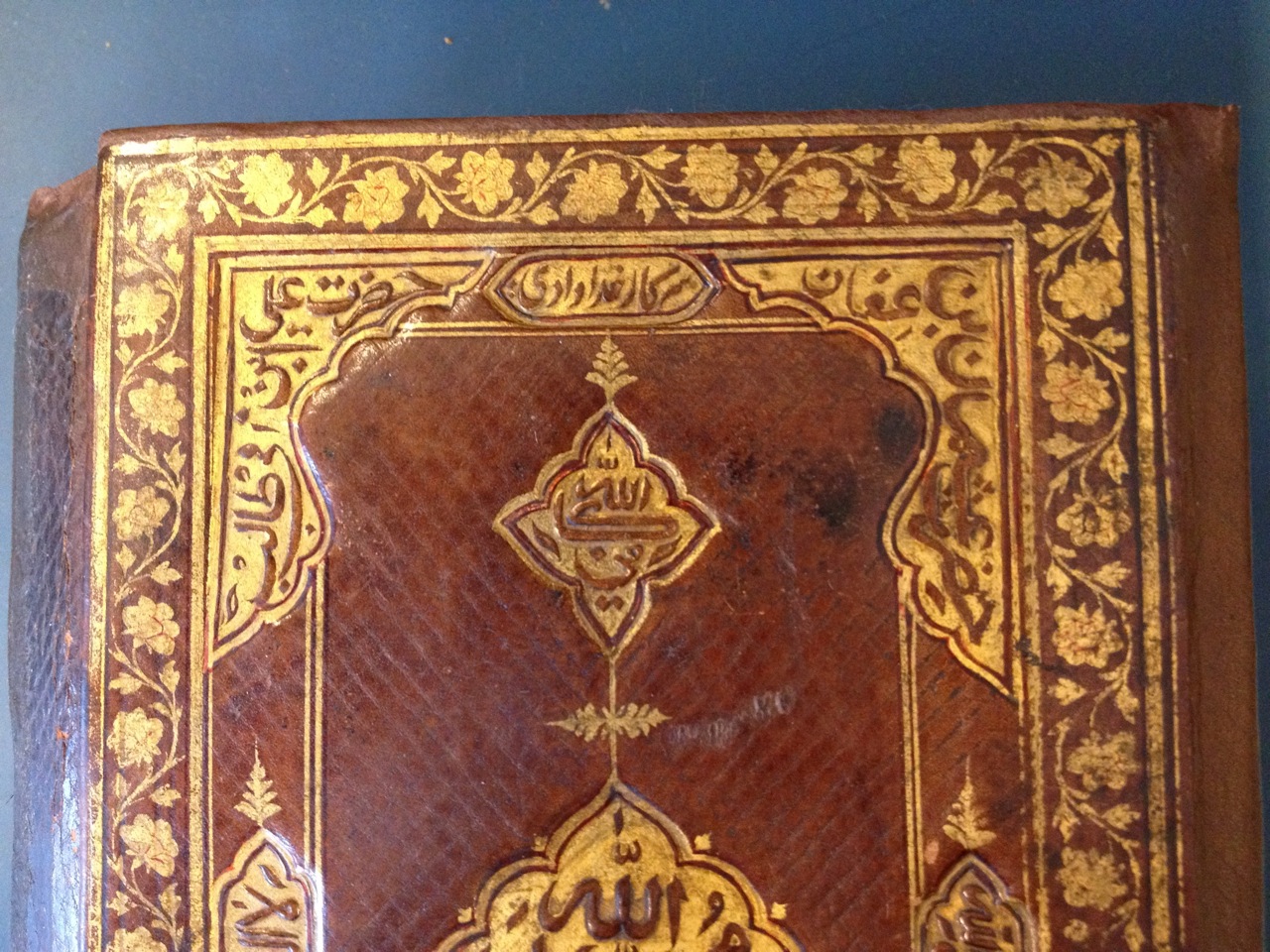
Once again, as with asadullah al-ghalib, the British medal turns Tipu’s own words against him: Allah has shown his true favour by taking Seringapatam away from Tipu, and giving it to the deserving British.
What I find fascinating about this medal design is how far Tipu Sultan, dead and buried, continues to set its terms. The symbolic argument of the medal, particularly as it’s made in the Arabic and Persian texts, presents the capture of Seringapatam in pointedly Islamic terms, in language and thought: the British are doing Allah’s work, and this in itself suggests how fragile Britain’s position in India was in 1799, thoroughly dependent on Indian allies and Indian manpower in its armies. It’s important to realise that the most important targets of the messages of this medal were Indian, not British.
But what the medal also conveys is what an incredibly potent propagandist Tipu had been. We know that Sir Charles Wilkins was closely involved in designing the medal, and it’s certainly Wilkins, the first Englishman to master Sanskrit (an achievement which assumes, in eighteenth-century India, complete fluency in Persian), who provided the Arabic and Persian text. He did a good job, too: it’s a witty and in one sense devastating contradiction of Tipu’s claim to authority.*
And yet in that imagery of big cats, in the panorama of Tipu’s glorious capital at Seringapatam, but especially in those words, it’s all done in Tipu’s own language of self-promotion. The respect for Tipu that the medal betrays, despite itself, gives the lie to the demonization of Tipu as a cruel and fanatical Muslim despot that a lot of British accounts of the time indulged in, and that Tipu’s Tiger particularly seemed to embody. (His legacy remains controversial to this day, as these responses to this Republic Day float (representing the state of Karnataka) in Delhi make clear.)
Tipu was no Tigger, for sure, a ruler as ruthless as any other in eighteenth-century India, but he also presided over a court of culture and sophistication, something that the British again tacitly recognised by looting his artistic masterpieces and shipping them and his extensive library back to their big houses and museums in Britain. (Tony Theaker reminds me that one of the most famous fictional treasures, Wilkie Collins’ Moonstone, came into British hands at the capture of Seringapatam, “an ornament in the handle of a dagger” belonging to Tipu, “who commanded it to be kept among the choicest treasures of his armoury.”) Sir Charles Wilkins later became librarian of the East India Company, where his role was mainly to look after the Company’s collection of Eastern manuscripts–a large proportion of them also picked up in 1799 at Seringapatam, including the Quran we saw earlier. I’m not with William Dalrymple with everything he says in this polemic, drawing parallels between the Twenty-first Century and events 200 years ago, but where I think he’s absolutely right is on the true source of the fear that Tipu provoked in the East India Company. “What really worried the British was less that Tipu was a Muslim fanatic, something strange and alien, but that he was frighteningly familiar.”
And the fact a British medal marking a famous victory speaks Tipu’s symbolic language tells us that just as clearly.
A. Buddle, The Tiger and the Thistle: Tipu Sultan and the Scots in India;
S. Stronge, Tipu’s Tigers;
M. Archer, C. Rowell & R Skelton, Treasures from India: The Clive Collection at Powis Castle.
* Wilkins is best known for an enormously influential translation of the Bhagavad Gita: here, for example, is Thoreau reading it beside Walden Pond. Eric Sharpe ends his study of Western responses to the Bhagavad Gita, The Universal Gita, with the arresting claim that “it was on the appearance of Charles Wilkins’ Gita translation in 1785 that “Hinduism”, all unawares, took its first step towards its present identity.”